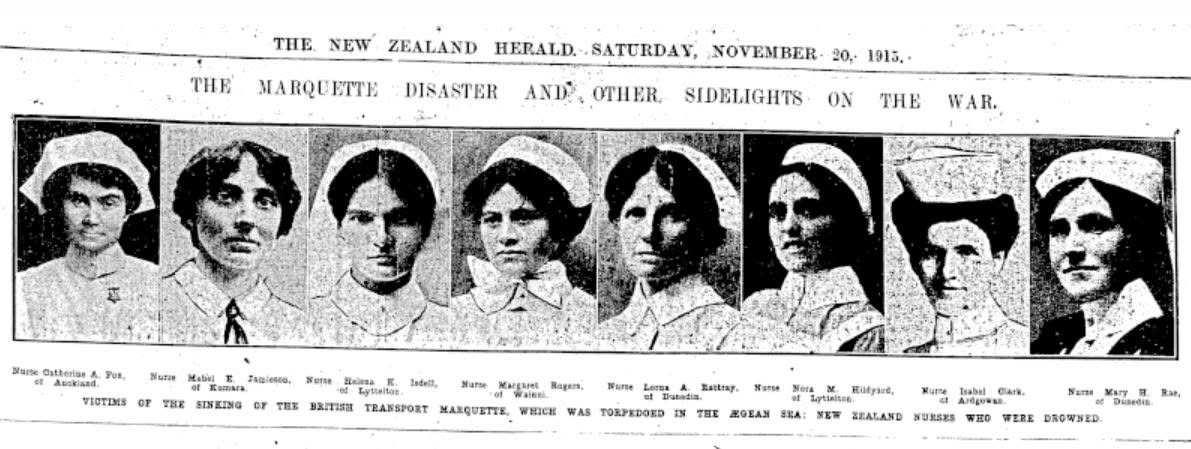
 The loss of the ship Marquette in World War One was always going to be a tragedy but for New Zealand it was devastating.
The Marquette was a British transport ship on the way to Salonika (Thesaloniki) on October 23, 1915, when it was sunk by a German Uboat. On board were 36 nurses plus eight officers, nine non-commissioned officers and 77 orderlies of the New Zealand Medical Corps. Earlier in the month they had been in Alexandria before being ordered to pack up and leave, going to support French and British forces. Also onboard were the 500 men and officers of the ammunition column of the British 29th Division, plus 500 mules, some horses and many wagons loaded with ammunition. Crucially the troop ship was not marked with the Red Cross that would have given them a measure of protection. Just before the ship was due to arrive, its escort (and protection) was called off. Just after 9am on October 23, some of the nurses were walking on the deck when they saw something in the water. It was a torpedo and it struck forward on the right side of the ship. Well trained, those on board hurried to grab their life jackets and went to the lifeboats. They managed to get the first lifeboat into the water but the second was stuck and when the Marquette rose in the water as she was sinking, the lifeboat swung and fell, fatalling injuring some and killing others. On the other side a lifeboat hit a door tipping up and nurses fell into the water. Once in the sea, the lifeboat then capsized, losing more. As those in the boats watched, the Marquette sank bow first. An SOS had been sent but unknown to the survivors waiting for rescue, the uboat who sunk the Marquette had sent another - giving a totally different location. It was there the rescuers went first - so it was late afternoon before they found the survivors. It took more than a day for a full roll call to be made and it was found that 10 New Zealand nurses had been killed: Marion Brown, Isabel Clark, Catherine Fox, Mary Gorman, Nona Hildyard, Helena Isdell, Mabel Jamieson, Mary Rae, Lorna Rattray and Margaret Rogers. The only bodies recovered were those of Rogers and Isdell. Also dead were 22 New Zealand men. Of the 741 onboard the Marquette, 167 had perished. Questions were asked about why the nurses in particular were on an unmarked ship carrying ammunition when another more appropriate ship was available but they were never satisfactorily answered. Even those who survived had life changing injuries and were unable to continue their service. Many of the nurses who died were from the South Island and the tragedy plunged the country into mourning. Mary Grigor who survived gave accounts of the horror - she described the launching of the lifeboats as a failure. Once she was in the water, Grigor had her arm crushed and struggled to stay afloat and around her, people were dying. The nurses are of course, recorded as lost at sea - although a number have memorials in cemeteries around the country.
0 Comments
 We think of hacking as a new thing. Like the British tabloids hacking phones or secretive hackers in back rooms breaking into computers.
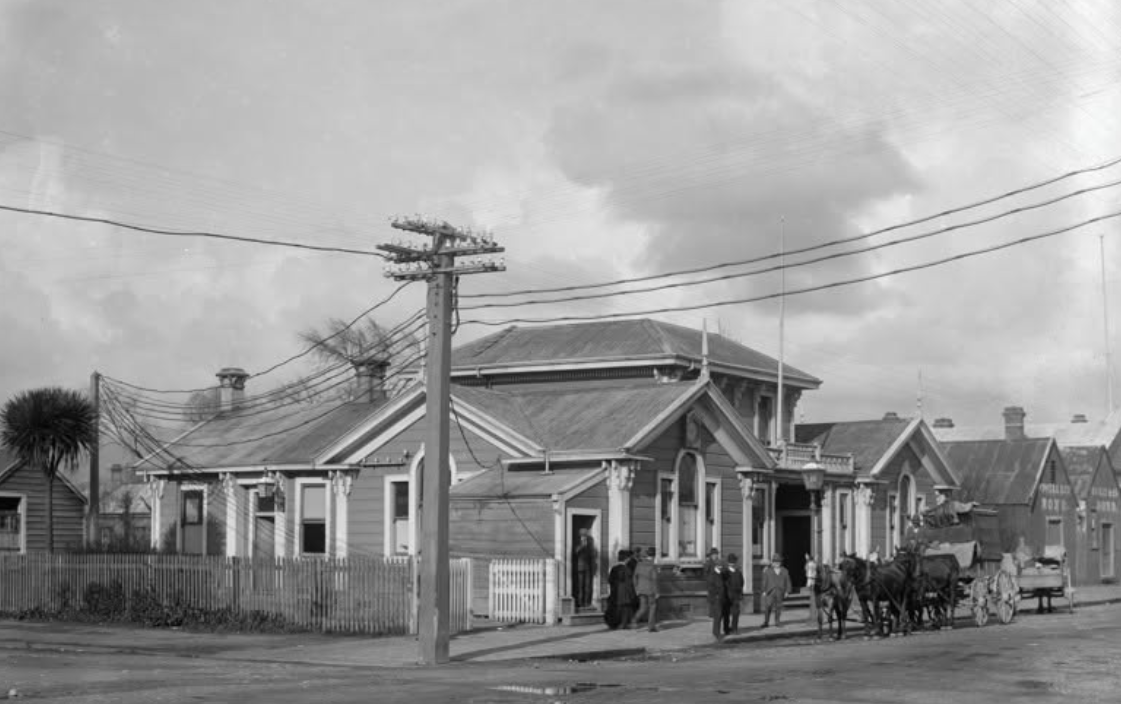
But it’s been around a long time and New Zealand had its own scandal that led to accusations, lawsuits and even a select committee investigation. And this was in 1870. At the time telegraph was new. The telegraph system stretched from Invercargill to Auckland and had quickly become a source of news and communication. George Barton was initially a lawyer but his interest in journalism led him to become the editor of the Otago Daily Times. On October 3, 1870, in an article he claimed that the government was deliberately delaying telegrams coming to the Times until a summary of them was provided to opposition newspapers of the day who supported the government. He had been waiting on huge news. That Napoleon had been captured and imprisoned and Frances declared a republic. It was important international news. A ship was bringing the newspapers which would be turned into telegraphs to send to the newspapers of the country. Barton said the telegraph to the ODT was delayed while the news went first to one of its rivals. It caused outrage and accusations flying. Then it led to a criminal prosecution against Barton for libel. He was committed for trial and then resigned his position with the paper. After which the criminal trial was withdrawn. But that wasn’t the end of it. The staff at the Otago Daily Times staff were even offered a pardon so they wouldn’t incriminate themselves giving evidence against Barton. Despite the charge not going ahead, Barton decided to countersue and brought a case against Charles Lemon who was then the general manager of the telegraph department. That too ended before it began - the case was thrown out. A parliamentary select committee was then appointed to look into it. Over a couple of months it took evidence and finally produced a report that exonerated the government, although it also told off a few ministers for minor things, like paying for personal telegraphs with business funds. Lemon went on to be in charge of the Telegraph office for 25 years and is known now as the man who designed the huge poles that the telegraph wires were on, called in the trade Lemon trees. He died on May 6, 1901 and is buried in the Otaki Public Cemetery. Photo from Te Papa’s collection.  Imagine going for a Sunday walk and being passed by a buggy pulled by four zebras.
The first governor of New Zealand was Sir George Grey whose name exists on streets all over the country. But one of the things he is best known for is his weird obsession with importing exotic animals for his private island. George Grey was born in Lisbon, Portugal, in April 1812 just a few days after his father was killed in a war. After being educated in England and military service he became governor of South Australia in 1841. Coming to New Zealand in 1845 he became governor until 1848 when he took the same post in South Africa. He returned to New Zealand in 1861 and became governor again before being appointed Premier in 1877. On his return to New Zealand for his second term he bought Kawau Island in the Hauraki Gulf and lavished a great deal of his personal wealth on it. The island had been the home of a copper mine and the superintendent had built a large house which Grey took over and enlarged it. But it was his passion for animals and plants that led to him collecting exotics, including zebras that he liked to hitch to a buggy, four at a time and ride around the island. His menagerie included kangaroos, wallabies, antelopes, monkeys, zebras, gnu, emus, peafowl, Indian peacocks and kookaburras. At one point he had monkeys freely swinging from the trees. Along with such exotics he brought pheasants, Californian quail, turkeys and guinea fowl. His plan was that the island would be a paradise. He also took native species from the mainland to the island. Grey also brought many plants from overseas that had never been near New Zealand before, creating gardens on the island in European styles. A pair of Chilean Wine Palms - huge trees - still stand near the house. Also brought in were Moreton Bay figs, bamboos and oaks and elms from England. He also had a jetty built for his own boats. It was the oldest surviving jetty in the country. But animals were not the only thing he collected. Books and manuscripts were also something he coveted. He had French and Greek manuscripts and early editions of Chaucer and Yeats. His private letters included many from explorer David Livingstone. A fair amount of the plants survived but one of Grey’s greatest joys - the zebras - did not survive long. He lived on the island until late in his life - returning to England - where he died at his home in London in 1898 - and is buried in St Paul’s Cathedral. 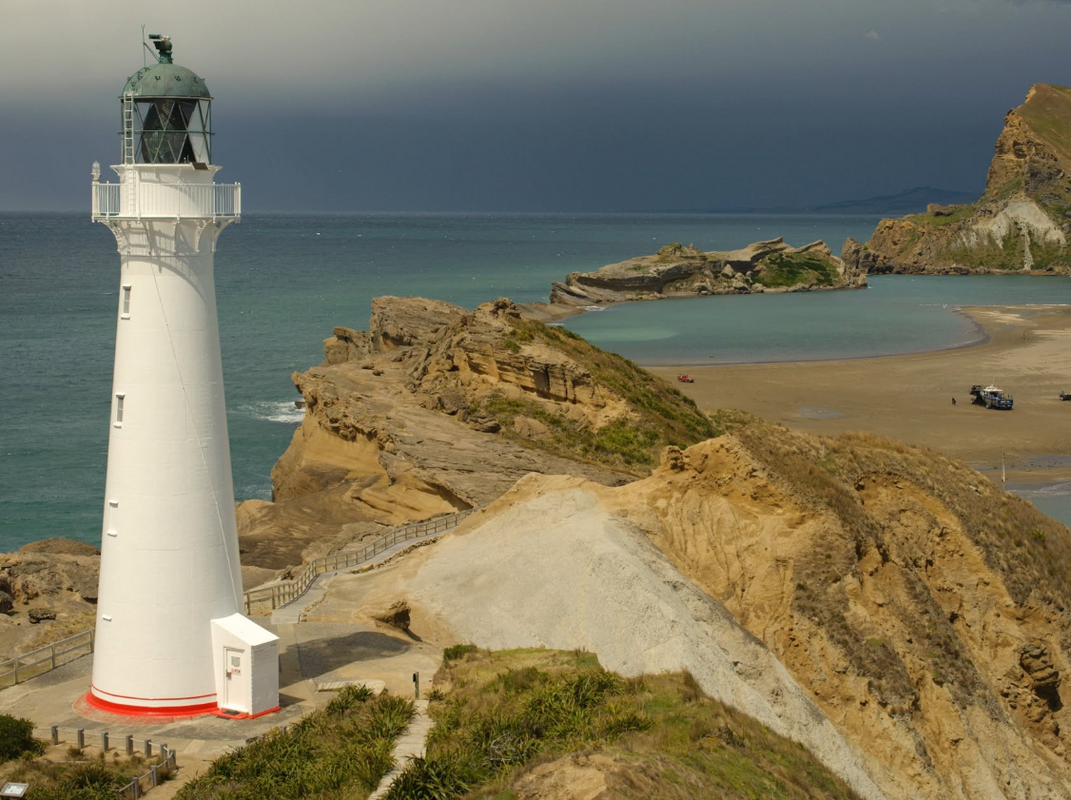 Victoria Howell, by all accounts, was a kind woman who had run a nursing home before her death.
In many ways, it made the extraordinary circumstances of her death, burial, then exhumation and reburial even odder. Victoria had been born in Riverton on Valentine's Day in 1871. Her father was Captain John Howell of the Fairlight station at Lake Wakatipu and her mother Caroline Brown. Her closest friend was Florence Hall, a nurse. In the papers of the time Florence was referred to as friend and business partner - but given that they lived together and worked together for many years, a case could be made for a different relationship. When they moved to the Wairarapa they bought a home and turned it into a nursing home. And for a time everything was fine. Then in 1906, Victoria took ill. Initially it was thought to be influenza and a nasty case at that. But a consultation with a doctor led to a diagnosis of a cancerous growth in her stomach. He advised them to go somewhere quiet - and the pair moved to a home at Castlepoint. Florence nursed her diligently but Victoria died on January 23, 1906. She was buried in the Archer St cemetery. Normally that would end the story - but it was only the beginning. Victoria’s brother questioned why her will would name Florence as her beneficiary and not any members of the family. He was suspicious and made a case for Victoria’s body to be exhumed. It was done and she was examined. But no growths were found. So what did Victoria die of? Samples were taken and sent for analysis and suspicion began to fall on Florence. And by the inquest it was clear Victoria had died of zinc poisoning and all eyes turned to Florence again. Poor Victoria’s body was again exhumed for further tests. A series of investigations came to astonishing conclusions though. Victoria had been drinking water from a zinc tank, new tanks put in at the home in Castlepoint. At the inquest it turned out a few other people who used the water at Castlepoint had also been ill, just not to the degree Victoria was. A government analyst told the inquest the water Victoria was drinking contained four times the amount of zinc as other water. With all the information to hand a jury at the inquest found that Victoria had died from zinc poisoning - made worse by the fact she was already ill. The jury also found no other person was responsible for her death. Victoria was again quietly buried, finally to rest. Florence sued several newspapers who had all but convicted her before the findings of the inquest and moved on going to Wellington to work. Victoria had been buried in what is called the old ground at the Masterton cemetery and the whereabouts of her grave is now not known. 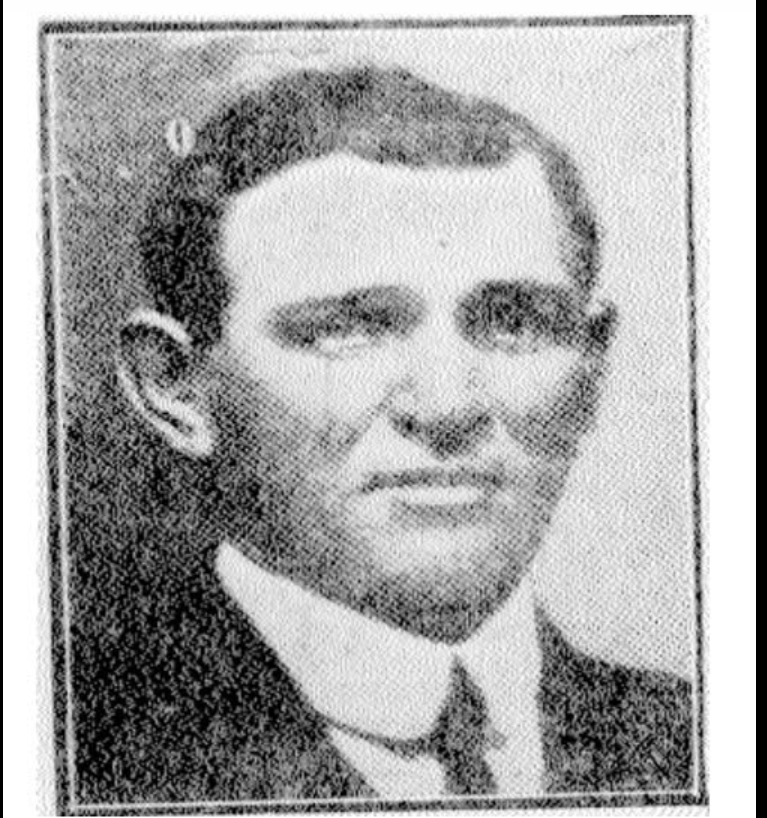 There are more unsolved murders in New Zealand than most know. We know big names and those from recent times but there are still some - even over 100 years later - that still have had no justice.
James Dorgan was born in Gortaleha Co. Kerry, Ireland on Jan 26, 1884, to John and Margaret where he grew up working as a labourer. He had 12 siblings and by 1912 he had come to New Zealand and joined the police force. He married Agnes May - called Minnie - in December 1915 in Timaru. They went on to have three children. James was known as a fearless police officer wading into fights and even shoot outs. So he probably wasn’t phased to be left to watch a business premises because it was believed that a burglar or burglars were at work inside, but when police reinforcements arrived they found Dorgan fatally shot. He was at Thomson’s Drapery in Stafford St in Timaru on August 27, 1921. He had started on his beat - walking the streets a few hours before. Also on the beat was Constable Thomas Christopher. Outside the drapery Christopher could see lights inside and believed a burglary was in progress. He alerted James and they checked the entrances to the shop. James told Christopher to go alert the owner. As Christopher was coming back he heard four shots - and saw James staggering. Three of the shots had missed. But one had hit him in the chest. James was still alive as other police arrived but was not able to say who had shot him. Despite a doctor arriving very soon after, it was too late - James died in minutes. A search of the shop showed rather than money, whoever it was had been after clothes. A bag filled with shirts and socks was found abandoned near the door. Police descended on Timaru - determined to solve the murder of their own. Fingerprints were taken from many men - and a prime suspect became clear - Albert Lamb who had been fired from the drapery shop. But he had left town before the murder happened and was able to prove it. As time dragged on, no other suspects were able to be pinned down. More than a year later Christopher himself was investigated. He had left the police and then worked in a drapery store himself where his boss became suspicious, finding he was stealing goods from the shop. He was convicted and it prompted police to take another look at him. Christopher was not quite who he portrayed. He was a World War One veteran who had been sent back to New Zealand and discharged after numerous discipline problems. But that came to nothing despite lots of odd rumours. James was buried in Timaru Cemetery. He is the only police officer in the country whose murder remains unsolved. Picture from the Christchurch Star. 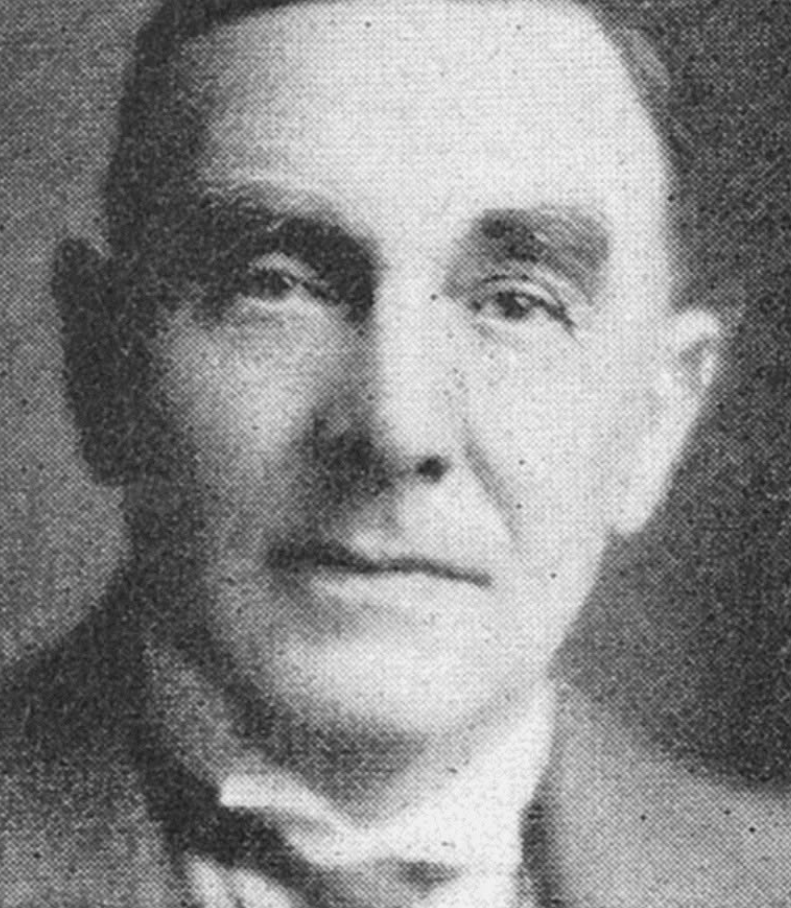 Did you know that Kāpiti Island is actually the tip of a huge mountain?
The island has been occupied on and off since Māori arrived in New Zealand, used by whalers and for a while was the centre of the flax trade. In 1870 it was identified as a possible nature reserve - although by then much of it had been deforested. Farmers also lived there, leasing the land from the Maori who owned it. The Kāpiti Island Public Reserve Act 1897 prohibited any further private sales of land on the island, and provided the basis for the island being acquired by the Crown, to be set aside as a nature reserve, with the exception of land still held by original Māori owners or their descendants. One of its fiercest protectors was Ernest Valentine Sanderson. We know him now as the founder of New Zealand Forest and Bird. Sanderson was born in Dunedin on February 8, 1866 the son of Jane Sanderson and William Walter James Spreat before the family moved to Wellington. It was Spreat’s behaviour that initially broke up the family and when they returned to live with him, he attacked Val as he was known and his brother Louis, ending up shot to death which was ruled a justifiable homicide. Val enlisted for the South African War and served before coming back to a clerking job. When his father’s estate was finalised he had enough money to start his own business, Magnus, Sanderson and Company. Initially they imported bicycles then moved into cars. When war was declared he tried to reenlist, lying about his age. He was eventually accepted and served as a quartermaster but only served seven months before becoming ill. He had married Emily Louisa Cooper in 1904 but by the end of the war he was estranged from her and they divorced. Sanderson was increasingly concerned about conservation and in 1921 he and the Evening Post newspaper went to the island. The resulting publicity about how badly off the island, with no fences for the reserve area or to protect it from the goats and sheep, was created a groundswell of support for better protection for the island. “We have robbed the birds of tremendous areas of bush on the mainland. Are we not patriotic enough to give them a last secure resting place on this small island, seven miles by one mile in area, in order that our children and children’s children may see and learn what New Zealand was really like when their daring forefathers first set foot in this land of ours?” he wrote in 1922.* Sanderson launched the New Zealand Native Bird Protection Society and built a membership of supporters and in 1935 renamed it the Forest and Bird Protection Society of New Zealand. He campaigned against things like soil erosion and the menace to our bush by deer. He married Nellie Milne in 1934 and set up home in Paekākāriki - from which he could watch Kapiti Island. Sanderson died on December 29, 1945 and was buried in the Otaki Public Cemetery. But even if his name is not as remembered anymore - his legacy - the Forest and Bird Protection Society continues. * From the Forest and Bird website. 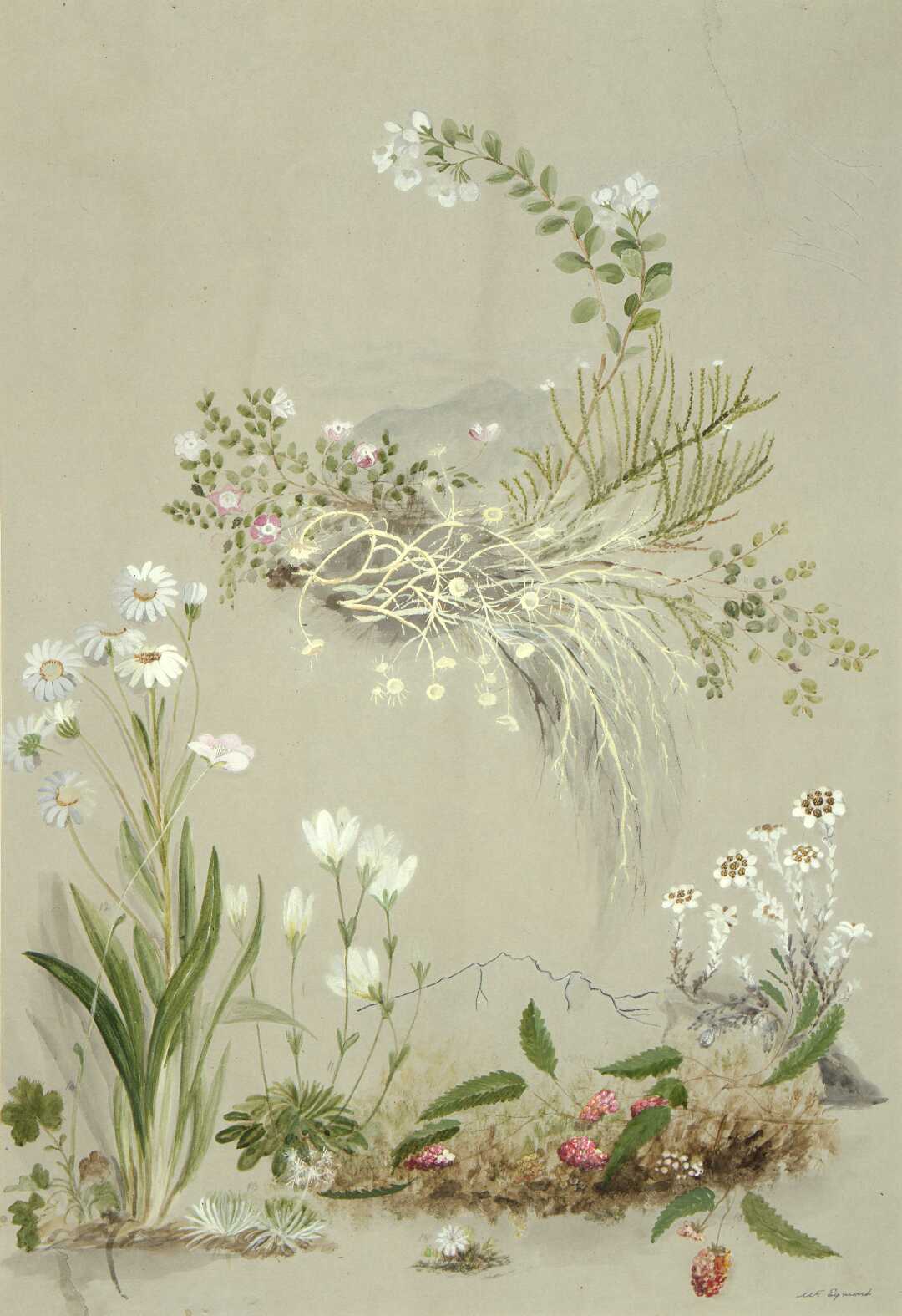 Even with her work in the public eye, Emily Cumming Harris - one of New Zealand’s first professional artists - had a hard time letting go.
When asked to submit a painting for the art union at the Wellington exhibition in 1885, she wrote, 'I grow to love my pictures, and after I have worked & thought about & toiled at a picture for a long time I cannot endure the idea of perhaps some half drunken man, who coming into the Exhibition, pays 10/6 and maybe wins my picture.' Now her beautiful work resides in the homes of private collectors and museums. Emily was born to Sarah and Edwin in Plymouth, Devonshire, England on April 18, 1837. Three years later, the family came to New Zealand reaching New Plymouth. Her hard working parents had decent jobs, her father was a civil engineer and surveyor and her mother ran a school. Later they moved to Nelson and Emily went to Australia to study art. On her return, she and her sister Frances and Ellen ran a small school where they gave lessons in music, dancing and drawing. Emily kept a diary and described the poverty her family lived in. It was a hard life and while she would have preferred to pursue art full time she was unable to due to needing to make money for her family. She was able to sell some of her work but it was not enough to live on. Her works were studies of New Zealand flowers and plants but also birds, still lifes and landscapes. Emily’s work went into exhibitions including into the Sydney International Exhibition in 1879 where she won a first degree of merit. In the New Zealand Industrial Exhibition in Wellington in 1885 she won first prize and a silver medal for a painted screen and third for a table top. She was also commended for her work in a London exhibition. There was a pressure that came with success to exhibit more and sell more which she found difficult. In 1890 she, along with a Nelson bookseller, published three books, New Zealand flowers, New Zealand ferns, and New Zealand berries (which were published the same year in a single volume, Flowers, ferns, and berries of New Zealand). Each contained 12 lithographs with descriptive text, and some copies were hand-coloured by Harris herself. She also illustrated a children's book, Fairyland in New Zealand, by Sarah Moore (1890). Emily never married, and continued to work until her death in Nelson on August 5, 1925 after living in poor circumstances for years. Along with her art, Emily also wrote poetry but very little of her work has survived. A new book on her work Groundwork: The Art and Writing of Emily Cumming Harris has recently been published. Emily is buried in Wakapuaka Cemetery. 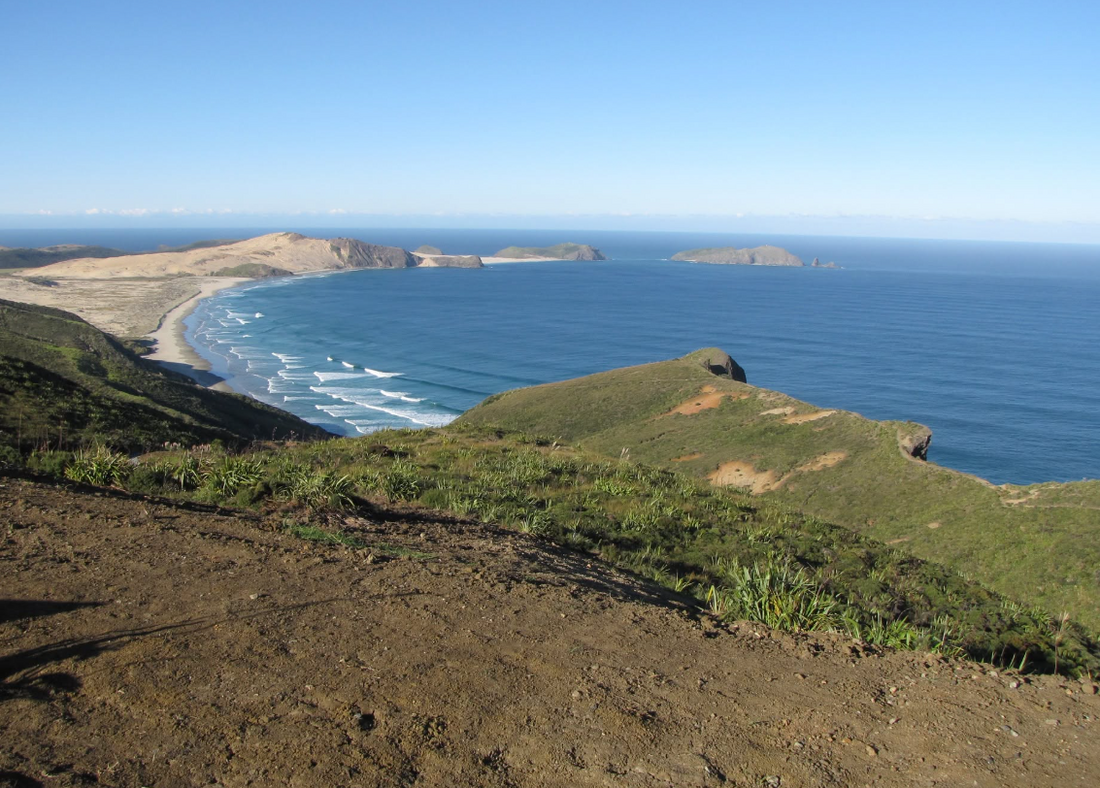 Lighthouses are both romantic and tragic places. Often isolated and windswept, they might seem like a dream for those seeking escape from the world—but when something goes wrong, there is no one nearby to help. You just have to cope.
So it was with 12-year-old Donald Young, who found himself thrust into adult responsibilities when tragedy struck the small lighthouse community where he lived. His father was the head keeper on Motuopao Island, a lonely outpost off Cape Maria van Diemen at the northwestern tip of New Zealand’s North Island, just southwest of the spiritually significant Cape Reinga. The lighthouse had stood there since the 1870s, built to guard against the treacherous seas where the Tasman Sea meets the Pacific Ocean. Alongside it were a few weather-beaten homes for the staff and their families—sturdy structures built to endure constant salt spray, howling winds, and complete isolation. Living there in 1933 were Donald’s family, Henry and Minnie (Betty) Newson, and Frederick Gage with his wife Mary and their two children. Despite the era—well into the age of radio and steamboats—life on Motuopao remained primitive, reliant on sea-based supplies and good weather. When storms came, there was no leaving. There was only waiting. On October 14, 1933, Henry Newson, his wife Betty, and Frederick Gage went fishing on the rocks below the lighthouse. It was a common pastime and sometimes a necessity, supplementing food rations. But that day, the sea was in one of its darker moods. Betty noticed the massive wave first and cried out—but it was already too late. The wave crashed over them, sweeping all three into the churning water. Henry managed to reach Betty and pull her to shore, desperately trying to revive her with assisted breathing—what we’d now call CPR. But it was no use. She was gone. Frederick Gage, too, was lost to the sea. His body never recovered, only his memory held by those left behind. In the immediate chaos, 12-year-old Donald stepped forward. With the weight of grief all around him, he helped his father maintain the light, care for the surviving families, and manage daily operations until help arrived. Newspapers would later describe him as “doing the work of a man,” a tribute to his courage under unthinkable pressure. A steamer was dispatched from the mainland to collect Minnie’s body, but the sea refused to return Frederick. Mary Gage and her children had to leave without a chance to say goodbye. Henry Newson eventually remarried in 1935 and lived until 1975. But Motuopao Island changed forever after that day. The lighthouse, once a symbol of safety, now also stood as a quiet monument to loss. In 1940, the lighthouse was automated, and the last keepers left. Today, the island is part of a Department of Conservation nature reserve. The light still shines, but no one lives there now—only seabirds, salt air, and the silent stories of those who once called it home. Minnie was buried in Waikumete Cemetery. 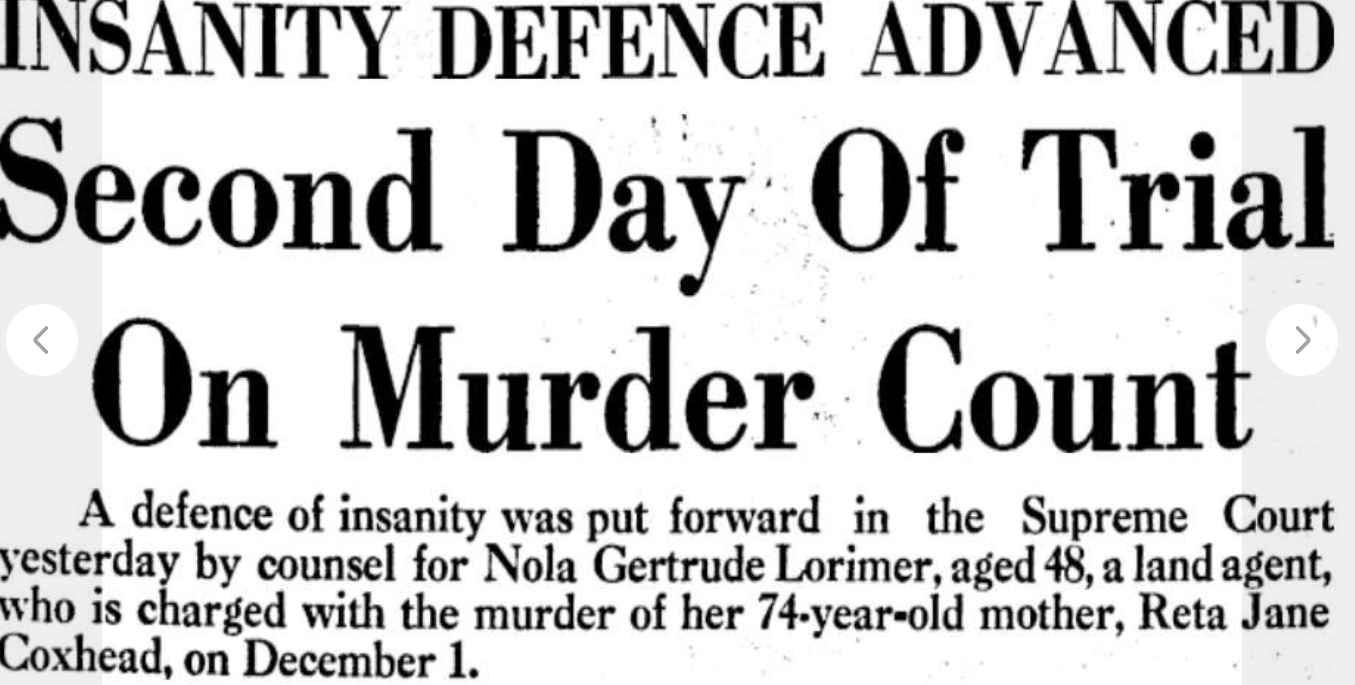 The killing of a mother by a daughter always seems particularly shocking.
The recent case in Wellington echoes a case in Christchurch 60 years ago. Nola Lorimer was found guilty of killing Reta Jane Coxhead, her own mother. On December 1, 1965, Dr D J Lough visited Reta at her home about 10.15am in her St Albans home and found her up, dressed and ready to go out shopping. Two hours later she was found dead, dressed in the same clothes, lying in a pool of blood at the entrance to the bathroom. A pane of glass in the back door was broken. She was found by her daughter Nola. Police were quickly called and found she had been beaten about the head with a large wooden barometer that had been on the wall and was now lying beside her broken. Another weapon had been used to cut her throat. There were no signs of burglary in the house. Reta had lived at the house for a few years. She had a son and daughter. Police searched the home and surrounding area thoroughly but found nothing. When Nola was charged with her murder six weeks later, it sent shockwaves through the community. In a court case, Margaret Mundy who worked for Reta had been in and out of the home twice that morning, the last time about 11.15am. Nola - a land agent - had been at her work until about 11.45am when she left for the day. Malcolm Moore who lived opposite Reta saw Nola about 12.50pm in the driveway of her mother’s home saying she was worried about her. He had been the one to break the glass in the backdoor to get in and they had found Reta. During questioning by police Nola initially said she had pushed Reta during a dispute and she had fallen and hit her head. Then she said she panicked, got the barometer and bashed her. But Reta was still breathing so she took a knife, cut her throat and washed it and put it back. She claimed she adored her mother. Insanity was raised at her trial, her lawyer outlining her parents unhappy marriage, her own two unhappy marriages and working in a high pressure male dominated industry. It had been, her lawyer claimed too much for her, and she resorted to pills and alcohol. Nola would sometimes get angry or be unresponsive and had seen a psychiatrist a couple of years before who had given her medication. The jury heard that she became frenzied on the day of the murder and did not understand the quality of her actions. Nola’s daughter Kay also spoke of seeing her mother drink and knew she had used some medication. A doctor called for the defence believed Nola was suffering psychomotor epilepsy. Other doctors said they did not believe she was responsible for her actions on the day of the murder. The jury found her guilty after four and a half hours but added a rider to her verdict that her sentence be less than life. However the judge had no choice, his only option was to sentence her to life. An appeal to overturn that failed. A memorial to Reta is at the Canterbury Memorial Gardens and Crematorium. |
AuthorFran and Deb's updates Archives
September 2025
Categories |
 RSS Feed