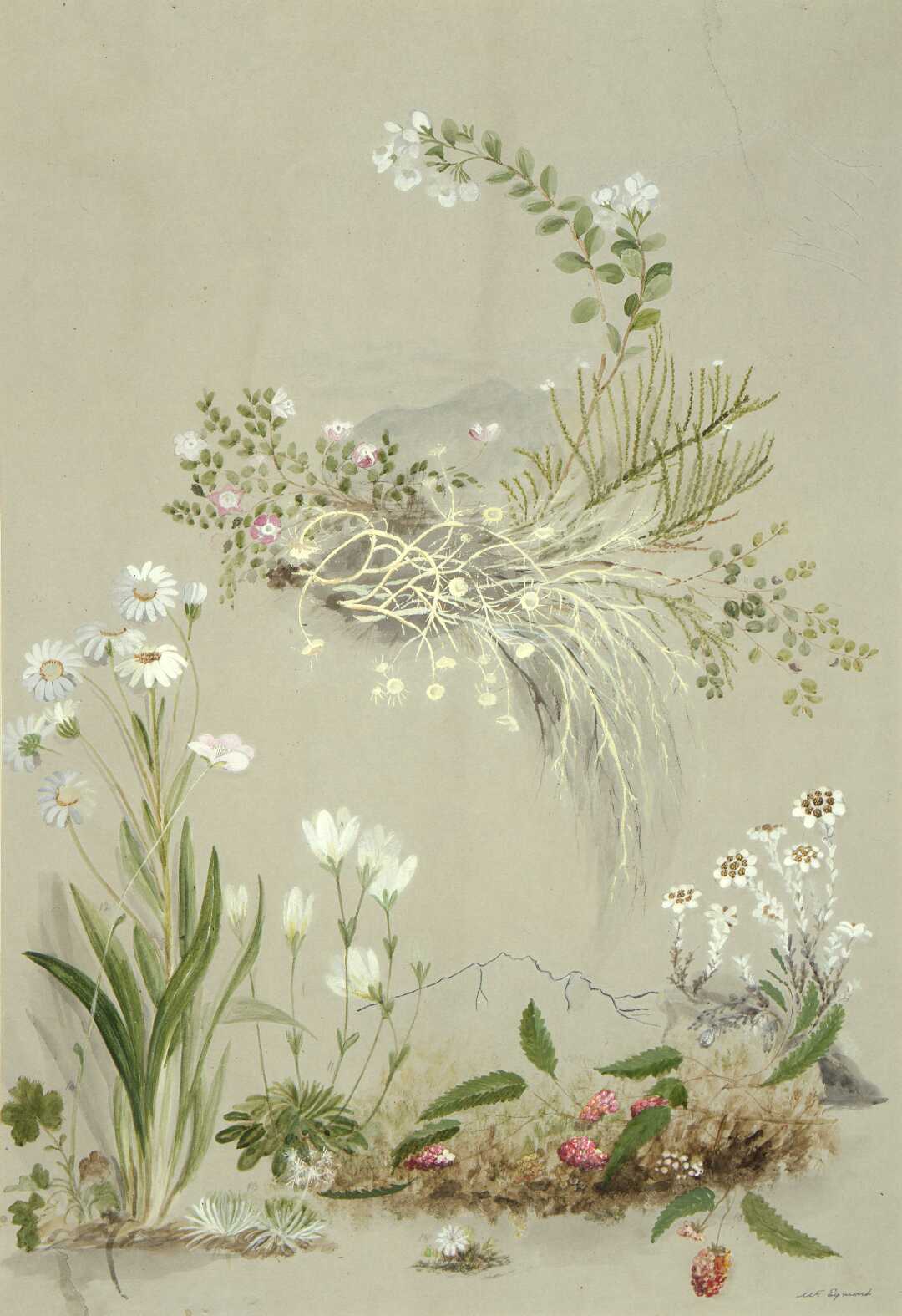
 Even with her work in the public eye, Emily Cumming Harris - one of New Zealand’s first professional artists - had a hard time letting go.
When asked to submit a painting for the art union at the Wellington exhibition in 1885, she wrote, 'I grow to love my pictures, and after I have worked & thought about & toiled at a picture for a long time I cannot endure the idea of perhaps some half drunken man, who coming into the Exhibition, pays 10/6 and maybe wins my picture.' Now her beautiful work resides in the homes of private collectors and museums. Emily was born to Sarah and Edwin in Plymouth, Devonshire, England on April 18, 1837. Three years later, the family came to New Zealand reaching New Plymouth. Her hard working parents had decent jobs, her father was a civil engineer and surveyor and her mother ran a school. Later they moved to Nelson and Emily went to Australia to study art. On her return, she and her sister Frances and Ellen ran a small school where they gave lessons in music, dancing and drawing. Emily kept a diary and described the poverty her family lived in. It was a hard life and while she would have preferred to pursue art full time she was unable to due to needing to make money for her family. She was able to sell some of her work but it was not enough to live on. Her works were studies of New Zealand flowers and plants but also birds, still lifes and landscapes. Emily’s work went into exhibitions including into the Sydney International Exhibition in 1879 where she won a first degree of merit. In the New Zealand Industrial Exhibition in Wellington in 1885 she won first prize and a silver medal for a painted screen and third for a table top. She was also commended for her work in a London exhibition. There was a pressure that came with success to exhibit more and sell more which she found difficult. In 1890 she, along with a Nelson bookseller, published three books, New Zealand flowers, New Zealand ferns, and New Zealand berries (which were published the same year in a single volume, Flowers, ferns, and berries of New Zealand). Each contained 12 lithographs with descriptive text, and some copies were hand-coloured by Harris herself. She also illustrated a children's book, Fairyland in New Zealand, by Sarah Moore (1890). Emily never married, and continued to work until her death in Nelson on August 5, 1925 after living in poor circumstances for years. Along with her art, Emily also wrote poetry but very little of her work has survived. A new book on her work Groundwork: The Art and Writing of Emily Cumming Harris has recently been published. Emily is buried in Wakapuaka Cemetery.
0 Comments
Leave a Reply. |
AuthorFran and Deb's updates Archives
September 2025
Categories |
 RSS Feed