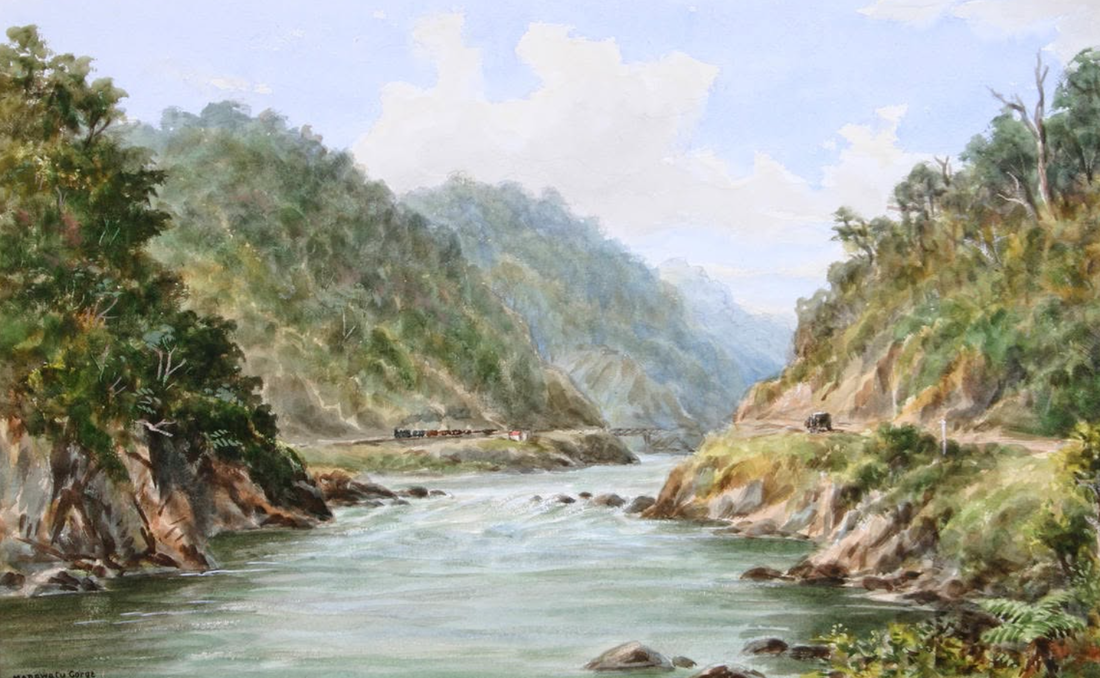
 We often think of artists in a studio surrounded by canvas and paints but William George Baker was more likely to be found on the road carrying all his paints with him.
William was born to George and Emma in 1864 in Wellington, New Zealand, the eldest of 10 children. He was apprenticed as an upholsterer but his employer discovered his artistic talent by letting him decorate cabinet panels. In 1889, he married Ellen King, the daughter of a prominent landowner in Greytown and they moved into their first home there. They would shortly begin travelling, looking for scenes to paint. Baker was looking for his favourites - landscapes which the majority of his works were, in both oil and watercolour. He captured scenes now long gone such as the Pink and White Terraces before their destruction and the southern lakes and fiords. Quite a number of his scenes also feature Maori settlements. As the pair travelled they funded their life by selling the paintings and they were popular. But it was only with the public. Although he never received any formal art training, Baker first exhibited with the Fine Arts Association when he was only 19. The Association became the New Zealand Academy of Fine Arts in 1889, and Baker was a member from 1892-1909. He exhibited throughout New Zealand as well as at international exhibitions, including the Louisiana Purchase Exposition in Missouri in 1904. Even so, he got mixed critical success. An 1897 critic for the Evening Post wrote rather scathingly of his painting, “the trail of the common-place is over most of the pictures of W.G. Baker”, saying of even his more highly regarded work that it “is too familiar in design”. Baker made no secret of the fact he was a commercial artist - selling his works wherever possible - at exhibitions, local auctions, agricultural fairs - even the hotels he stayed at during his travels. Even though critics were not that fond of his work, the public was. Baker sold countless works, often selling hundreds during an exhibition, despite his paintings being called common and at one exhibition it was recorded that 100,000 people went to it. In 1893 the couple moved back to Wellington and then in 1919 to Titahi Bay where they lived for the rest of their lives. Baker’s paintings, although popular, would not have been considered high art - he worked to an almost standardised composition and often added things to his paintings to create perspective and did not always accurately record the landscape he was painting. Many of the paintings, along with his sketch books and paintbrushes are now in the Wellington Museum. Baker died on June 21, 1929, and his memorial is at the cabinet niche in the small chapel at Karori Cemetery. With thanks to Te Papa and Wellington Museum.
0 Comments
Leave a Reply. |
AuthorFran and Deb's updates Archives
October 2025
Categories |
 RSS Feed