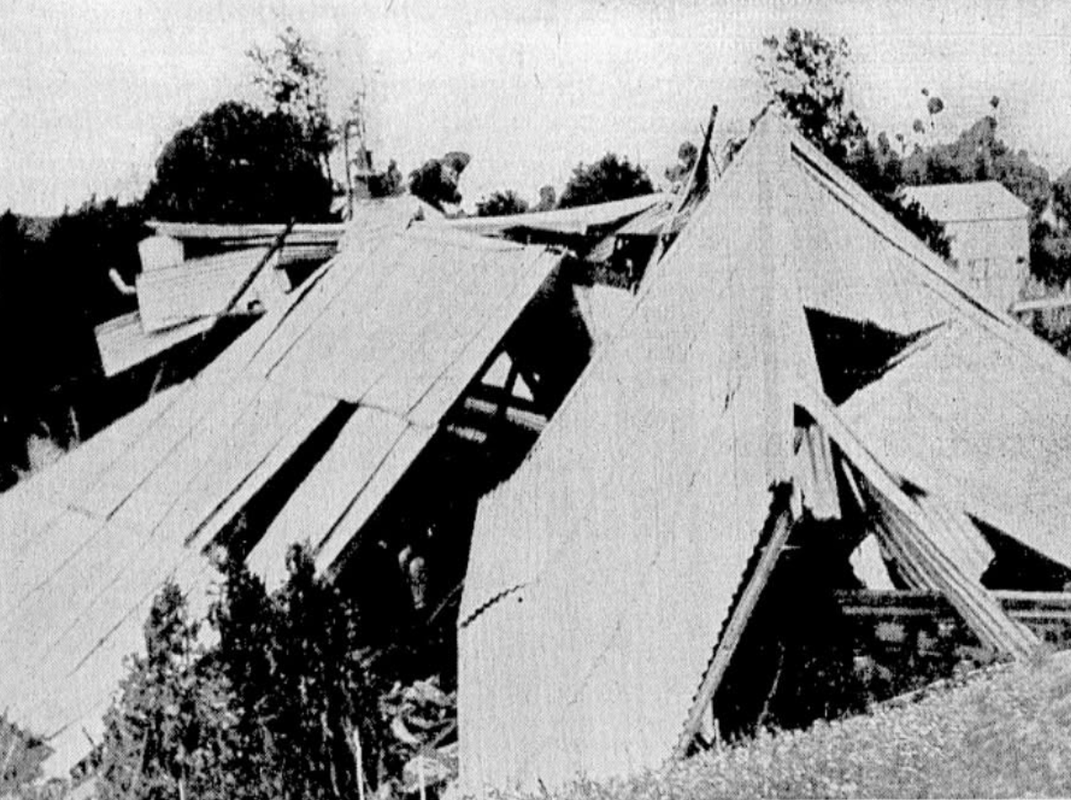
 On February 1, 1936, it was a cool night and everyone went to bed knowing there was a storm coming. They could not have predicted what happened next.
As the unnamed cyclone hit New Zealand, the rainfall and hurricane level winds caused havoc. Nearly every major river in the North Island flooded, buildings were uprooted and destroyed, footpaths were torn up and power went out. Near Shannon, a train was blown off the tracks. In Helensville, a train was cut off by floods and the passengers spent two nights stranded in the carriages until they were rescued. In remote areas people were cut off, boats sunk and crashed into rocks and there was damage on a massive scale. What had started as a storm at sea near the Solomon Islands bore down on New Zealand, hitting Auckland overnight and moving on down the country. Whangarei had 290mm or rain in 24hrs, Russell had 301mm and Warkworth 275mm. Auckland City recorded 162mm. It finally moved off, leaving before the worst hit the South Island but by the 12 people were dead. Walter Frederick Botterill had gone out into the weather, trying to help others in Kaitaia. He had been helping get things out of a house when he was swept into a drainage canal and drowned. Sixteen-year-old Eric Groves had also been trying to help - he was trying to clear a tree that had storm damage when a branch hit him on the head and killed him. William McLeod and his son Angus were on their launch ‘Mokau’ of New Plymouth when the storm hit. They were never found. In Palmerston North 72-year-old Benjamin Arthur Miller had climbed up to his roof to try and fix it. Roofs had been torn off all over Palmerston North in winds that reached 140kmh. A piece of iron from the roof tore off and struck him as he was working. William Alfred Joseph Soutar Montgomery is believed to have drowned in the Piako River in Ngatea. However what actually happened is unclear, as he was never found. Ralph Wood and James Wilson had been deer stalking in the Tararua Ranges when the storm passed over - both died of exposure. George Webster hopefully never knew what happened - he was sleeping in his hut at the Zeehan Mine near Thames where he was the caretaker. The hut was swept away in the storm. Both Francis Alexander Mikoz and William George Smith also drowned - in the Mangatangi Stream near Pokeno when it overflowed its banks. And as dreadful a toll as that is, it could have been even worse. In Wellington the steamer John broke its moorings and was swept into the Hutt river mouth and the Rangitira, a passenger ferry, hit a submerged rock as it tried to enter the Wellington harbour and was badly holed although managed to make it to port. There were 793 people on board. The storm was estimated to have caused well over $1 billion in damage in today’s money and farmers lost thousands of heads of cattle and sheep across the country. The victims are buried in several places, Mikoz is is the Waikumete Cemetery, Botterill in Hillsborough Cemetery, Groves in Tinui Cemetery, Miller in Kelvin Grove Cemetery, Smith in Pukekohe Cemetery, Webster in Shortland Cemetery, Wood in Terrace End cemetery and Wilson in Archer St Cemetery. There are memorials for the McLeod’s at Te Henui Cemetery in New Plymouth.
0 Comments
Leave a Reply. |
AuthorFran and Deb's updates Archives
October 2025
Categories |
 RSS Feed