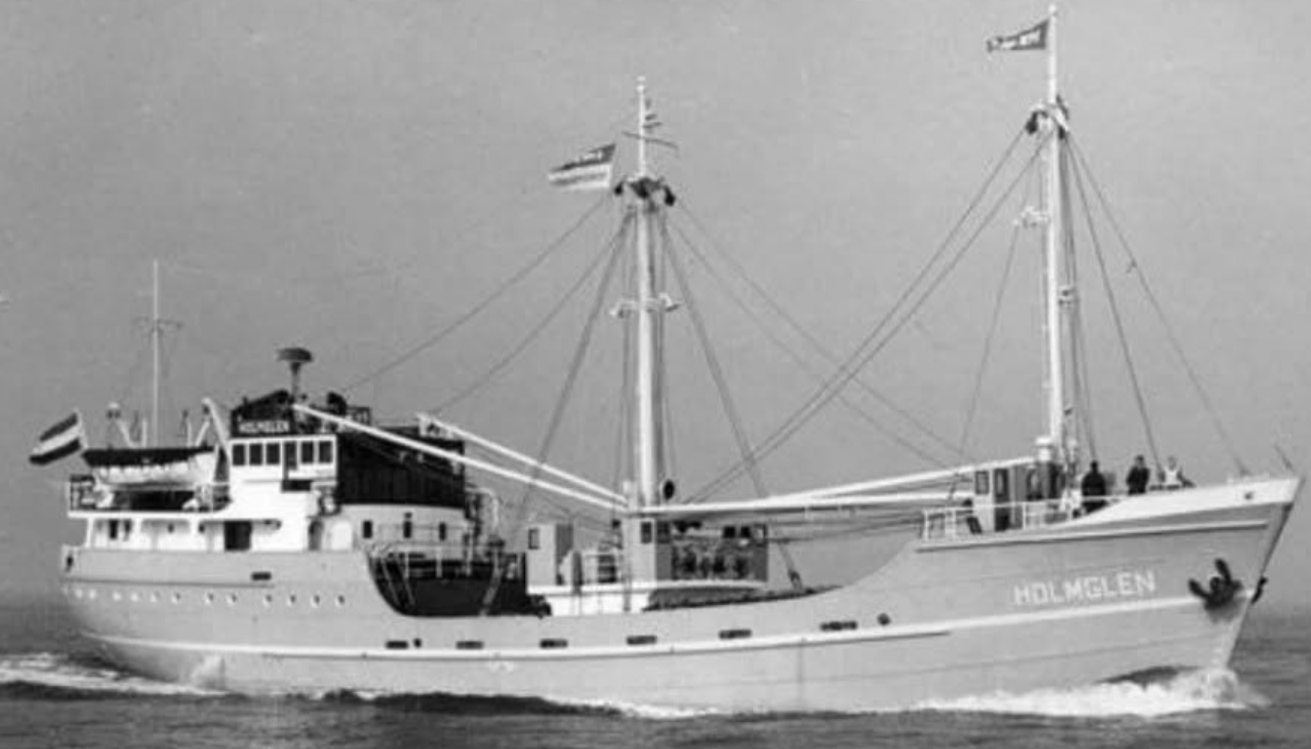
 On November 24, 1959, a mayday message was sent from 485-ton coastal freighter Holmglen travelling between Oamaru heading to Whanganui.
It was received by the Taiaroa Head Signal and Radio Station and also by Awarua Radio ZLB and Wellington Radio ZLW on 2182kHz. A voice, believed to be the captain, gave the ship’s position as 44° 35′ South, 171° 37′ East, and reported: “am heeling heavily to port … accommodation awash … preparing to launch boat.” Taiaroa answered and were told by the Holmglen to stand by for further information but nothing was ever heard again. On board were 15 crew, all of them died. Air and sea searchers rushed out to the last known location but they initially only found a large oil slick and floating debris. A further search found three bodies and an upturned lifeboat. The final resting place of Holmglen is 6-7 miles northeast of this position and 22 miles east-southeast of Timaru. Taiaroa Head, where the distress message was received, is 20km northeast of Dunedin. The ship was only three years old so the mystery was why had a new ship with an experienced crew sink? The ship had left Dunedin and stopped at Oamaru, taking on more cargo. It left the same day and the next thing that was known was the mayday call. Two naval survey ships responded and by early morning 17 ships had answered the emergency call for help. A couple of ships who found the oil slick used echo sounders and believed the Holmglen had sunk. The debris was found later in the morning including one of the lifeboats. Two bodies were recovered, James McEwen and Sydney McKenzie. As the weather got worse the search was abandoned. In the following days another lifeboat was found then a third body, that of Wilfred Henry Harding. A Court of Inquiry was unable to establish the cause of the tragedy. The Holmglen was only three years old and was not overloaded. There was no engine explosion, collision or striking of rocks. Although the weather at the time was poor, with a southerly wind and moderate to rough seas, it should not have troubled a vessel of its size. It certainly did not stop other ships responding to the call for help. There was speculation that shifting deck cargo, or some other instability, caused the ship to suddenly heel but to this day, the cause is unknown. On board was Master Edward Joseph Eugene Regnaud, Chief Officer Keith Douglas Billinghurst, Second Officer Keith lawdon (or Lawton) Barker, Chief Engineer Ronald Foster. Second Engineer Alexander James Wolgast, Third Engineer Wilfred Henry Harding, Able Seamen Sydney McKenzie, John Cleary, Derek Whorlow, Henry Weatherley Weatherley and Alfred Pemberton, Ordinary Seaman Garry Joseph Boyce, Cook: Joseph Anson, Steward: Aubry Shepherd McClelland and wiper James McEwan James McEwan (of Timaru) and Sydney McKenzie (of Glasgow) were buried side by side in the lawn cemetery in Timaru and Wilfred Harding (of Mangakino) was buried in Greymouth. An examination of the wreck by divers and a remotely operated underwater vehicle in 1999 failed to shed any further light on the loss of the ship. In 2008, another life was lost when divers went to the wreck of the Holmglen to retrieve its bell. After diving and beginning for the surface, the bell dropped dragging the ascent line with it. The divers got clear but Kevin Bailey disappeared from sight shortly after. His body was found days later.
0 Comments
Leave a Reply. |
AuthorFran and Deb's updates Archives
September 2025
Categories |
 RSS Feed