 New Zealand has many lost or hidden cemeteries. We’re going to see which ones we can find. Bridge St Cemetery, Lower Hutt. It’s a tiny peaceful little spot. On the corner of Lower Hutt’s Bridge St and Marsden Street is the remains of a cemetery. Through a little gate into a tree-covered yard with pretty flowers and a few notable memorials, the Wesleyan (or Methodist) Cemetery seems like you are stepping out of a city into a place out of time. 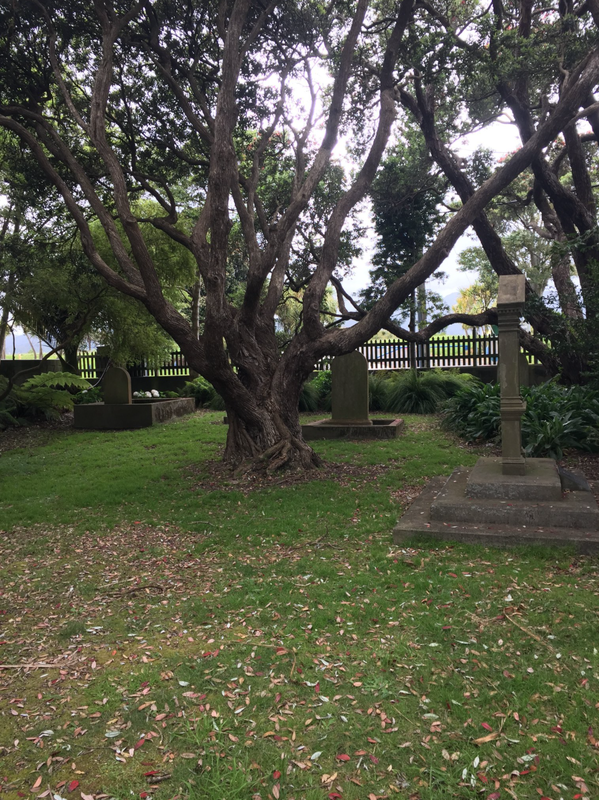 While it is still maintained, some graves have been lost to road widening - with a memorial stone now naming those whose final resting place has been disturbed. There are 51 graves recorded there but it is likely there are more than 100. 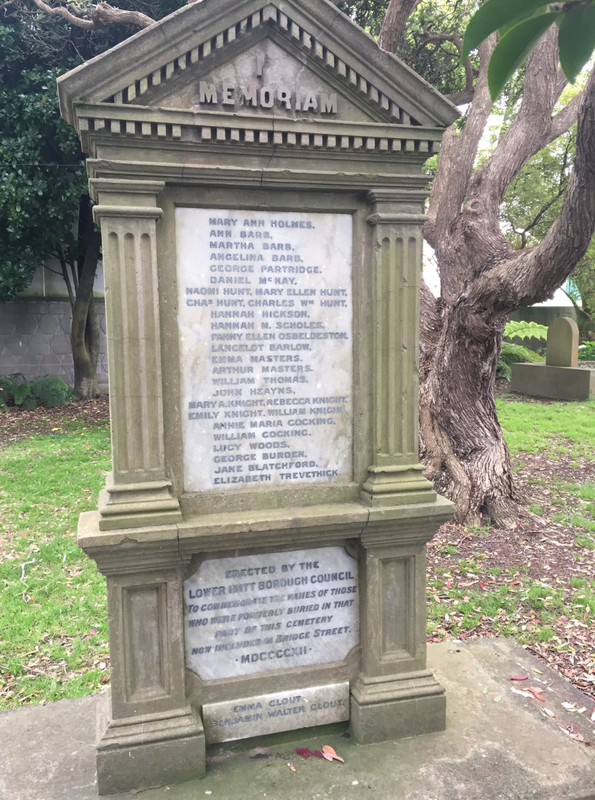 Of the few headstones that remain there are the names of families that were instrumental in the founding and development of Lower Hutt, the Sanson family, Frethey family, the Knights and William Bassett, shoemarker of Petone and his wife Mary, along with a poignant memorial to Thomas “William” Webb, a private with the New Zealand Expeditionary Force army who died at sea on board the troopship Mokoia on December 21, 1917 at the age of 27 headed for Europe, however he never saw battle. He died of illness aboard ship. He is also on the memorial at Karori Cemetery. The Knights, William and Mary Ann and their five oldest children were some of the first settlers in Petone arriving on the Duke of Roxburgh in 1840 from Cornwall. Son James Penrose Knight was a borough councillor and his son Willoughby was deputy mayor. If the names are familiar to those from Lower Hutt its because there are a number of street named for them, Penrose St, Knights Road, Willougby St and Frethey Grove. The little cemetery, still cared for by Hutt City Council, is all that remains of the original Wesleyan church on the banks of the Hutt River established in 1845 and stood nearby for only a few years before moving to Laings Road. There are drawings of the original church in the Alexander Turnbull Library done by Marion Swainson. Do you know of one of these ‘hidden’ cemeteries? 
6 Comments
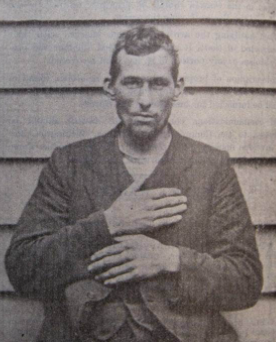 Joseph Pawelka, NZ Police Gazette Notorious Manawatu criminal Joseph John Thomas Pawelka had a pretty short and unremarkable list of convictions, but his actions led to two men being shot dead and panic in the communities of the Manawatu, Rangitikei and Tararua regions. Pawelka was born in 1887 in Oxford, Canterbury to Moravian immigrants and brought up in Kimbolton in the Rangitikei. At 13 he left school and apprenticed to his uncle at a Palmerston North butchery. In 1909 things started going downhill for Pawelka when a bout of typhoid fever put him in hospital for five months and saw him have part of a lung removed. The next year he married local girl Hannah “Lizzie” Wilson, but the relationship did not go well despite the impending birth of their child. At the end of that year Pawelka first came to police attention after he attempted suicide, a criminal offence at that time. Lizzie was granted a separation. A few months later, the Pawelkas turn up at Palmerston North police station after a dispute. Lizzie told them Pawelka had a gun, which he did, and it duly handed over. Police then searched his house for ammunition, unexpectedly finding a large amount of property recently stolen in burglaries. It was unclear whether Pawelka had committed these crimes, or had merely bought the furniture and other items from someone else. Nevertheless, he was charged with theft and taken into custody. This is where things began to get even worse. Five days later, Pawelka used two upturned buckets to help him climb the wall of the Palmerston North Gaol, steal a bicycle and make an escape. He was recaptured after two days and this time taken to the more secure Terrace Gaol in Wellington. On March 23, 1910 Pawelka was taken to the police cells in Lambton Quay as he was due to appear in court. When the gaoler forgot to lock the cell door, Pawelka took the opportunity to escape again. He headed north and a trail of burglaries, an armed robbery, three arsons and a shoot-out with police in Pahiatua were attributed to him. Fearing Pawelka would target their homes, hysteria began to overtake the region’s residents. Extra police were called in and residents volunteered to help hunt for the wanted man. The crimes continued and on the night of April 9 a former employer of Pawelka’s called police claiming he was trying to break into his house. Officers rushed to the house and in the darkness a struggle ensued between the apparent burglar and Sergeant John McGuire. Several shots were fired by police and the burglar, one of which hit McQuire in the stomach. He died four days later. Two days after McQuire’s shooting, a volunteer searcher from Pahiatua, hairdresser Michael Quirke, was shot in the head by another searcher in Palmerston North after he did not respond to calls to identify himself. On April 17, Pawelka was finally captured by police in Ashhurst, ironically one of his captors being the officer who had left the cell door unlocked. Pawelka was charged with the murder of Sergeant McGuire, robbery, theft, arson and escaping, but was eventually convicted of only the last three. The judge sentenced him to a total of 21 years in prison. Despite the community’s earlier fears of Pawelka, his lengthy sentence provoked protests, a deputation to parliament and a 15,000-signature petition seeking a reduction. Pawelka made further attempts to escape from prison and finally, on April 27, 1911, succeeded. At the time Pawelka seemed to disappear into the ether, but many years later it was revealed that he had made it back to Kimbolton and, with help from those who knew him, eventually to Auckland. From there he either sailed to Vancouver, Canada on the Makura, 119 years ago next week, on February 16, 1912 or to Sydney on another ship. His last resting place remains a mystery, but those of the two men killed during the manhunt are not. Sergeant John Patrick Hackett McGuire is buried in Karori Cemetery in Wellington. He was 41. Michael Patrick Quirke is buried in Pahiatua/Mangatainoka Cemetery. He was 36.   Across from the Hawke's Bay Earthquake Memorial at Park Island Cemetery is another less well known one - dedicated to the 10 men who died when the launch Doris collided with the ship Tu Atu in Napier harbour.
Erected by the NZ Waterside Workers Federation, it reads, “No pains, no griefs, no anxious fear can reach our loved ones, sleeping here.” The accident left 26 children fatherless. It was a calm mildly rainy night on December 28, 1932 as the Doris, with 31 watersiders aboard, headed for her moorings at the inner harbour. They had been working in the freezing chambers aboard a ship and were heavily dressed against the cold. At the same time, the Tu Atu left her berth at Ahuriri and headed out. She tried to stay in deeper water on the outward channel. The Doris, a bright white oncoming light to the men aboard the Tu Atu, looked initially to be on the other side of the channel. But at about 150 yards away both lights of the Doris could be seen, which meant it was on a collision course. The Tu Atu was in a narrow deep water channel with rocks on either side, unable to turn away and the crew watched in horror as the Doris disappeared under the bows of the Tu Atu. Boats, trawlers and tugs hurried to the area to help pull survivors from the water. Then the search began for the bodies. Walter Andrews, Robert Aplin, Alexander Boyd, Eddie Cooper, Harold Johnson, Thomas Kitt, Norman Low, Jethro Metcalf, John Wilson and James Woods lost their lives. A Marine enquiry into the disaster found that the helmsman of the Doris, Erik Mentzer, was directly responsible for attempting to cross the Tu Atu’s bow. Witnesses said the Doris appeared to try and change its course just before the collision. Erik Gunnar Mentzer was buried in the Hastings cemetery in 1969. Today the memorial lies in the shadow of the earthquake one, smaller but no less tragic. 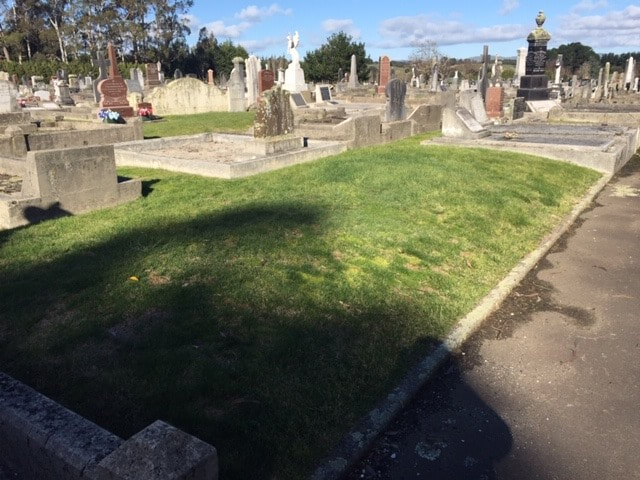 James Collins lived almost unnoticed for most of his life before suddenly becoming famous at the age of 91.
Three days after the Hawke’s Bay earthquake in 1931, when hope was fading of find anyone alive, the nonagenarian was pulled alive from the rubble of the Park Island Old Men’s Home in Taradale. The home was one of 15 buildings in Hawke’s Bay whose collapse led to the largest number of fatalities. Obviously a sturdy chap, even at that age, Collins tried to run when the earthquake hit, but was knocked face down on to a mattress as the building collapsed around him. It saved his life. Three days after the quake, a police officer heard someone calling out and a rescue team uncovered Collins, who while injured, was in remarkably good condition. Born in Tipperary, County Cork, he traveled as a military man in India. He had been in what was then known as Zululand and in Capetown. Something of an athlete in his young days, he won prizes for high jump, long jump and running. While he was recovering in hospital he recounted his time buried and waiting to be rescued being terribly thirsty and wishing for a gallon of beer. Sadly, shortly after his rescue he was admitted to Dannevirke Hospital and died in November 1931. Even sadder, his grave, one of the earliest ones in Dannevirke’s Mangatera cemetery, has no headstone. He was believed to have no family. Of the eighty people at the Home, 80 survived and 14 died in the earthquake, although a few died later. 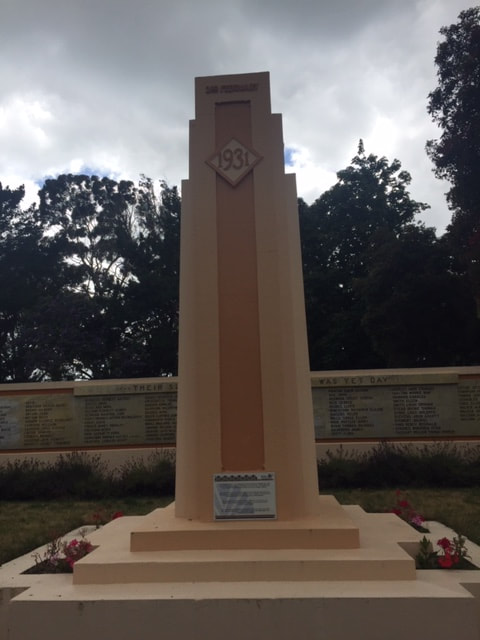 Everyone knows the basic story of the Hawke’s Bay earthquake. It hit at 10.47am on Feb 3, 1931 and was listed at 7.8 on the richter scale. The official death toll is listed as 256. It’s unclear, however, if that should be the final number. Some victims were never found and some of those who died from their injuries may not have been counted among the final dead. But alongside the well-known facts are snippets of information that have been forgotten over time. Here are a few. In just two-and-a-half minutes the earthquake moved sharply up and then just as sharply down. Much of Ahuriri lagoon was uplifted during the earthquake, exposing about 3000 hectares of seabed forming a land bridge between Napier and Taradale. The Hawke’s Bay airport is today on this land. Many of those who died were not killed during the earthquake itself. Instead, fire swept through the damaged stores and buildings killing many trapped people before help could get to them. HMS Veronica was in the harbour and during the earthquake was left nearly high and dry as the sea receded. But the sea swept back and the sailors scrambled ashore to help. She was able to contact two others, the Diomede and the Dunedin who rushed to Napier with food, medicine, tents, blankets and a team of doctors and nurses. Prisoners from the Napier jail were working on Bluff Hill. Four of their number were buried in a landslide. They were able to dig two out. None of the prisoners took advantage of the situation and were locked up in the jail again. More than 900 aftershocks were recorded and lasted until December that year. Explosives were used to create a hole big enough for the first 54 burials. While the official death toll is 256, there are actually 258 names on the memorial. Some of the stories of individual deaths became known. Gwen Butler, aged 21, was working at the Griffiths shoe store in Hastings. She survived the original quake. Gwen and the other staff helped evacuate the store but when someone mentioned to her that the money was still in the till she went back inside. A large aftershock hit, collapsing the brick wall of the bank next door, which fell into the store killing Gwen. She is buried in the Havelock North cemetery. Alfred Evers-Swindell’s name is on the list of the dead. If his name is familiar it's because he was the brother of Garry Owen Evers-Swindell - grandfather of the Olympic gold-medal-winning Ever-Swindell twins. One boy, originally counted among the dead, was later taken off the list when it was discovered his body had already been in the morgue, which had collapsed during the quake. More than half of the fatalities came from the collapse of just 15 buildings, like the Nurses Home on the hill, the Roaches store in Hastings and the Park Island Old men’s home. Napier used to have trams. But after the quake the tracks were left twisted beyond recognition and were never restored. And Napier’s now iconic Art Deco-look is a direct result of the rebuilding done after the earthquake. We have one more tale to tell from the earthquake. An amazing story of survival which will be published this coming Saturday.  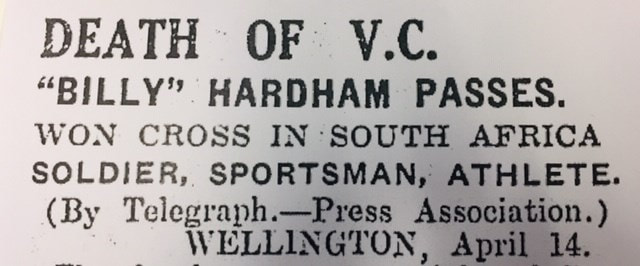 One hundred and twenty years ago tomorrow, on January 28, 1901, Wellingtonian Major William James Hardham, serving in the Boer War, saw one of his soldiers fall wounded and his horse killed.
So he acted. Hardham rode into heavy fire, dismounted and put the wounded Trooper John McRae, of Masterton, on his own horse and ran alongside to get him to safety. Hardham became the first New Zealand-born man to be awarded the Victoria Cross. He was an extraordinary soldier and man. Born in Otaki in 1876, Hardham was educated and grew up in Wellington going to Mount Cook School. He made his debut as a rugby player for Wellington in 1897. Hardham became a farrier, blacksmith and part-time soldier. He volunteered to serve in the Boer War. Posted to the 4th Contingent, nicknamed the Rough Riders, he was just 24 when he and his company were ambushed by about 20 Boer soldiers while on patrol near Naauwpoort - and he performed the heroic rescue of McRae. Hardham was presented his Victoria Cross by George, Prince of Wales, who was visiting South Africa at the time. Two months later he was discharged and he returned home. He volunteered again, although he did not return to South Africa. Back in New Zealand as a civilian he was a keen rugby player and was part of the Wellington team that won the Ranfurly Shield off Auckland in 1904. In all, Hardham represented Wellington more than 50 times. He became part of the rugby administration with the Wellington Rugby Football Union. A competition trophy, the Hardham cup, played for in Wellington senior club rugby, is named for him. Hardham volunteered to return to service in World War One serving as a captain in the Wellington Mounted Rifles regiment of the New Zealand Expeditionary Force in Egypt and at Gallipoli. The regiment was not part of the initial landings at Gallipoli arriving later, on May 12 (without their horses). During an attack on Anzac Cove the company fended off attackers. During a battle for No.3 Post Hardham was seriously wounded in the chest and a hand. He returned to New Zealand and while he recovered he was the Commandant of Queen Mary Hospital in Hanmer Springs. He re-enlisted returning to active service in Palestine in 1918 but after poor health he was discharged at the end of the war at the rank of Major. After loyally serving in the armed forces for years he returned to Wellington where he worked for The Dominion newspaper and the Public Works department. Hardham died in 1928, aged 51, of stomach cancer and is buried at the Karori Soldiers Cemetery. John McRae, the man Hardham rescued, was promoted to Lieutenant the following year. He remained in South Africa after the war, married and had a family. He died there in 1963 aged 87.  On 22 March 1931, 13 residents of the Horowhenua town of Foxton set off for an autumn boating and picnic excursion on the Manawatu River - only eight made it back alive. Tragically, the five dead came from just two families. By all accounts the weather was favourable on the morning the party, all residents of Union Street, set out on the recently refurbished, 30-foot (9-metre), kauri launch Nina. The boat was owned by Foxton Borough Council waterworks engineer William Neville, who was aboard with his wife and three children. Also aboard were flax worker Frederick Henry Henricksen, his wife Ellen, their children Elsie, Edna and Cyril, and neighbour 18-year-old Manly Symes, who was to become the hero of the day. The party was completed by launch’s skipper, Hape Hakaraia and his 10-year-old son Charlie. The party left Foxton at about 10am and sailed upstream towards Palmerston North. Nearing lunchtime, about 20 kilometres from Foxton, someone spotted some wild blackberries bushes growing along the riverbank. Hape was urged to pull the Nina over so the ripening berries could be picked and added to the lunch table. Once the baskets were full, the picnickers got back into the launch to sail a few hundred metres upstream to a small beach on the other side of the river where a fire could be made.  As the women went about preparing the lunch fare aboard the boat, tragedy struck. About 100 metres from their destination, in the middle of the strongly-flowing river, the Nina hit a large submerged object. The boat’s hull was torn off, sinking it within seconds. Most of the picknickers were thrown into the water. The life belts floated away down the river out of reach of the struggling party. Ellen Henricksen, her daughter Edna and Connie Neville managed to cling to one of the remaining belts, but fearing it would not hold all three safely, Mrs Henricksen let go, sacrificing her life. Frederick Henricksen, who could not swim, was also thrown into the water and drowned.
Hape, Charlie, Jimmie Neville and Manley Symes swam for the bank. During the swim, Hape suffered a seizure and dragged Charlie under the water with him. Both drowned. Manly Symes made it to the shore, but twice jumped back into the water pulling Jimmie, Edna and Connie to safety. Still clinging to the boat, were William Neville and his wife, who was also holding young Cyril Henricksen. William grabbed his wife by the coat and started swimming for the riverbank, but his feet became entangled in some ropes. Mrs Neville sank beneath the water and lost consciousness letting go of little Cyril. By the time William reached the shore and managed to pull his almost lifeless wife from the water Cyril was gone. The township of Foxton mourned the tragic loss of lives. Hape Hakaraia, born in Otaki, had lived in the town for many years. He was a noted singer, performing as the lead in many concerts in the area. Frederick Henricksen was born in Grovetown in the South Island, the child of Danish immigrants. His wife Ellen was the daughter of one of Foxton’s earliest settlers Abraham King. Frederick and Ellen Henricksen and Cyril are buried next to Abraham King at Foxton Cemetery. Hape Hakaraia and Charlie are buried in Otaki in the Rangiatea Churchyard. But from the tragedy love blossomed. Three years later, two of the survivors, the hero of the day, Manly Symes, and Frederick and Ellen’s oldest daughter Elsie Henricksen, married. If you want to find out if your family has interesting stories we can help. 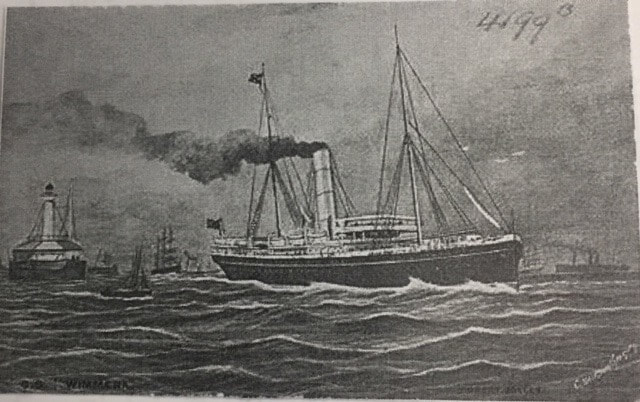 The steamer Wimmera travelled through the night of June 25, 1918, her passengers on their way from Auckland to Sydney, asleep.
On board were 76 passengers and 75 crew. They woke suddenly as the ship vibrated violently. The Wimmera had struck an enemy mine, laid by the German merchant raider SMS Wolf. The huge explosion had blown away part of the stern and some cabins and broken the main shaft and put the dynamo out of action. Under a moonlit night, Captain Herbert James Graham Kell ordered the lifeboats launched. For a short time the ship remained stable and passengers were quickly put into a heavy sea. All the boats managed to make it away from the sinking ship which suddenly rose by the bow for her death plunge, sending up a huge geyser of water. Captain Kell had remained on the ship. For a while the lifeboats made good progress. Four landed near Tom Bowling Bay near New Zealand's North Cape. More landed at Taemaro east of Mangonui. One boat was swept along ending up at Kaiamou Beach. Under wartime censorship, little was initially able to be published. Later, lists of the survivors and fears that the last boat had been lost were in newspapers. Eight months before the voyage a warning had been issued about a moored enemy mine that had been swept off the coast of Australia. Captain Kell had seen that warning. A court of inquiry found Captain Kell had taken that too lightly. Twenty-six had died in the disaster. In 2010 the wreck of the Wimmera was believed to have been found using advanced underwater sonar developed by the company of Auckland electronics expert Mike Hodson north of Cape Reinga. Captain Kell’s resting place is now known.  New Zealand has many lost or hidden cemeteries. We’re going to see which ones we can find.
Lower Hutt’s High St is one of the busiest. Most people driving into town, however, never know they are driving past one of the original graveyards and the original settlers buried there. The Knox Presbyterian Church, just down from Hutt Hospital used to be the site of the Blackbridge Cemetery - now there is a garden and two memorial stones. The church, which began in 1840, opened its first building in 1858 and burials took place in the late 1800’s. But after difficulty maintaining the cemetery it was decided to remove all the headstones and monuments and create a small garden with a memorial. No bodies were moved. Many of the immigrants were from Scotland, but there were others from India, England, Ireland and France. Buried there are Alexander Dalgety and members of his family. Dalgety, who arrived in 1841, was one of the original purchasers of the church ground. George Stratton was found dying on the ground near the hospital in pouring rain and at an inquest he was found to have died of “apoplexy by exposure to cold and rain.” Most of his family are also buried there, including his wife Sarah. Others include Peter Bruce, involved in setting up a public school in Taita, stood for the Hutt River Board several times, and is named on a plaque in the church as one of the founders. Robert McCulloch and his wife Euphemia who arrived in 1852. Robert helped set up the Taita school. The couple, along with their daughter Catherine are named as founders of the congregation. Also there are George McIlvride, blacksmith, farrier and district licensing commissioner and Rev John Hope, who formerly opened the church in 1890. The last recorded burial was in 1913. However a recent memorial stone also includes those connected with the church who had permission to have their ashes scattered there. Do you know about a “hidden” cemetery. Let us know in the comments and we’ll see what we can find out. 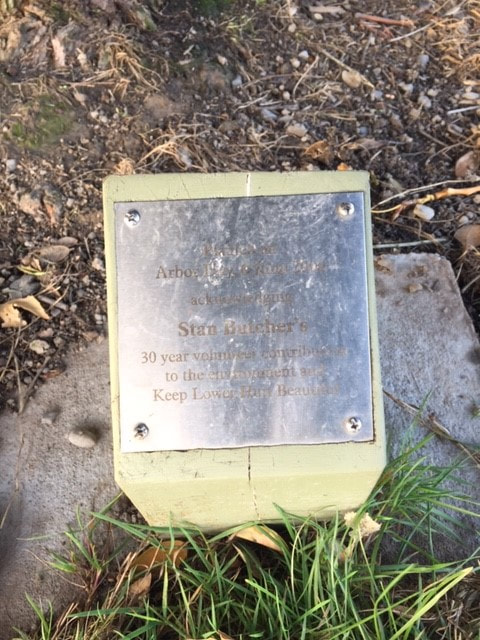 In fact, it’s 92,500 natives planted on Matiu/Somes Island, turning it from a barren rat-infested island back into a haven for native species.
So it’s fitting that under a little tree in picturesque Avalon Park in Lower Hutt is a little plaque commemorating his life. A life member of Lower Hutt Forest and Bird, he played a vital role in the 30-year project to replant the island. By 2006 he had estimated the number of trees he had planted to be 92,500. With the planting of native bush came the chance to return Tuatara to the island in 1998. He received the Queen’s service medal in 2006 for his environmental work. Stan became interested in native bush growing up as a young boy in Nelson. The native fuchsia trees entranced him. Stan was inspired by the stories of Johnny Appleseed - John Chapman in real life - an 18th century American nurseryman who distributed and sold apple tree seedlings to pioneers through Ohio and Indiana. He left school intending to become a surveyor. He married his childhood sweetheart then decided to go into teaching. He trained at Wellington College in the 40’s and was principal for Korokoro and Epuni schools but it was once he retired, that his fascination with nature led him to begin the projects that would define his life. Although he had been a paying member of Forest and Bird since 1941, he never went to a meeting until 1981, only a few days after he retired. The next day he was asked to join the council and then went to a planning meeting about Somes Island. Since then he has raised hundreds of little trees in his back garden, many destined for their new life on the island. Stan died in 2006 aged 94 and was cremated. He truly left a living legacy. |
AuthorFran and Deb's updates Archives
August 2025
Categories |
 RSS Feed