 Are you hoping for chocolates under the tree this Christmas?
After all, who doesn’t like chocolate? Well, chocolate has been used as a weapon before. New Zealand had three cases of poisoned chocolates being sent through the mail and one of poisoned chocolates as a Christmas gift. In Blackball, on the West Coast in September 1934, Ethel Bragg and Jean Clark, both 20, received an exciting and unexpected gift. A box of chocolates with a note signed from Jim. It was addressed to both of them. A friend of theirs, Maggie Smith, worked next door at Dumpleton’s Bakery in Blackball’s main street. When they offered her chocolate she took it. In fact more than one. It would prove fatal. While Ethel and Jean both tasted the chocolates, they complained they were bitter and spat them out. Maggie later collapsed and died within an hour. The chocolates had been tampered with, with strychnine crystals added to them. Several of the chocolates had little holes on the bottom. John Skikelthorp Page - a miner, was charged with murder and attempted murder. But it was clear he was insane and he was committed to the Seacliff Mental hospital. Less than a year later in Hawke’s Bay Alma Keith received a box of chocolates. With it was a note that appeared to be from a farmhand she was friendly with, Jack Masters. Alma’s mother was suspicious and they took the box to the police station. The poison this time was arsenic. Two months after that in 1935 Phyllis Marshall, 18 was charged with attempted murder. Masters had been paying attention to both the women. Marshall denied it, saying she just wanted to give the other woman a good scare. She was found not guilty when her defence pointed the finger at Masters as the mastermind. But the strangest case came from Blenheim, when Alma Rose confessed to sending herself strychnine laced chocolates. She could not offer a proper explanation but the Magistrate at the time thought it was “a morbid yearning for sensationalism.” A copycat perhaps, after a year of publicity about similar poison chocolates. She was put on a good behaviour bond for a year. The last case in 1951, James Mayo was found not guilty of poisoning chocolates with strychnine resulting in the death of Harold Palmer. Rita Osbourne had gone to the police when she became aware of the death to say that Mayo had given her poison to kill a dog at one point. Police also used hand writing analysis to prove the writing on the Christmas label on the chocolates was Mayo’s but it was discredited by the defence lawyer who instead pointed the finger at Rita Osbourne. It worked and the jury acquitted him. Still want those chocolates?
1 Comment
 Charles Barraud was an extraordinary man. Chemist, artist, businessman and a philanthropist, his family name is memorialised on a street in Lower Hutt. Born in London, England, he was the 10th child of 12 and wanted to be a doctor but after his father died when he was young the family could not afford the training and he became a chemist instead. After marrying and producing six sons and three daughters, the family emigrated to New Zealand arriving in Wellington in 1849. He set up a chemist shop on Lambton Quay. He was a success, opening another in an octagonal building on Manners St called the Pill Box along with branches in Napier and Whanganui but by 1880 his shop was on the corner of Molesworth St and Hill St, Wellington. By then he had set up a meeting that led to the formation of the Pharmaceutical Society of New Zealand and became its first president. That led to the Pharmacy Board which, for the first time, registered pharmacists and set standards to protect public health and the reputations of chemists against fakers selling drugs. When his Lambton Quay store was destroyed by fire in 1887 (for the second time) he retired and devoted his time to his other love, art. He won recognition for his painting, working mainly in water colours but also in oils. Many of his works are in the collection of Te Papa, including a painting of the White Terraces which were believed destroyed in the eruption of Mt Tarawera. His works can still be bought today. In 1882 he was the principal founder of the Fine Arts Association - now the New Zealand Academy of Fine Arts and due mainly to his efforts was the building of the first gallery, the forerunner of the National Art Gallery. Along with that he was the chairman of the Wellington Sailors Rest and treasurer of the Wellington Hospital Convalescent Fund. As if he didn’t have enough to do he was a churchwarden at St Paul’s and painted the illuminated texts that decorate the nave. He is buried at the Bolton St Cemetery.  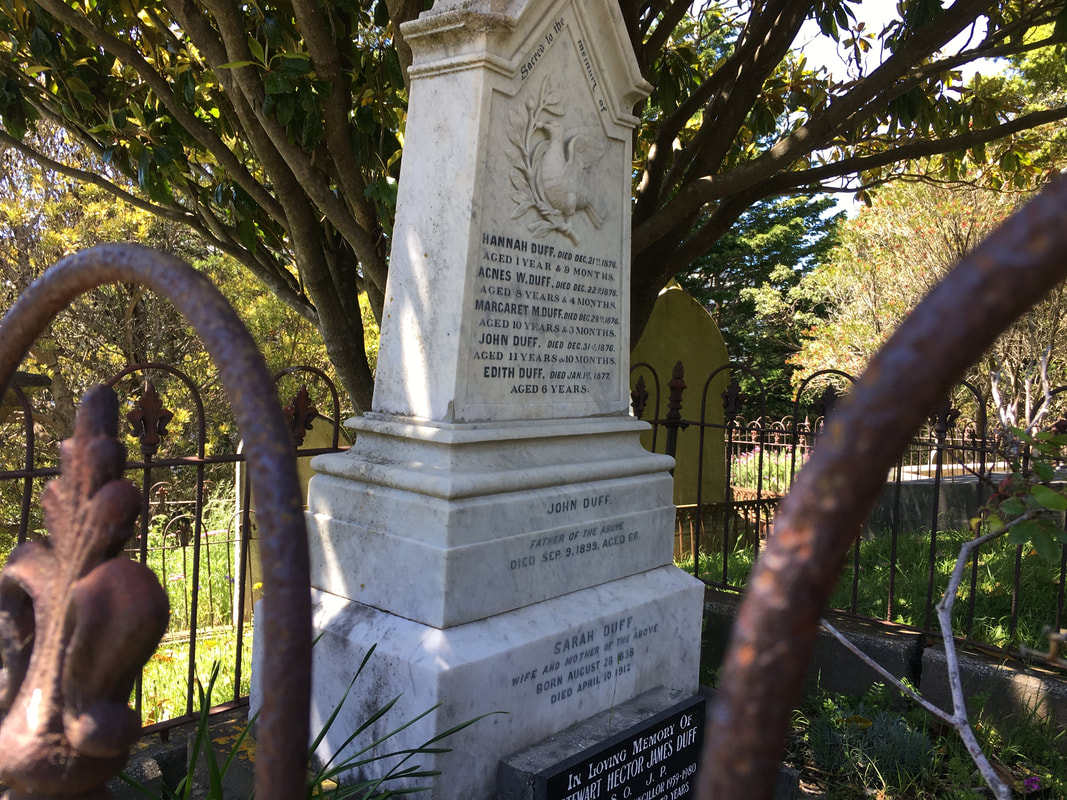 At the beginning of December 1876, John and Sarah Duff of Wellington had a family of six apparently healthy children, then one by one, over a period of 11 days beginning just three days before Christmas, five of them died, all falling victim to diphtheria.
John, a cabinetmaker, and Sarah were the pity of the town when day after day the funeral cart of undertaker W. Nicholson arrived at their Lambton Quay home to take the children’s little coffins to the Bolton Street Cemetery for internment. The first signs of illness arrived at the Duff home on December 7, when three of the children became ill. The Duff’s decided to treat the children with home remedies, and fearing for the safety of the other children, sent the healthy ones away. The Duff’s struggled on, but by December 21, it was clear they needed assistance from medical professionals. John sent for Drs Driver and Kemp, who arrived to find the children in an extremely unwell condition, suffering from, what Kemp described as, malignant diphtheria. That same day, one-year-old Hannah, succumbed. Her death was followed the next day by that of her eight-year-old sister Agnes. To the Duff’s relief, 10-year-old Margaret appeared to be making a recovery. On Christmas Day the other children returned to the house, but it was clearly not a day for celebration, as they too had symptoms of the disease. Three days later Margaret too died. The two doctors battled to save the two other sick children who were declining quickly, and on December 29, a third doctor was called in to advise. It was to no avail, as on January 31, 11-year-old John died, followed the next day by six-year-old Edith. The Duff’s had just one child left, three-year-old David. Before vaccines became widely available, diphtheria was the leading cause of childhood death globally. Diphtheria is caused by bacteria, which can affect the respiratory system and may cause blocked airways, heart, nerve and kidney damage as well as paralysis. Even with today’s treatments, which include antibiotics and antitoxin, about one in 10 people who contract the illness die. Without treatment the mortality rate increases to about 50 percent. New Zealand has had several outbreaks of the disease, the worst being in 1892 when 281 people died. The most recent outbreak was in 1941-42. According to NZ public health data, the last reported case of respiratory diphtheria in New Zealand was in 1998 in Auckland. Despite the setback of losing so many children, John and Sarah went on to have four more children; another boy they named John in 1877, William in 1879, Arthur in 1881 and Duncan in 1883. The Duffs owned a number of properties in Wellington including the Britannia Hotel in Willis Street. In 1897, Sarah was granted a separation order from John, who had moved to Gisborne in a failed property venture. He was declared bankrupt that year and, according the newspapers, died in 1899 in St Helier, Jersey. Sarah remained in Wellington and is buried with her five young children in Bolton Street Cemetery. Interested in finding if your family has interesting stories? GI can help.  Hangman Tom Long helped many into their grave but his own is mysteriously missing.
He was famous in New Zealand but for something no one else wanted to be known for. He was the hangman, called upon to kill his fellow man, those sentenced to death by hanging. Many of those who he hanged are buried in former prison graveyards but no one knows for sure where Tom Long himself was buried. Time and again Long stepped up when called upon to carry out a duty that no one wanted to do. By all accounts he was good at it, a little too good because boasting about it sometimes got him into trouble. Tom however was an old hand at trouble. And mystery. He said he was born in Ireland, although his date of birth is uncertain. One prison release records he is said to have been born in 1841 or 1851. Long is described as a man with sandy grey hair and grey eyes with a crucifix and anchor tattoo on his left arm in 1890, although in one record it had changed arms. He claimed to have served in the Navy and was an artilleryman during the Indian Rebellion of 1857 where he said he learned his skill as a hangman. On finding his way to New Zealand he was often a labourer and bushman. In 1877 he was hangman for the first time for William Henry Woodgate for the murder of the child of his niece in Marlborough. He asked Woodgate if the rope was comfortable or too tight and wished him a pleasant journey. For each hanging he got £25. Tom was barely able to keep out of prison himself and several times was taken out of prison and escorted to the area where he was to carry out his duties. He may well have been in the same prison as those he was to hang, most often for charges like drunkenness and obscene language. The most famous of those he hanged was Minnie Dean, the only woman ever hanged in New Zealand in Invercargill. He allegedly demanded her clothing and shoes as part of his payment. After Tom took the train away, he told a travelling football team about it. Upset, they tried to string him up from the hat rack but he was saved by the conductor. Tom hadn’t learned his lesson though, because he had another close call at the Tauherenikau Hotel, where after he lost money at the horse races he tried to auction her boots. While it is not certain, he was the current hangman at the time Rowland Herbert Edwards was hanged at Napier Prison for killing his wife and four children and then understood to be buried standing up in the prison yard. The last man Tom hanged was James Ellis, known as John McKenzie who had killed Leonard Collins. He was hanged at The Terrace gaol in Wellington. Only three years later Tom was dead. He was crushed by a tree which fell on him while he was working in the bush at Kauangaroa near Whanganui in 1908. His death made headlines in newspapers across the country with the New Zealand Times running the headline Exit Tom Long. But here’s the weird bit. Nowhere is there a record of where he was buried, just a cryptic mention that he was buried or lost at sea. An old newspaper report says he was buried at Neil Bros cemetery which might have been on private property but there is no note about where that is. Please let us know in the comments if you know more. We are dying to know. We were recently interviewed by the New Zealand Law Society about what we do.
We were really excited because it gave us the opportunity to explain what our business does. They wanted to talk to us because we are one of the few companies that do this sort of work. Read more: The Will-Finders. https://www.lawsociety.org.nz/…/l…/genealogy-investigations/ For the past five years, journalists Fran Tyler and Deborah Morris have used their joint talents of mystery solving, and their extensive court reporting experience, to help both families and lawyers trace lost family members and beneficiaries of wills and estates....  In a quiet row of graves at Karori Cemetery is a little grave of a little girl whose name is barely remembered. But Elsie Marion Glasgow’s dog is a Wellington icon.
Her once faithful companion - originally called Dash - is now known as Paddy the Wanderer. He and Elsie used to go with her mother Alice to the waterfront to meet the ships bringing Elsie’s father John home. But when Elsie died at only three and a half years old from pneumonia in 1928, Paddy ran away and began wandering the waterfront. Despite attempts to settle him again, he never again had an ‘owner.’ He became famous for getting on coastal steamers and heading away only to return to make another trip. He became beloved by the watersiders and seamen who ensured his safety, making him an assistant night watchman whose job it was to keep guard for pirates, rodents and smugglers. As he aged he spent time with the tally clerk’s office. His adventures have been made into a book, a memorial, museum exhibits and every year the Wellington Museum pays for the Wellington City Council registration tag, put on the statue as a way to memorialize him. The Airedale terrier was a common sight on the waterfront and he was fed by the men who came to know him best. He had stowed away to Australia, sailed around New Zealand, rode the Wellington trams and became the first dog in New Zealand to fly in a plane. He wandered the streets, knowing how to cross a street once the light went green. He was awarded the freedom of the city in 1935. There were also rumours he made it as far as San Francisco. On his death in 1939 there was a funeral procession through the city including 12 black taxis who took him to the city crematorium. Now a brass plaque with a likeness of Paddy now sits on the waterfront with two drinking bowls for all good boys. And a permanent exhibit at the Museum of Wellington City & Sea displays a life sized statue of the dog that captured the hearts of Wellingtonians. Elsie herself - usually called Bubby - is buried at the Karori Cemetery. Her relatives still live in Wellington.  A terrifying explosion in the middle of the night during wartime would be a cause for panic anywhere.
It woke half of Auckland just after midnight in June 1942 but there was no headline, no explanation and no one spoke of it despite worry that the Japanese had invaded. It wasn’t until 1945 that the story of the death of 11 airmen from a plane crash became known. Wartime censorship had done its job to keep secret that a Flying Fortress plane - the first of its kind to reach New Zealand - had crashed into a low hill on farmland at the extreme end of one of Whenuapai airport’s runway. The plane called the Texas Tornado was in New Zealand on a secret mission. And on board has been 11 airmen, from the United States and one from France. The plane hit so hard it knocked a house almost apart and pieces were found for miles. Horribly, there were two immediate survivors, one man was seen dragging a comrade from the crash. He then returned to the plane for others but it burst into flames and within minutes two of the 500 pound bombs being carried exploded. Several days later a very quiet funeral was held at Waikumete Cemetery and the men were interred on June 21, with the then Minister for Co-ordination of Defence in attendance. Army and Navy men made up a silent honour guard. It took years before the names were mentioned, for the first time in the Auckland Star newspaper in 1945. And the worried parents and relatives of those killed spent months trying to get confirmation of what happened. A special part of the cemetery was set aside for them and they were reburied there until the end of the war when they were repatriated to America and buried with full military honours They were James Bruce, Charles Brunson, Curtis Childers, John Clanton, Richard Cobb, Harry Cohn, James Herriotts/Herriotta, E Hoffman, E Hurst, J Lopez and Free French Navy liaison Jesn Gilbert/Githerd.  Ah Kirkcaldie and Stains, Wellington’s prestigious department store.
Home of the doorman who gave you a little bow, massive sales with huge queues, quality goods and bullets flying in the tearoom. Wait, what? Yep, that’s right, in 1898 there was an attempted murder at Kirks. It’s a story of stalking, corsetry, debt and a trial. On a quiet Thursday afternoon in October, Annie McWilliam spotted tearoom owner Ellen Dick just a few paces away from the counter, on the top floor of the store. Obsessed over a grudge, Annie stood and pulled out a six-chambered pistol and fired. Astonishingly Ellen’s corset saved her, the bullet ricocheting off the closely-spaced steel stays. But Annie wasn’t done. As Ellen ducked, she fired again and again. One closely missed a cook in the process of making scones. Bullets buried themselves in the walls of the tearooms. Other customers fled in terror. A shop walker grabbed Annie as she began to leave followed by Sydney Kirkcaldie, then a junior member of the firm, who took the gun away from her. Annie had been nursing a grievance against Ellen over a lawsuit about a hotel on the West Coast and had been noticed by Ellen at the tearooms several times. Annie was described as slightly built, about 49, of pale complexion with dark eyes. She was separated from her husband with a son and two daughters. She was understood to have mortgaged her home to provide the purchase money for the City Hotel in Reefton which Ellen was running. The hotel was later sold by the mortgagee. At the trial in the Supreme Court, Ellen said she had paid every penny of her salary as housekeeper toward liquidating her debt but that was never accepted by Annie. The short trial was contentious, Annie was warned many times by the judge about interrupting to call Ellen a liar. The debt was supposed to be over £2000, a huge sum for the time. Then suddenly only half a day into her trial Annie changed her plea to guilty and the jury discharged. She was given seven years imprisonment and hard labour at the Terrace gaol. Ellen, meanwhile, returned to work the day after the shooting. In a strange twist to the end of Annie’s story, she lived for many more years only to drown after falling from the Auckland ferry wharf aged 76. Annie Geraldine McWilliam (nee Mannix) is buried at the Hillsborough cemetery in Auckland. 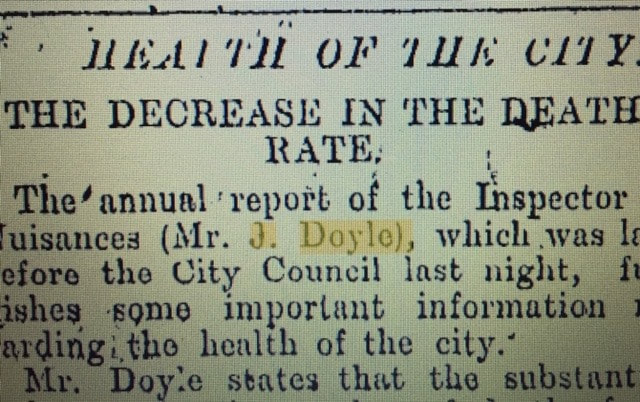 Do you think you have a rubbish job?
Spare a thought for the men who held the title of Inspector of Nuisances to various councils around New Zealand. Great title aside, they literally dealt with the rubbish of a city. Started in Britain, they were a type of sanitation and environmental health inspector, expected to deal with everything from dead animals in the street, night soil and a weird array of other problems. A quick search in Wellington City Archives and newspapers at the time show a vast number of complaints about things like horrible smells, dog taxes, unsanitary premises, gorse, cow sheds, loitering fruit sellers and even a case of leprosy. And proving that Wellington traffic problems have been around forever, the increase of motorcars and the speeds they traveled. (The first cars in New Zealand were imported into Wellington.) What a job huh? One of these men was James Joseph Doyle. Born in Williamstown, Australia in 1852 he came to New Zealand in 1868 attracted by gold but ended up in Wellington in 1879 where he went into the police force. He left the police in 1895 to become a muscular temperance lecturer for six months but then rejoined the police. Doyle became Inspector of Nuisances to the Wellington City Council, a role he developed into that of chief sanitary officer. He held the role until 1922. His term is marked by the reforms he made. Especially in regards to the prevalence of typhoid fever, an ever present threat. He is credited with helping prevent deaths. He was the first to suggest setting up municipal abattoirs and the need for a pure milk supply. At one point in his career in 1900 he was doing inspections for bubonic plague. He prosecuted people for selling diseased meat and in one annual report was able to happily report that spitting on the sidewalk had decreased probably due to a £20 fine. He was noted for literally sniffing out problems. He was also a noted athlete, a runner and heavyweight lifter. Mr Doyle died aged 76 in 1926 after serving his city loyally for many years. Flags on the municipal buildings were flown at half mast for him. He is buried at Karori Cemetery. With thanks to Wellington City Archives for their amazing resource. 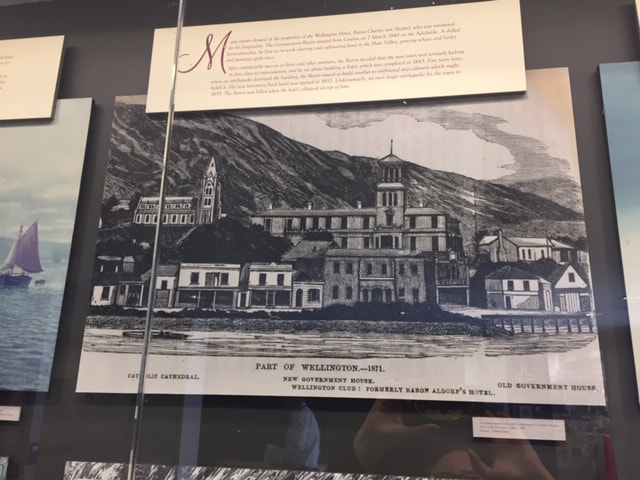 Grave Story #6 The earthquake that forever changed how Wellington looked also killed one of its most colourful citizens. Baron Charles Ernest von Alzdorf had come to New Zealand in 1840 and bought land in the Hutt Valley but he preferred his grand new hotel on Wellington’s waterfront to being a farmer. It had been standing in the earthquake of 1848 and had some damage before being rebuilt to two storeys. Von Alzdorf boasted about The Wellington hotel built of brick and plaster. He was justly proud of it, complete with European facilities like a steam bathhouse, one room with a vapour bath. It was flash and new and the Premier at the time Henry Sewell called it quite the most pretentious building New Zealand had yet seen. The Baron had derided the other buildings in Wellington built of wood. He thought brick was the way to go. It would be fatal. He had not learned the lessons that Wellingtonians had learned only seven years before when a series of earthquakes all but destroyed 80 brick and stone buildings leaving the wood ones standing. On January 23, 1855, a massive earthquake struck Wellington and the Wairarapa area.  The Baron, who had had a stroke a couple of months earlier, had been sitting before a fire and a portion of the wall with the chimney on it fell in on him. His son Walter and wife Mary were at their home in Lower Hutt. The earthquake set the standard for powerful shakes, registering as 8.2 and originated on the Wairarapa fault and generated a tsunami in Cook Strait. About 250 aftershocks were felt in the following hours. His name is the only one readily found as being a fatality of the quake in news stories of the day. Several Maori died in Wellington and the Wairarapa, many when a building collapsed on them, but reports from the time don’t name them. The Baron is buried in Bolton Street Cemetery, however his precise whereabouts is unknown. This was, unusually, at his own request that there be no marker on his grave and that it be near his friend, Colonel William Wakefield who had died only shortly before him at the Baron’s hotel.  The destruction of Government buildings and banks built with brick led to a revolution in building in Wellington. The Old Government building - now the Victoria University Law School - began in the 1870’s. Now a heritage site, the lesson had been well and truly learned. But it wasn’t just the buildings, the Basin Reserve, formerly a swamp, began to drain, the coastline around Porirua was raised and thousands of miles of land in East Wellington were raised by several metres. The remains of von Alzdorf brick-lined wine cellar have since been found in Bowen House. A display shows bricks from the cellar along with bottles recovered. His only son Walter married and moved to Foxton where he died, leaving a large family. Their descendants are spread around New Zealand. 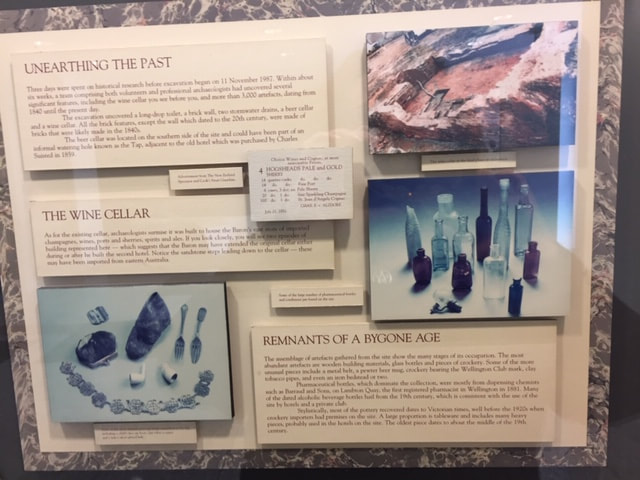 |
AuthorFran and Deb's updates Archives
August 2025
Categories |
 RSS Feed