 William Snodgrass was there one minute and gone the next.
Which might not be unusual in a missing person’s case except he was on the ferry between Wellington and Nelson at the time. William Wallace Snodgrass was born in Liverpool in England in 1870, the son of Robert Snodgrass and Dorothy Barker. He attended school there until, aged 10, his family moved to Nelson, New Zealand. In 1896 he married Sarah Annie Frankham and they had three daughters and two sons - one of whom was All Black Wallace Frankham Snodgrass. Snodgrass worked as a member of his father’s merchant firm R. Snodgrass and Sons in Nelson. He also became a city councillor and then contested the mayoralty several times before being elected mayor from 1917 to 1921. He was appointed to the Legislative Council by the Governor-General in 1921, reappointed in 1928 and again in 1935. He was also president of the Nelson Chamber of Commerce, a member of the Nelson Harbour Board, Patriotic Society, and War Funds Council. He had received an MBE for his patriotic work during World War I and the King George V Silver Jubilee Medal. All of which he would be remembered for - except for the strange way he vanished. Snodgrass was aboard the Arahura, a steam powered passenger and cargo ship that routinely ran between Wellington and Nelson. On March 20, 1939, Snodgrass was travelling to Nelson. He had supper with the Master, Captain Hay and retired to his cabin. He was sharing it with a Walter S Dillon who said when he went to bed Snodgrass was in his bunk reading. But in the morning Snodgrass was not there. All his clothes and belongings were still in his cabin. Ironically during his time as Nelson's mayor he often spoke out and campaigned for a better ferry service between the two islands. Oddly three years later his daughter, Florence, also died at sea. She had married Colonel C. S. J. Duff, Commander of the New Zealand Artillery and had been serving in the WAAF in England. She lost her life when SS Port Hunter was torpedoed and sunk by U-582 in the Atlantic north-west of the Canary Islands on 11 July 1942. We usually say where someone is buried but of course, official records list Snodgrass as lost at sea.
0 Comments
 There were clear signs that something was not right with Duncan Munro right up to the moment he bashed in the heads of his family with a flat iron. Sadly, the signs were missed or ignored
It was the milkman who, while doing his early morning deliveries on February 10, 1892, found Munro’s wife Grace and his four children lying in pools of blood in their Tauranga home. Only one survived. Munro was born in Australia in 1861 and as a young child his parents James and Jane Munro (nee McPhail) moved their family to New Zealand. James Munro died in 1865 in the Waikato. In 1866, Jane, now a widow with four children, quickly remarried to James Bodell a recently discharged Waikato militiaman, with a reputation for being a tough, heavy drinker. (Bodell would in 1888 become the Mayor of Tauranga). Munro began to exhibit signs of severe mental health problems from a young age and these grew worse as he grew older. He suffered from bouts of religious mania. In 1885 he became engaged to Grace Freeman. According to news reports, Grace was warned by friends and family to hold off on the marriage for a year to see if Munro’s mental state would improve. She ignored the warnings and on March 10 that year the couple married. Eleven months later their first child, George was born, followed a year later by their second child, John, then two years after that a third son, James Alexander, was added to the family. Soon after James Alexander’s birth Duncan had a fit of mania which was witnessed by a nurse who was looking after Grace. She said Duncan smashed a clock, because it offended him, and then tried to smash a kerosene lamp over the baby’s head to anoint it with oil. The nurse complained to police and in July 1889, he was sent to Whau Lunatic Asylum in Auckland for treatment. After six months of confinement, Munro’s mother Jane arranged for his release from Whau, promising that she and his younger brother Peter would care for him. Munro returned to Tauranga to his wife and children and all seemed to be going well for a while, but then the fits returned. He was kept locked in the house until they subsided. In 1891 a daughter, Lilly, was added to the family. Munro’s bouts of madness continued and he was moved to the back bedroom of the house where he was locked away at night. The day of the tragedy, February 9, Munro was found in the school grounds suffering from another bout of religious mania. He was taken to his mother’s house and, after he appeared to recover, his mother and brother took him home to his own house. They left him there, his mother waiting on the other side of the road to make sure all was quiet. Grace locked Munro in his back bedroom. About 7am the following day the milkman saw Munro on the beach behind the house wearing only a nightshirt and heading out into the waves. Fearing the worst he went into the house and discovered a scene of absolute horror. Authorities were alerted and found Grace and George lying in a pool of blood in the kitchen, James Alexander was in his cot in the front room covered in blood and Lilly and John were lying on the double bed. All had massive injuries to their heads, inflicted with a cast iron flat iron. All were still alive, but within hours, John, George and Lilly died. By the following day accusations of blame were flying. An inquest on the three children found that Munro had wilfully murdered his three little ones. The inquest jury took the unusual step of including a rider blaming his mother and brother for the tragedy. They said Munro “should not have been discharged from the asylum and that since his discharge proper precautions have not been taken by his family or the present calamity would not have happened”. The jury had a clear view of Munro’s condition as part way through the inquest he had to be forcefully removed when he started singing hymns. Munro was taken to Auckland and readmitted to the asylum. The following day, February 14, Grace died. This time the inquest jury urged that the Government should hold an enquiry to determine how Munro came to be released. Possibly anticipating such an inquiry, Dr Moir, Munro’s former doctor, spoke to the NZ Herald saying he had warned the family of the dangers and said he had also seen them tie him down with ropes during a bout of mania. On March 9, Munro was sent to trial for the murders, but was found not guilty by reason of insanity. He was sent back to the asylum where he died on October 27, 1904. He is buried in the Presbyterian section of Waikumete Cemetery, Auckland. Grace, George, John and Lillian are buried in Tauranga Cemetery in the Bodell family plot. They have no headstone to mark their deaths. Remarkably, little James Alexander recovered from his injuries.  Sir Bernard Freyberg was known for many things; as an extraordinary soldier, Governor-General and champion swimmer.
But one of the most astonishing things he did was completely alone and naked. On the troop ship the Kennet, young Freyberg was detailed to take a platoon ashore at the Gulf of Saros, the morning of April 25, 1915, at the start of the Gallipoli campaign. The platoon was tasked with lighting flares on the beach to distract the enemy from the main attack, but Freyberg, a champion swimmer, asked to do it. He was sure his swimming ability would help. So, naked, except for a revolver and a knife, oiled up and blackened, he slipped over the side and began the swim in icy waters towing a raft filled with flares. At one point he was aware of something big swimming with him. He made the shore, slowly making his way up the beach, getting close enough to the enemy lines he could hear them talking. Crawling along he lit the first flare. Immediately he was surrounded by gunfire but continued lighting more as he went. Then he got back in the water and swam back. It worked to divert the enemy from the main landing. What was even more astonishing was the night before he had spent most of the night helping to dig the grave of young English poet Rupert Brooke. Freyberg was born in Richmond, London on March 21, 1889, the youngest son of James Freyberg and Julia Hamilton. The family came to New Zealand in 1891. He attended Wellington College. He was not academic but made his mark as a swimmer, being the 100 yards champion in 1906 and 1910. At first he wanted to be a doctor, but instead trained as a dentist, practising in Hamilton and Levin. In 1914 he set off for San Francisco but at the outbreak of war went to England. He was wounded badly several times and during the first battle of the Somme he so distinguished himself in the capture of Beaucourt Village that he was awarded the Victoria Cross. He continued to fight despite being wounded a number of times. He ended the war by leading a squadron to seize a bridge at Lessines in Belgium - one minute before the armistice came into effect. On June 22, 1922 he married Barbara McLaren, a widow with two children and would have a son with her. At the outbreak of the Second World War he took command of preparing troops and in 1939 was appointed to command the Second New Zealand Expeditionary Force. He was badly wounded in 1942 and again in 1944. In 1945 Freyberg accepted an invitation to become New Zealand’s Governor General. He later left in 1952 to return to England where he was made Baron Freyberg of Wellington, sitting in the House of Lords. He died on July 4, 1963 from complications from a wound he sustained at Gallipoli and is buried in the churchyard of St Martha on the Hill. William Lee
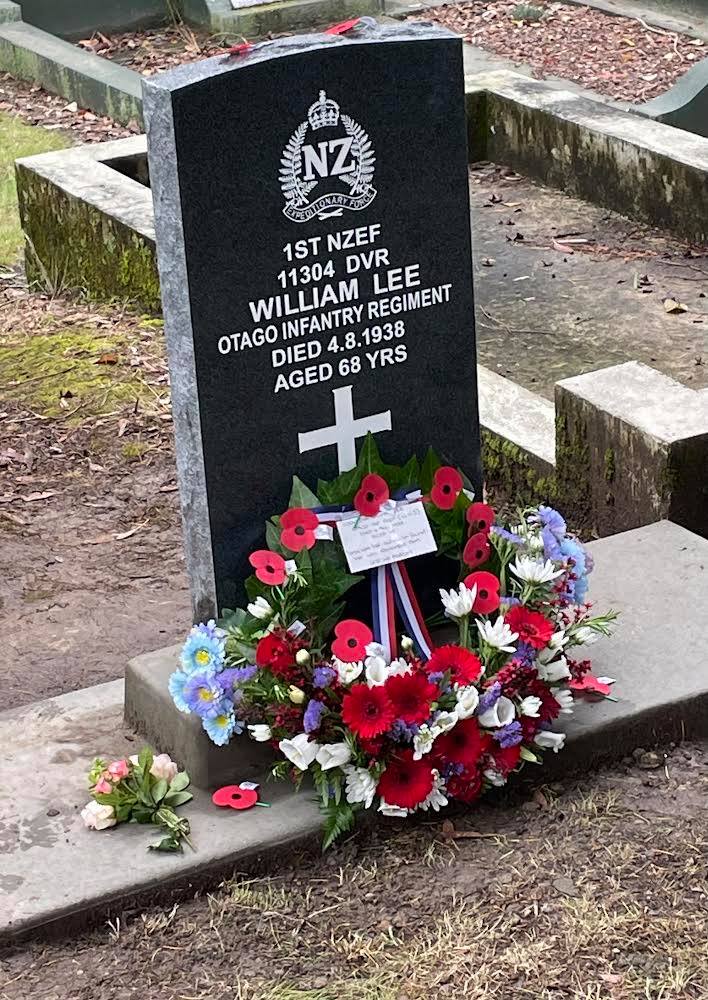
On Saturday I had the honour of going to the unveiling of William Lee’s headstone. We don’t often get the chance to see the outcome of our work. What our clients do with the information we give them is up to them. And we don’t always find out if our Facebook stories have an impact. But William Lee is the welcome exception. When we write a Grave Story we often start with an event and find someone to write about. Which is what happened here. I was looking at the Esk Valley flood. Initially I was looking at the history of a family who was driven out of their home by a landslide when I found the little mention of William Lee who had been pinned to his bed by a beam in his house. It started a sequence of events. The New Zealand Remembrance Army asked for what I had found on Mr Lee - I was able to provide the records, and they started the ball rolling to get a headstone. It was also wonderful to see the family of Mr Lee was able to attend. RIP Mr Lee. We will remember.  Otari-Wilton’s Bush would have been irresistible to young botany student Jean Marie Martin.
So it wouldn’t have been a surprise to anyone that she went for a hike there on April 8, 1945. But what happened next was extraordinary. She vanished. Without a trace. Yes, people go missing all the time but often something is known or suspected. But Jean Marie was just gone. Nothing of her was ever found. Jean Marie was born in 1922 to Waipawa dairy farmer Montague Martin and his wife Ethel. She was the eldest of six children and had moved to Wellington where she was working as a laboratory technician and studying botany part-time at Victoria University. She had been living in Glenmore Street, near Wellington’s beautiful botanic gardens. On April 8, 1945, she and a companion went for a walk in the native reserve of Otari-Wilton’s bush. About 3pm her friend left and she kept going. A little later in the afternoon, near a farm, Jean Marie spoke to someone and indicated an interest in the Crow’s Nest, a 166m hill. It wasn’t considered a simple walk and it was already late in the afternoon. She was never seen again. Jean Marie was five foot two with short curly black hair and prominent teeth. She had been wearing a blue jumper, grey skirt, fawn overcoat and a green scarf. She was also supposed to have been carrying a black patent leather handbag. Not a single piece of that was ever found. The search that followed was huge. Police and search and rescue style teams began and were augmented by 70 police recruits and students from Victoria. The search extended as far afield as Makara and Ohariu Valley. Students from the Teachers Training College also joined in, Jean Marie’s sister was going to the college at the time. Her father offered a £100 reward for any information. There was concern because Jean Marie had a breakdown the November before and her family was worried she had lost her memory. Police eventually decided she had died of exposure. Months later however there were two sightings of women in Ponsonby who looked like Jean Marie in Auckland - but neither sighting came to anything. Many years later in 1967, there was another sighting which turned out not to be her. And since then nothing more is known. Both Montague and Ethel died never knowing what happened to their eldest daughter. Both are buried at the Waipawa Cemetery.  Charles and David Howden brought their golf clubs from Scotland when they emigrated to New Zealand. They were both passionate players but there was a problem.
There were no golf courses in New Zealand. Charles and David were from Edinburgh, Scotland, the home of the modern golf game. Charles was born on October 25, 1838 and David on May 1,1846 to Peter Howden, a wine merchant and Jessie Ritchie. Charles came to New Zealand in 1871, aged 23, and began working on sheep runs in Otago. He later started a wine and spirit business in Dunedin and started the New Zealand Distillery Company making whiskey. But after it closed, he turned to golf. In 1871 he and some friends started a golf club and Howden became the first Club Captain of the Dunedin Golf Club (later the Otago Golf Club). In 1872 the City Council gave permission for a course to be laid out and it was Howden who was the designer. It closed down and Howden returned to Britain on business but on his return in 1889 there was renewed interest in golf. Meanwhile in Wellington brother David helped set up the Hutt Golf Club in 1892. Golf was first played at the Hutt Park Raceway. During attempts to create a club in Wellington, David and Ethel Duncan (one of the first woman golfers) had their eye on land at Miramar. They and others leased the land from the Crawford family who owned it and created the golf course with an official opening in 1895. Later the club left that course and created the one at Heretaunga in Upper Hutt. One of the oldest golfing trophies in the South Hemisphere, the St Andrew’s Cross, presented by Charles to his club on St Andrew’s Day for an annual competition is still going. While Charles is called the father of golf in New Zealand - it took both brothers to establish the sport - and many golf courses around the country. Charles died on August 28, 1928 and was cremated at Waikumete in Auckland. David is buried at St John's Church in Trentham, Upper Hutt.  The murder of Margaret Burke in 1871 was, in its day, sensational enough but in the many years that followed, the appearance of a bloody handprint on her gravestone led to shudders down the spines of those who saw it.
Margaret, 21, daughter of John Burke and Mary O’Malley, had come from County Galway, searching for a better life. She was a maid, living and working in the house of William “Ready Money” Robinson - called that because he paid for a huge estate with cash. He was wealthy and well-known in the Canterbury district and famous for racing horses. During his world travels, he had taken on a man in Panama as his butler, Simon Cedeno, part African-American and part Indian. He and three girls were the servants in the Robinson home. Cedeno had been courting a woman called Mary who he intended to marry. Margaret and another girl, Catherine Glynn had teased him about her several times, mainly about whether she even existed. This angered Cedeno - who was doubly troubled because he had apparently already asked Margaret - who had said no. On January 9, 1871, Robinson’s wife Eliza had been entertaining a guest when they heard screaming in the hallway. Margaret burst into the room followed by Cedeno holding a knife. As he attacked her, the guest Patrick Campbell tried to restrain him, but he stabbed her several times, even as Campbell’s hand was on the knife to stop him. Margaret died and they found Catherine, also bloody and stabbed, but alive, hiding in her room. Cedeno, who was prone to fits of anger, was arrested and taken to trial. He was found guilty of murder, attempted murder and threatening murder and was sentenced to death. He was hanged at Lyttelton gaol in April that year. Margaret was buried in the Barbadoes Street Cemetery in Christchurch with a headstone put up by the Robinson family. It was a month later that what appeared to be a bloody handprint appeared on the stone. The stone had come from Halswell quarry and the type of stone was known for flaws, including showing a red liquid when it rained. The grave became an unlikely attraction with people travelling to see it. When the original headstone had to be replaced there was shock when the handprint appeared again. It was not until 1962 that the story faded away. The stone was smashed by vandals and it was removed to be repaired but the pieces were lost and now there is no headstone. Before they were lost however, it was found the sandstone used became red when wet. But does that explain it? (Happy Halloween everyone)  Dennis Quinlivan was attacked and beheaded, his body left near the Buller River.
He was a resident of Lyell, a historic mining town in the Buller Gorge where Māori prospectors had found gold in 1862. The gold rush was on and the population grew rapidly, making it to 2000 at its highest point. In 1883, Dennis was a United Victory mine employee at New Creek, Buller. Originally from Tipperary, Ireland, at 38 he had been in New Zealand for a few years. He was last seen alive on January 28, 1883. Given the rural area, it wasn’t surprising that it wasn’t immediately noticed that he was missing. His body wasn’t found until February 3, by a Patrick Carroll who noticed his horse kept shying away from a particular area. Quinlivan’s head had been severed and burned while his chest had severe wounds. He was found only 100 metres from the house of a Mrs Mary Gramatica. Another miner, John Davidson eventually confessed, saying he had been planning to marry Mary. He told police had been drinking at her house on January 28. Quinlivan had come in and there was a struggle. He said Mrs Gramatica hit Quinlivan with a piece of wood and he fell to the floor. She put him out the back door. She had told him two other men had rolled him off the road. Gramatica’s account was a little different. She said Quinlivan had accompanied her home that day and they found Davidson already there. The two men were drinking when she went to bed. When she awoke she saw a heap of blankets with two boots sticking out. Later Davidson dragged the body out of the house. Davidson was given a life sentence for manslaughter while Gramatica was acquitted, but not before being told off by the judge for her immoral lifestyle (drinking and being interested in more than one man). Davidson went to the Nelson Gaol on March 15, 1883 and became a cook. But it was not the last time he made headlines. Usually those with life sentences were transferred to Wellington but it wasn’t until July Davidson was told he was to be moved. He took it badly. He didn’t want to go. On July 28 the Inspector of the prison Robert Shallcrass was woken by screaming. He found Davidson had a gun. Shallcrass kept Davidson talking but to no avail. Davidson shot himself. It was then they discovered the body of warder Samuel Adams in a cell. He had been stabbed to death. Davidson’s body went the same way as a lot of murderers. He was buried “outside” Hallowell Cemetery. Meanwhile Quinlivan’s body is one of the few interred at the Lyell Old Cemetery on the Upper Buller Gorge Road. Pic by Muir and Moodie Studios  It’s not clear exactly who notorious New Zealand prison escapist Isaac Robinson was.
The blond, blue-eyed soldier was supposed to have been born in County Tyrone in Ireland and joined the British Army in 1854. His most distinguishing feature was a brand on his chest - D for deserter - which he got for deserting four years after enlisting in the British Army. For this he got 84 days imprisonment in 1858. Later he attempted to cover it with a tattoo. Even his age is uncertain - some references list him as 25 - others 31. In 1860 he was tried again for being absent without leave and losing his uniform and kit. By that time his superiors had had enough. He was shipped out to Melbourne, Australia with the 40th regiment. He wasn’t having it though and tried to desert again. He was court martialled in 1861. Robinson got into plenty of other trouble, breaking windows, assaulting others and being disorderly. By 1863 he had been shipped to New Zealand and in 1864 he was on trial in Te Awamutu for deserting - and once again losing his kit. Getting rid of his clothes would turn out to be a familiar refrain in his life. He was sentenced to the stockade at Mount Eden and then likely dishonourably discharged and cast out. He got a job in 1865 working for Adam Chisholm on Waiheke Island, supposedly looking after the cattle and horses, but after three days Chisholm tried to pay him off. Robinson took offense at the small amount he was offered and assaulted Chisholm, taking all the money he had, a gun, two pistols and threatened another man. He was caught and sent back to Mt Eden for six years but in January 1866 he escaped by concealing himself among the rocks in the quarry and slipping away while no one was looking. It started a pattern that lasted until he vanished from sight for good. He had been wearing a highly visible prison uniform but knocked down and forcibly stripped a man of his clothing, including a lavender-coloured coat, near Onehunga. Robinson headed for South Auckland where he found work - while everyone was looking for him elsewhere. Days later he was caught by two police officers and sentenced to six more years. It didn’t last long. On October 17 he escaped again. He had been in irons but after a period of good behaviour they were removed and while he was working in the mason’s department he ran off, hiding in the officers’ quarters until he could go over the wall. He took off his coat and turned his prison shirt inside out. He stole another man’s boots and jacket. The boots didn’t fit so he knocked out another man, stealing his boots and trousers. It took until November to corner him again and he went to a Supreme Court trial. This time he got four years for escaping and six for assault on top of his other jail terms, bringing him to a staggering 22 year jail term. His final escape was in March 1872 - he simply walked out, managing to dress himself in warder’s clothes and arming himself with one of the warder’s pistols. The next day he was seen in the Waitakere Ranges by a police detective who took careful aim and fired. Robinson plunged into the bush but has never been seen again. It’s unclear if he was shot and crawled off to die, but there were sightings later in the year that came to nothing. In 1873 a man thought to be him was apparently working in a hotel in Maraetai then possibly being on the Bella Mary bound for Tasmania. Whichever it is, no one now knows where he lies. Photo by Deleece Cook.  How often have you heard God Defend New Zealand in your lifetime? Hundreds?
Did you know it’s not even a song? At least not originally. It’s a poem. One written by a man whose name is rarely known now, but whose work is celebrated every time that song is used. Thomas Bracken was the son of Margaret Kiernan and Thomas Bracken, born on December 30, 1841 in Clonee, County Meath in Ireland. His mother died only a few years later and his father in 1852. Thomas was mostly cared for by an aunt before he was shipped off to Australia at the age of 12 to an uncle near Melbourne. He worked at various jobs and began writing poetry. His first volume of poems was published in 1867. In about 1869 he came to New Zealand and took up a job as a warder at the Dunedin prison but soon moved to journalism, finding a job at the Otago Guardian. He and two others started three newspapers including the New Zealand Literary Miscellany, full of political, literary and social issues. In 1881, he won the seat of Dunedin Central and was in Parliament for three years. He married Helen Hester Copley on February 1, 1883 and had a son, Charles. He never stopped writing poetry and published both in New Zealand and Australia, sometimes using a pseudonym Paddy Murphy. He was a passionate advocate for the use of the Māori language, translating many of his poems - including God Defend New Zealand, into Māori. Of all his poetry, it is God Defend New Zealand that survived the longest. The New Zealand Saturday Advertiser ran the poem under the title National Hymn and announced a competition for a musical work to go with it. The winner was a score written by John Joseph Woods - a teacher from Lawrence in Otago. It gained rapid popularity even though it was not official. Bracken gave up his rights to it to Woods. It was not until December 1938 that the National Centennial Council recommended that the government adopt it as the national hymn and the rights to Thomas’s words and Wood’s music were bought. However, the work was not given equal status with 'God save the Queen' as a national anthem until 1977. He was also the first person to use the phrase “God’s own country" in relation to New Zealand. Thomas died in Dunedin of goitre on February 16, 1898. He is buried in Dunedin’s Northern Cemetery. From Bracken’s poems, To Find The Key: An hour of joy, a day of tears, A lesson in life’s changeful school, A dream of happy fleeting years, A mad plunge in the whirling pool, A sail upon the waves which flow, Unto the hidden mystic sea, Wherein we sink! And then we go, To try the lock and find the key. |
AuthorFran and Deb's updates Archives
September 2025
Categories |

 RSS Feed