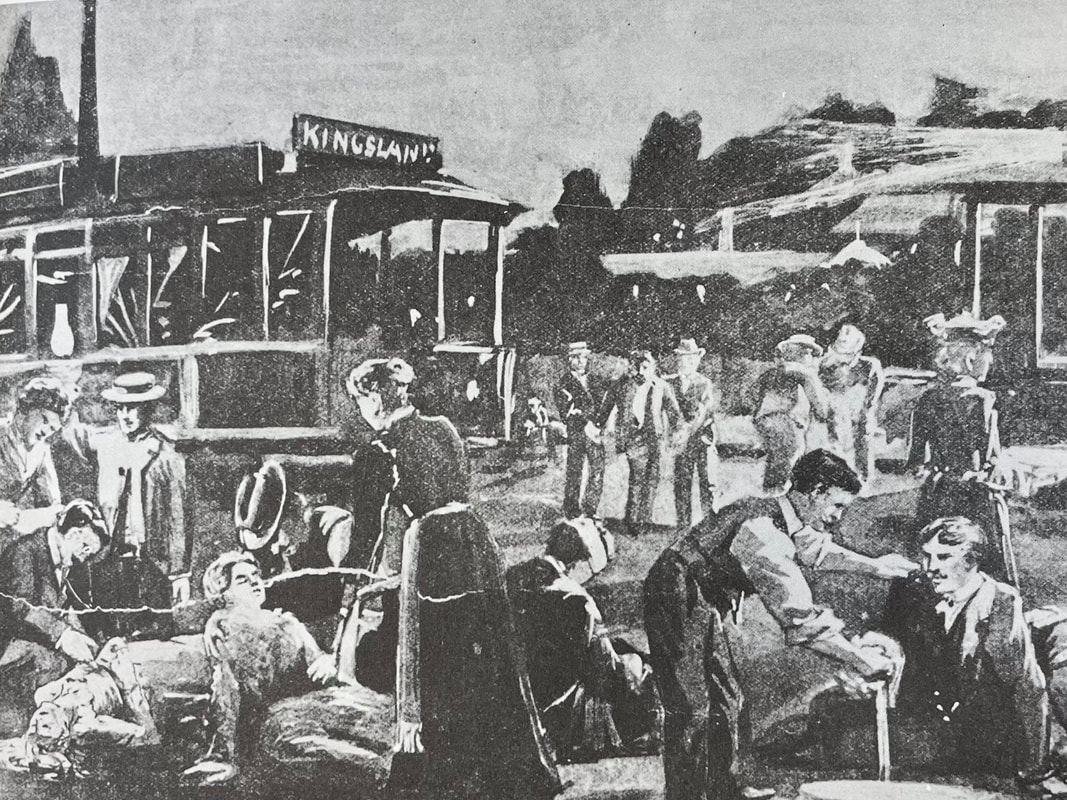
 On Christmas Eve 1903, New North Road in Auckland, was busy.
People were hurrying home, carrying presents, from the numerous sales in the darkening evening, anticipating a holiday. The big trams rolling past were familiar, used by many and indeed, that evening they were packed, with quite a number of people standing. About 8pm, one big double decker tram on the Kingsland line went to stop, to wait as another tram cleared the way. It was headed up Eden Road, but a brake failed and it began to roll backwards, gathering speed as it headed for another tram, coming toward it from Kingsland. Within minutes it reached a speed of 60kmh, the ratchet brake, meant to hold it, had failed. One of the overhead wires snapped, plunging the racing tram into darkness. The driver of the second tram threw it into reverse to lessen the impact but as the two collided, they telescoped into each other. Passengers were thrown around the car and had to smash out windows to climb out. Mt Eden resident Ann Young Hogarth, only 23, a dressmaker, had been travelling on the top deck. When the pole to the overhead wire snapped it whipped around, smashing her in the head and killing her instantly. Benjamin Morrison Lindsay (also listed as Morris Benjamin) and William Caley were crushed between the two cars. One man sitting back in the tram said he could see fire and initially thought the engine had exploded. Among those on the tram were a number of visitors to Auckland - visiting family for the holidays. Over 60 people were injured, some very badly. An inquest found that the ratchet brake had failed. The terrible tragedy cast a pall over Auckland’s holiday season. It led to a loss of faith in the tram system which ended up being phased out. Ann Young is buried at Purewa Cemetery, Benjamin Lindsay is buried at Waikumete Cemetery and William Caley is buried in the Symonds Street Cemetery. This is our last Grave Story post of the year.
0 Comments
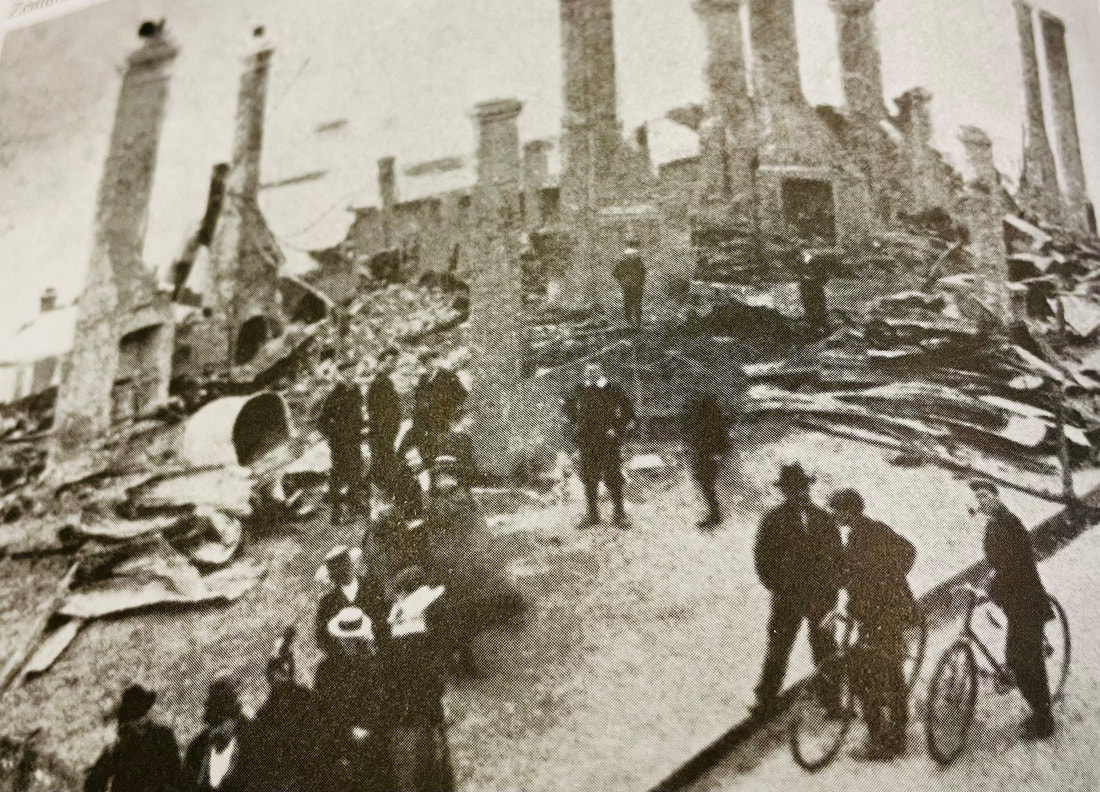 Fire raged across the streets and hillside of Mount Victoria in Wellington on May 30, 1901.
Fuelled by high winds and with the fire brigade hampered by weak water pressure and distance, it began to consume houses. Wellington City Councillor James Joseph Devine watched as it got closer and closer to his home. By the time it was out, he had lost the house and everything in it. Devine was born in 1856 in Tipperary, Ireland to James Devine and Jane Anne Jackson. A lawyer, he opted to head for New Zealand and arrived in Wellington on the Hurunui in 1876. It was 2am when the fire was first noticed at the home of Charles Moore in Hawker Street. It was a tongue of flame from a window seen from the city and the alarm was raised. The fire brigade was on the scene very quickly, but a lack of adequate water and high winds saw the fire spread. Their hose reach was only 20ft (6m) and water pressure was weak. Gale force winds helped the fire spread. The neighbouring houses burst into flames then leapt the street and before long was in Shannon and Moeller Streets. Devine’s Hawker Street house wasn’t right beside the others, but in the end it did not matter. Vegetation caught fire and carried to his large handsome home. Miraculously no one was injured but by the end 22 houses had been destroyed and the fire raged on the hillside for some time. Many of the grand houses, built for the businessmen of the time, were never rebuilt. Devine was elected a member of the Wellington City Council in 1893 and served for many years. He has been president of the Catholic Literary Society, and of the Irish National League, besides filling a great many other positions connected with literary societies in Wellington. He was one of the founding members of the Hibernian Society. Devine, who had married Margaret Stanislaus Augustine White, with whom he had six children, died on August 17, 1910 after a sudden illness. He was taken to hospital and had an operation but never recovered. His funeral was held at St Mary’s of the Angels church. He is buried in Karori Cemetery.  Kiwi kids grew up on Weet-bix. It’s been a staple of our households for decades. Dry biscuits to which you add anything you like and there’s breakfast.
It was Edward Clarence Halsey who helped bring it about. A Seventh-day Adventist, Halsey was born in the United States on November 5, 1869. He trained as a baker under another name you might recognise, Doctor John Kellogg, at the Battle Creek Sanitarium making health foods. Halsey was invited to Australia by a pastor - in part to make granose - or what would become Weet-Bix. He was the first baker employed by the Sanitarium Health Food Company. The Weet-Bix we know today was developed by Bennison Osborne from the granose biscuits Halsey had made. Halsey began working for the Australian Union Conference at Northcote, a suburb of Melbourne. In March 1898, it was reported that they were making Granola, Caramel Cereal, and Nut Butter. He married Sarah Jane Jeannie Mansell (called Jeannie) in 1898 but she died in 1900 after contracting blood poisoning. After losing his wife, Halsey accepted an invitation to transfer with his young son Vernon to Papanui in Christchurch. They left Sydney on December 27, 1900, travelling via Hobart, Tasmania, and Bluff. They arrived at Lyttelton, disembarking on January 11, 1901 where he set himself up in a small building in Papanui. He met and married Alice Louisa Merab Knight in 1902. After working for eight years in Christchurch, Halsey travelled with his son in March 1908 to visit family relatives in the United States, leaving his wife, Alice, in Christchurch. He was away for some nine months. When the Sanitarium Health Food Company built their new factory in 1920 there was no further work for Halsey even though he had developed many of the products that were to be manufactured. Now Weet-Bix is on the shelf in every supermarket in New Zealand. It was also Sanitarium who first imported marmite into New Zealand obtaining the sole rights in 1908. Halsey died on November 5, 1926, of a wasting disease and was buried in Bromley Cemetery, Christchurch.  Mollie the Asian elephant was beloved by the children in the audience of Bullen’s Circus.
The 13-year-old elephant from Thailand was part of one of the biggest Australasian circuses which routinely toured New Zealand. She was known for her ability to stand on her back legs and for being able to do a headstand on her front legs. Mollie was often the star of the big ring. She had been one of five baby elephants bought by Stafford Bullen from Thailand in 1947. Whatever we think of animals performing now, back in the 1950s it was a big business and Mollie and the troupe of eight other performing elephants were huge drawcards. Sadly however, Mollie met her end in New Zealand. While on a walk in Ohakune she broke away from her handler, ate some tutu plant and was immediately poisoned to death. Tutu - coriaria arborea - is widespread and responsible for quite a number of deaths including some of the first livestock brought here by Captain James Cook. All parts of the plant are poisonous except the soft black fleshy petals. It acts on the central nervous system leading to nausea, vomiting, blurred vision, seizures, convulsion, affects breathing and can lead to a comatose state. Deaths from consuming toxic honey (from bees visiting tutu plants) were recorded in the 1800s, but non-fatal poisonings have been more recently reported. There have been 9 cases since 1974 with the last occurring in 1991 in the Eastern Bay of Plenty area and 2008 in the Coromandel. So what do you do with a dead elephant in Ohakune? You bury it of course. Mollie was buried near the main trunk line near the entrance to the Tongariro National Park. A bit later in the year an Auckland University biology technician Derek Challis (who died earlier this year) got permission to exhume the body and removed Mollie’s skull - which is now on display at the McGregor Museum primate display. And many years after Mollie’s death - a plaque, put up by the Raetihi-Ohakune Rotary Club is now at her gravesite. Pic is by artist Raymond McIntyre.  Ah, the beautiful Mackenzie Country, home to skiing, Aoraki/Mount Cook, lakes, glaciers and starry skies.
Named after James Mackenzie, notorious New Zealand outlaw and infamous sheep rustler. Right? Well, sort of. It’s unclear if the man we know as James Mackenzie spelt his name that way, or if it was even his correct name. He was often called Jock, John or James, and sometimes called himself John Douglass, was maybe born in Ross-shire, Scotland (some say Inverness-shire) around 1820 and since he spoke Gaelic fluently and indifferent English, his name might even have been anglicised. Nevertheless, the story of the rogue grew until the truth was inseparable from fiction. Mackenzie himself had once said his family had been well off with his father holding a Crown position but died in Ceylon (now Sri Lanka) leaving his family desperate. So he went to Australia about 1849 and with the help of a cousin bought a team of bullocks and earned money hauling goods to gold fields. He moved on to New Zealand, arriving in Nelson then worked his way through Canterbury to Otago. He is said to have applied for a land licence and while waiting worked as a drover. But in March 1855 he was caught with 1000 sheep from the Levels station of Robert and George Rhodes. The sheep had been tracked through an inland pass to the basin of the upper Waitaki River. Mackenzie denied everything saying he had been hired to drive the sheep to Otago. However he escaped from the hunters and walked the 100 miles to Lyttelton - apparently without shoes - where he was captured He was mostly silent throughout the court case until his faithful Border collie sheepdog Friday was brought into the court. She whined and tried to go to him. He pleaded to be allowed to keep her even if he was imprisoned and warned them she would not work for anyone else. It was refused, and true to Mackenzie’s word, Friday would not herd for anyone. He was promptly found guilty and given five years hard labour on the roads but he escaped twice more. After the last escape attempt he was kept in irons. Then came Henry Tancred, a magistrate in Christchurch who investigated Mackenzie’s case, finding it seriously flawed. So Mackenzie got a pardon. Now most stories end with him getting on a boat to go to Sydney, Australia and was never seen again. But it’s also not quite true. Police Inspector Edward Seager wrote in 1900 that in fact Mackenzie had tried to return to New Zealand but was warned off by police so left again. It was Mackenzie’s rebelliousness and then his pardon that won him folk hero status, including songs being written about him. The legends, about his strength, prowess as a drover and Friday (immortalised by a bronze memorial to working collie dogs on the shores of Lake Tekapo) grew and grew - but it appears no one really knew Mackenzie - or where he might lie now. Photo by Casey Horner 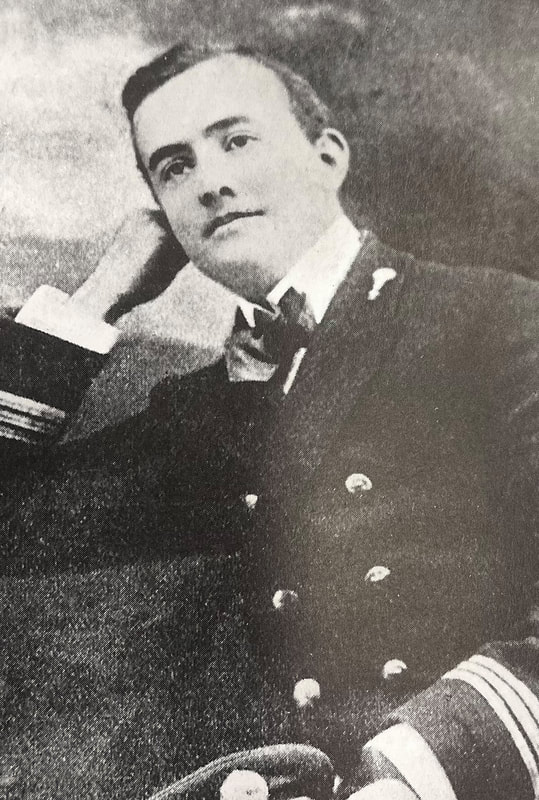 Crowds gathered at Lancaster Park in 1899 to see Captain Charles Lorraine ascend in his balloon.
Captain Lorraine was the stage name of Auckland-born David Mahoney who became transfixed with ballooning while in England in 1892. Mahoney was born April 19, 1874, growing up in Parnell. After schooling he found work at Hoffman’s music factory and developed a love for performing. He moved to Australia then on to England where he got a chance to use a gas filled balloon for the first time. After that Mahoney reinvented himself. He saved the money to buy his own balloon, called himself Captain Lorraine after his ballooning mentor, and on his return to New Zealand in 1899, began making a name for himself as a performing parachutist, dropping from his balloon, called Empress, sometimes as high as 15,000 feet (who on earth could see him up there??) to do gymnastics for the waiting crowds. On November 2, 1899 he can have had no idea that things were going to go so wrong. After all, he had performed the stunts many times before. He had told The Press: “Christchurch is the ideal place for a balloonist, and if the wind does not carry me too far, I am going to try and break my record of 20,000 ft.” He set off about 4pm, his balloon filled with coal gas, soaring high before disaster hit. His parachute came loose and unfurled, becoming unusable. A shocked crowd saw him try to grab hold of it to save his only way back to earth but it fell leaving Lorraine rising on a strong north-west wind and heading out to sea until he was just a black speck to the watching crowds, including his wife Frances (nee Juriss). Desperately he tried to pop the balloon. Lorraine was spotted near Godley Heads before he and the balloon fell into the sea His body was never recovered. He is considered New Zealand’s first aviation fatality. He was only 25 years old. 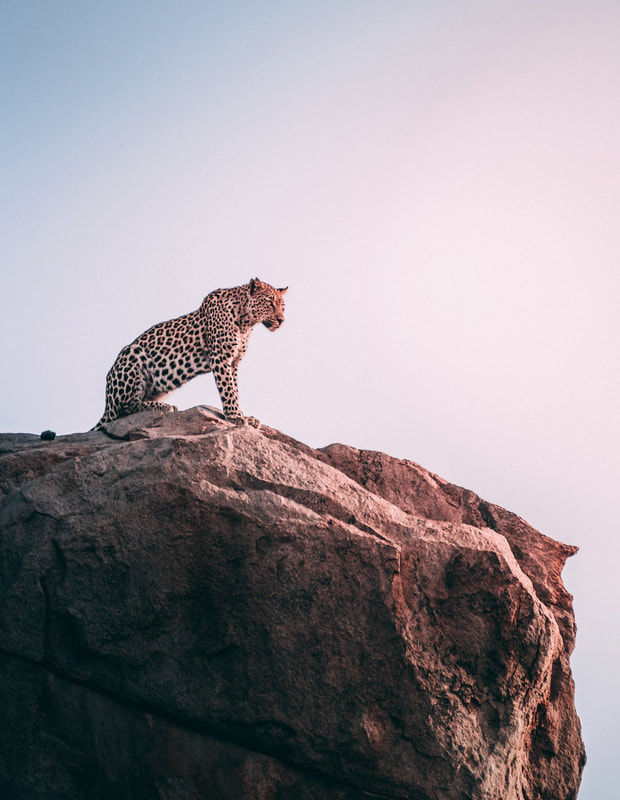 Auckland residents were on high alert in September 1925 after the terrifying news that a female leopard had escaped from the new zoo.
The zoo, at Western Springs, had only been open three years and its first director - and the man behind the animals - was Louis Thomas Griffin. Griffin was born in England in 1871, in Royal Tunbridge Wells. He was an ichthyologist (the study of fish), curator and Egyptologist among other things. He came to New Zealand in 1910. It was also Griffin who in 1923 went to Africa to get animals for the zoo. In his time as curator/director at the zoo he consulted about animals all over New Zealand and was brought odd animals to identify, including what was termed a sea serpent - that turned out to be a Great Oarfish. The female leopard had come from India and had only been at the zoo for three days when keepers noticed her enclosure was empty on September 16. The theory was she had slipped through her bars and out into Auckland without anyone noticing. For 27 days people kept their doors and windows shut, did not walk alone, and were regaled with tales of sightings around St Luke’s. Several people saw it but could not get near it. Worried, and alert to recent reports in newspapers of the day of man-eating leopards from the wilds of Africa, the council offered a £20 reward. It was on October 11 that it all came to an end when four young men out fishing found her, floating and drowned off Karaka Bay beach in Glendowie. It was Griffin who said he thought she may have been stuck in the mud behind a tannery and caught by the rising tide. An investigation into the escape by Internal Affairs showed the bars were mostly 11.4cm apart but in one small area they were 12.7cm. Along with that an inquest was held for the big cat with the finding that it drowned. Exactly how it escaped is still a mystery. It was by no means the only escape from the zoo in the first years. Along with the leopard, a Tasmanian Devil was lost, an agouti and a young sea lion - not nearly as scary. Griffin, who was also the assistant director of the Auckland War memorial museum director died in 1935 and is buried in Purewa Cemetery. Pic by Geran De Klerk. 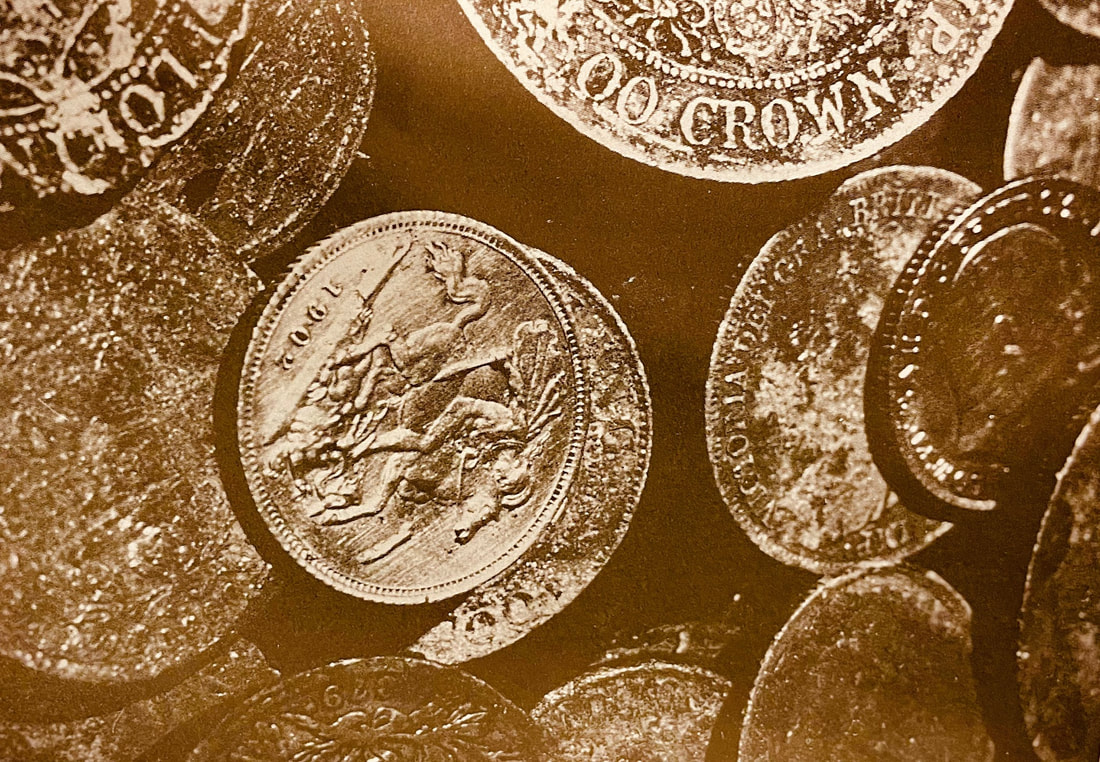 Edward Harper was looking for gold.
Specifically he was looking for a fortune in gold coins that went to the bottom of the sea when the cargo and passenger steamer the SS Elingamite sank in 1902. The 2.5 tonne Australian steamer started service in Sydney in 1887. With 100 first class berths and a top speed of 11 knots, she was popular and the Victorian government picked her to be an armed cruiser, loading her up with four Armstrong guns. Early on November 5, 1902, the Elingamite left Sydney for its regular run to Auckland with 136 passengers and 58 crew. On board were 52 boxes of coins for New Zealand banks including 6000 gold half-sovereigns. On November 9 the ship ran into thick fog. Despite the care of Captain Ernest Atwood, creeping along at half speed, the ship struck West Island, one of the islands in the Three Kings group about 65 km off New Zealand. The ship foundered and sank in only 20 minutes. Most aboard managed to get to lifeboats, some making it to islands while others made the mainland. One boat however was never seen again. In total 45 people were killed. Captain Atwood was found guilty of grossly negligent navigation at a court of inquiry, and his master's certificate was suspended. It was only eight years later that it became known that the map showing the Three Islands he was relying on was wrong. The location of the wreck of the ship was well known and there were attempts to recover the gold from it over the years, even by famous showman Felix Tanner who we have already written about. One of the first recovery efforts was in 1907 when Edward James Harper dived on the Elingamite. Harper was born in London and became a well known diver, completing many salvage missions all over the world. Diving off the schooner the Huia, Harper went down several times, bringing up £1500 in coins, some of it gold. He brought up more over several days but on his last dive on January 22 he complained of chest pains and collapsed, dying of what was thought to be a heart attack (but may have been decompression sickness). He would be the 46th death attributed to the Elingamite but not the last. A year later a Mr Clarke died having dived three times and complaining of cramp in his legs and arms. Further salvage operations continued over the years, including, in 1965, efforts by Kelly Tarlton (from Underwater World fame) and Wade Doak, a famous marine conservationist, along with two others, who began the first of many expeditions to recover what they could. But much was left behind. The wreck is now privately owned. Harper is buried in Northland’s Leigh Cemetery.  Convicted killer Frederick Patrick Mouat was careful to stipulate in his will that his body be buried after his death. He showed no such care to his wife when he killed her, dismembered her body in the bath and incinerated the pieces in the garden of their Christchurch home in 1925.
Frederick, a mining engineer and hotel keeper, was skint, and when his wife Nellie began to question where all their money went, she disappeared. Frederick was born in Purakanui, near Dunedin in 1878. He was one of the youngest of a long line of children born to Peter William Mouat, a settler from the Shetland Islands, and his wife Maria nee Driver. As a young man Frederick headed to the West Coast where his older brother William, was an engineer. He found employment at the Garden Gully Mine, but soon decided more was to be made in the mines in West Africa. By 1907 Frederick had emigrated to England and was working stints in a gold mine near Seccondee, Ghana. In 1910 he married Ellen Louisa Merrett (known as Nellie) in Catherington, Hampshire, England. Nellie was also a New Zealander. She was born in Turakina, near Wanganui in 1886, the youngest daughter of George Merrett and Phillis (nee Whittington). After the wedding Frederick returned to the mines in Ghana and Nellie, after a short time in England, returned home to New Zealand. Shortly after, Frederick joined her and convinced her to go back to Ghana with him. By 1922 the couple decided to come back to New Zealand permanently and they settled in the small town of Glenavy, on the banks of the Waitaki River and bought the Glenavy Hotel. After a year, they sold up and moved to 10 Beckford Street, St Martin’s, Christchurch under a rent to buy arrangement. But by February 1925 their money was running out. Frederick had some work on a drainage project, but it was not enough to cover their spending. On February 19 the Mouat’s landlady called around to pick up the mortgage cheque, which Frederick later admitted he had told Nellie would have bounced. They then went to visit some friends returning home later that night. It was the last time Nellie was seen. The following day Frederick told neighbours that she had gone to visit her brother and would then travel with him to Dunedin to visit his mother. However, Frederick never left. Instead, neighbours noticed fires in the garden and smoke from the Mouat’s kitchen chimney. When Frederick was questioned about Nellie’s whereabouts, he first said she had gone away on holiday and then later said he did not know where she was. But Frederick did not report her missing. That was left to Nellie’s brother John who contacted police on March 2. Police made a search of the Beckford Street house and property and discovered her hand bag, false teeth and all her clothing was still there. They dredged the nearby Heathcote River and dug through the ashes of the fires – locating small pieces of bone. Frederick was interviewed by police, but allowed to go free on the condition he return to the police station the next day. He didn’t, and like his wife, just disappeared. On March 9, dishevelled and hungry, Frederick was arrested. He had been sleeping rough in the Port Hills. He was charged with Nellie’s murder and the following day made his first appearance in court. Mouat’s first trial was held in April. The evidence seemed overwhelming. The jury were told: that many of the bones uncovered in the ash were human; that Mouat had pawned Nellie’s jewellery the day after she disappeared telling the pawnbroker that he had no use for the items; that blood and flesh was found under the rim of the bath; that blood was found on blankets and sheets from the bed and that blood was found congealed in the drain under the bath. But the jury could not agree. A second trial was held on August 24 and this time he was found guilty of the lesser charge of manslaughter – the defence counsel had given the jury a stern warning that if Nellie turned up alive Frederick would have hanged for nothing. The sentencing judge appeared to have no qualms over Frederick’s guilt, sentencing him to 17 years in prison, with hard labour. An inquest into Nellie’s death was not held – the coroner decided that the bones did not constitute a body, so her death was never officially recorded. In 1929, Frederick petitioned Parliament to quash his conviction – it was refused. Frederick was released from prison on August 10, 1937. He moved to Glenfield in Auckland where he took a job as a fitter and turner. Frederick died on October 18, 1959 and is buried in Birkenhead Cemetery - as per the instructions in his will. The bone fragments ended up at the Police Museum and in 2017 the mystery of what really happened to Nellie Mouat was finally solved. Forensic testing by Otago University confirmed that the bones were in fact Nellie’s mortal remains. The bones were buried with her parents in Linwood Cemetery 92 years after her brutal death. Photo: New Zealand Police Gazette  Alexander Aitken’s phenomenal memory was both his biggest asset and his greatest horror.
He was able to do complex maths in his head, recite Pi up to 707 places and is still considered one of the fastest lightning calculators in the world. But because of his memory, he also couldn’t forget his wartime experiences. Alexander Craig Aitken - called Alec, was born April 1, 1895 in Dunedin, the oldest of the seven children of Elizabeth Towers and William Aitken. His grandfather had emigrated from Lanarkshire in Scotland in 1868. Aitken freely admitted arithmetic bored him, and he wasn’t any good at it at school until suddenly at the age of 14 at Otago Boys’ High, something clicked when he had one of those teachers who inspire us. He began practising mental calculation from memory, training himself. He was the school dux and won the Thomas Baker Calculus Scholarship in his last year at school. Aitken went on to the University of Otago but his studies were cut off when he enlisted in 1915 for the First World War. He left with the Sixth Regiment, Otago Infantry. He saw a great deal of combat, serving at the Gallipoli landing, and in Egypt and then in the Battle of the Somme in France. He often astounded his fellow soldiers with his memory, and when the platoon book was destroyed, he was able to recite the names and numbers of all the members of his platoon. He was also remembered for playing the violin he had been gifted by a friend who won it in a raffle. Many nights in the muddy trenches he played. It was at the Battle of the Somme that he was seriously wounded and spent three months in Chelsea before being invalided out. He returned to New Zealand where he completed a degree at Otago then was briefly a teacher. His next stop was the University of Edinburgh and was elected a Fellow of the Royal Society of Edinburgh. His mathematical lectures were unusual. A bit of clear lecturing, five minutes of jokes and five minutes of tricks. Aitken spent his entire career at Edinburgh working in statistics, numerical analysis and algebra - with a break during World War Two when he worked at Bletchley Park decrypting the Enigma Code. In psychological tests in Britain he took thirty seconds to multiply 987,654,321 by 123,456,789 and produce the correct answer: 121,932,631,112,635,269. Aitken married Mary Winifred Betts - herself astonishing as a lecturer in biology and the first female lecturer appointed at the Otago University. They had a son and daughter. His skill at mental arithmetic was such he is still considered the greatest ever living lightning calculator. An accomplished author he wrote a book, Gallipoli to the Somme - his wartime memoirs. But he was never, thanks to his memory, never able to escape his memories of the war. They never faded for him like they did for some others. His memory made his career but it also meant his wartime experiences haunted him for the rest of his life until his death in Edinburgh, Scotland, on November 3, 1967, aged 72. He was cremated at Warriston Crematorium in Edinburgh. |
AuthorFran and Deb's updates Archives
September 2025
Categories |
 RSS Feed