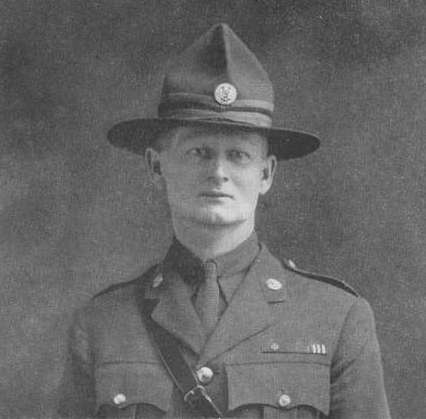
 In the space of a few weeks, one Kiwi soldier won three medals for bravery.
Reginald Stanley Judson was a boilermaker in Auckland in 1914 when war broke out and he went to enlist and was overseas in 1916, going to Egypt. Judson was born in Wharehine, Northland, New Zealand to Edgar and Emma on September 29, 1881 and trained as a mechanical engineer and worked as a boiler maker. He married Ethel May Grice at Mareretu, Northland in 1905 and they had four children. Judson served with the New Zealand Rifle Brigade and the Auckland Infantry Regiment in France but was wounded severely early on and was evacuated to England to recover. He did not return to the front until May 1918. Now a sergeant, in July he led an attack on the enemy positions at Hébuterne, a village in north France during which he rescued six men. For that he was given the Distinguished Conduct Medal. On August 16 he led a bayonet charge against a machine gun post earning the military medal. Only 10 days later he went on a series of raids on German trenches, at one oint he climbed a parapet and ordered an enemy machine gun crew of about 12 to surrender. When they fired on him he threw in a hand grenade, killed two and captured the machine gun. He was awarded the Victoria Cross. The citation said his prompt and gallant action not only saved many lives but also enabled the advance to continue unopposed. Judson had won all three medals within 33 days. He was the victim of a gas attack a month or so later and was sent to recover. He then went to officer training. He returned to New Zealand in 1919 and was discharged before enlisting in the New Zealand Staff Corps serving in Auckland and New Plymouth. After a divorce from Ethel he married Kate Marion Lewis and had a daughter. He suffered from ill health due to wounds suffered during the war - he had shrapnel lodged in his chest and abdomen - and retired from the army - going on to work at Mount Albert Grammar and tried his hand at local politics, serving on the Auckland City Council as a Citizens’ and Ratepayers’ Association councillor. He re-enlisted at the outbreak of World War Two by falsifying his date of birth and served at home. At the end of the war he moved to Mangonui in Northland to farm - working also as a justice of the peace and a coroner, retiring in the 1950s to Kohimarama in Auckland. He died on August 26, 1972 and was buried at Waikumete cemetery.
0 Comments
Leave a Reply. |
AuthorFran and Deb's updates Archives
September 2025
Categories |
 RSS Feed