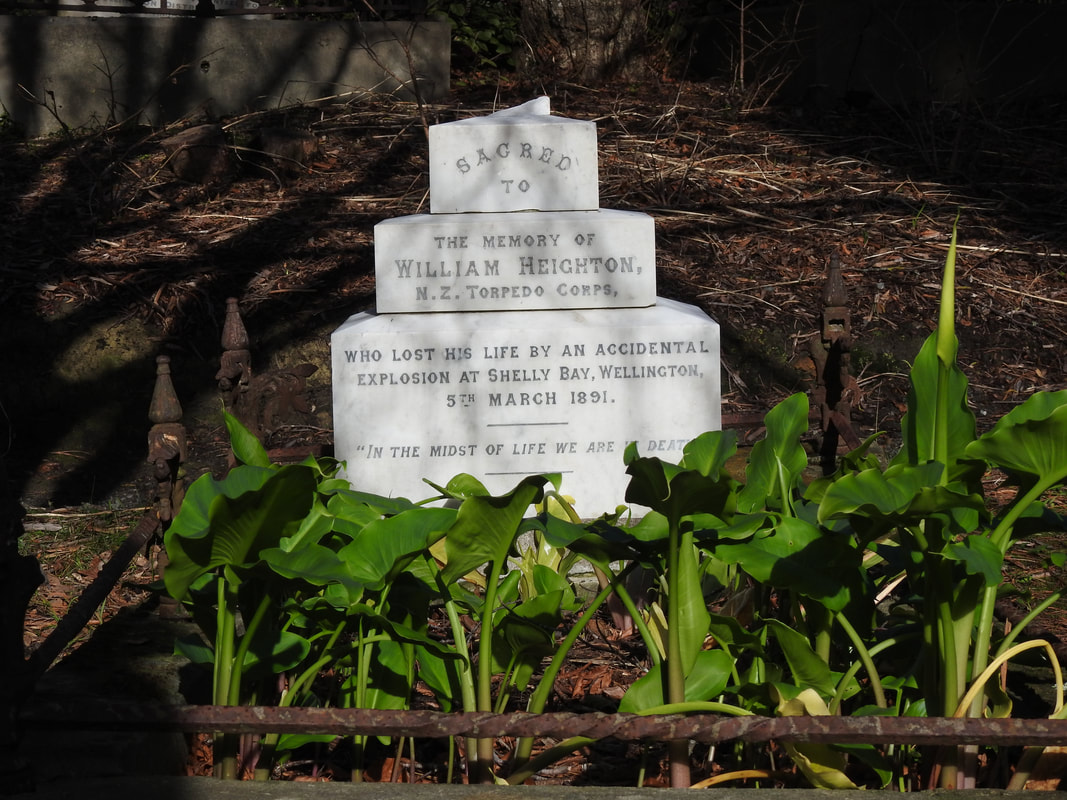
 A lot has been reported lately about Wellington’s Shelly Bay thanks to a planned controversial residential development on an old military base, but 130 years ago it was in the news for a much more tragic reason. On March 5, 1891, five members of the NZ Torpedo Corps, which was stationed at the base, were blown up in an explosion during routine filling of torpedo shells. Two of them, first class torpedomen Walter Horrocks Heighton (aka William Ross), 35, and William Densem, 22, died from their injuries the day after the accident. The other three, first class torpedoman George Neilson Goldie, 23, and second class torpedomen Samuel Wheatly McCallum, 24, and Frederick William Cornwall, 24, were badly injured. An inquest into the deaths of the men was launched with the spotlight of blame initially falling on Heighton, who was described by one witness as an “inveterate smoker” who might have been enjoying a pipe while he and Cornwall were filling and soldering the shells. The blame, however, soon shifted to the corps’ leader Captain John Falconer, a veteran of the Royal Engineers and a trained instructor in submarine mining. Evidence was presented that in 1886, five years before the explosion, the War Office had issued a circular prohibiting the use of soldering irons in the type of work the men were doing. One witness said he had received a copy of the circular from Captain Falconer, however, the Captain said he knew nothing of it and was not even in the country at the time. While the inquest was in process, the government announced its own enquiry into the explosion to be conducted at the same time. After sitting for more than six weeks the inquest concluded on April 21 the jury finding a verdict of accidental death, but adding three riders; that the shell manufacturing process was updated, that the instructors at the base get training, and that Captain Falconer was not to blame. Despite the jury’s rider, the following day Heighton’s widow Eliza filed a private prosecution against Captain Falconer charging him with manslaughter. The charges were, however, dropped two days later after her lawyer explained that she had no evidence. The government inquiry also cleared Falconer of blame, but criticised the laxity of the Defence Department in making sure the orders about use of soldering irons were circulated to all concerned. Goldie and McCallum recovered completely from their injuries however, Cornwall was left permanently maimed. He was discharged from the Torpedo Corps as being medically unfit and was given an allowance of 10 shillings a week – a far cry from the 7 shillings a day he received before. The following year Cornwall wrote to the government to ask for an increase. In his letter he said his future had been ruined through no fault of his own. “As it is now, I, at the age of 25, am ruined for life – unable to earn my living in any way.” It is unclear if the amount was increased. Cornwall returned to his parents’ home in Taranaki, where he took up breeding Jersey cows becoming a noted expert. He never married and died in 1935. Goldie married, became a father and an electrician. He died in Port Chalmers in 1933. McCallum became a master mariner. He married and had several children. He died in Devonport, Auckland in 1945. Heighton is buried in Bolton Street Cemetery. He left a wife and four children. William Densem is buried with his parents in Port Chalmers Cemetery. 
0 Comments
Leave a Reply. |
AuthorFran and Deb's updates Archives
September 2025
Categories |
 RSS Feed