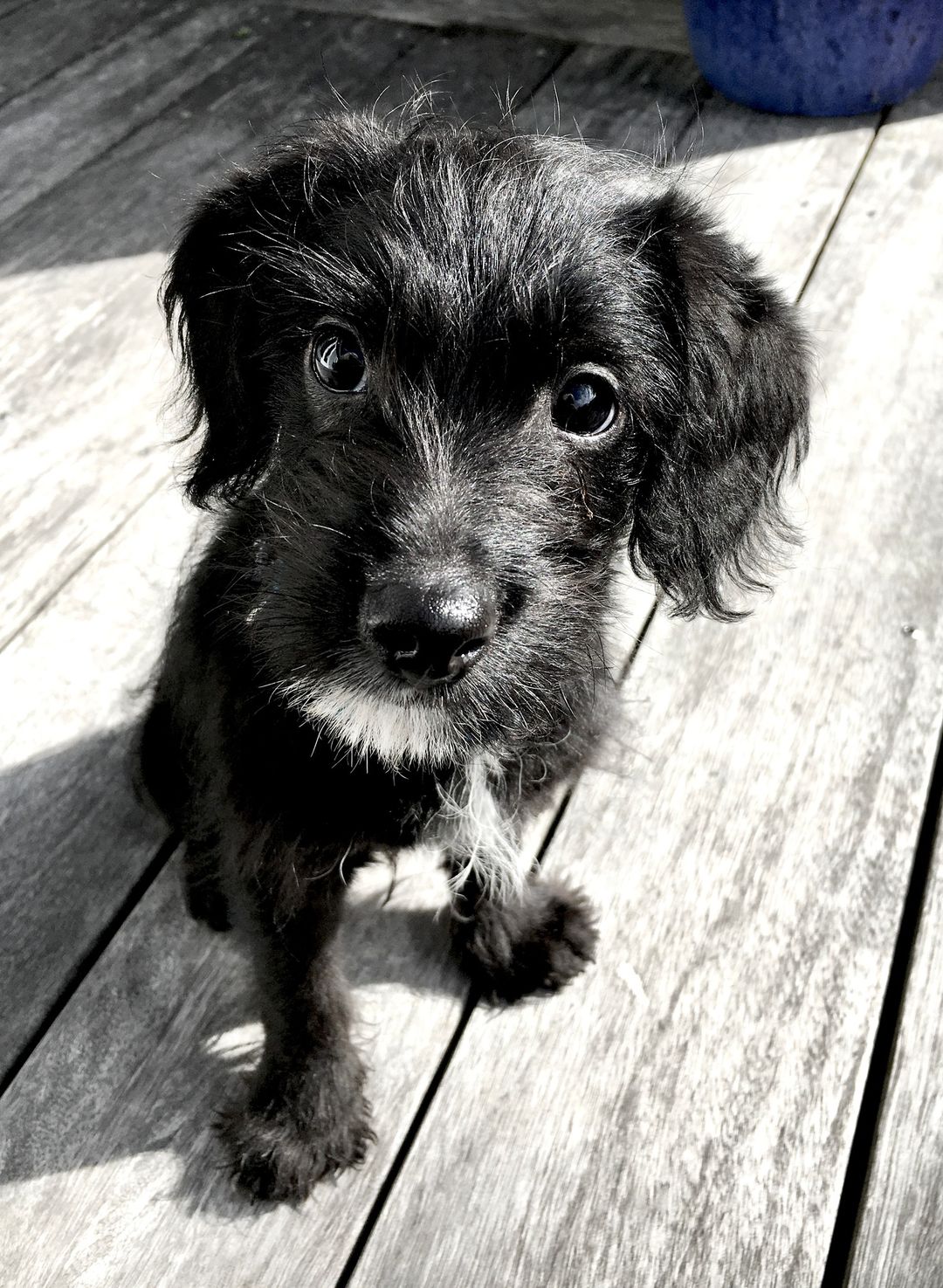
 We are taking a break in our regularly scheduled Grave Stories for you to meet Cricket, the newest addition to the Genealogy Investigations team.
This delightful little scrap is a Foodle. (Don’t look at me like that, apparently that's what they are called.) So in the best tradition of our posts we are going to do a little research on Cricket’s history. So a Foodle is a cross between a poodle and a fox terrier. Cricket was born in Waipawa 11 weeks ago. His mother was a poodle and his father a fox terrier. We all know the traditional image of a poodle - with its odd haircut. Originating in France (or Germany depending on who you believe) the standard - large - poodle was a hunting dog bred to retrieve birds from water. Evidence to support the German origin story is that the name Poodle likely came from the German word puddeln - meaning to splash. That distinctive hair cut - called the lion or continental cut - was to provide warmth to the vital organs on the chest and body - and to streamline the hindquarters in the water. The smaller versions of the poodle were bred from the larger. The fox terrier originated in England, bred from different types of terriers. This sturdy little dog was bred for hunting, often used along with fox hounds. The terrier would drive the fox from its den before the fox hounds took over the chase. Cricket has some manners to learn and some training before he can be our full time office assistant but he will also be helping us sniff out Grave Stories. We’ll keep you up to date with Cricket’s adventures.
1 Comment
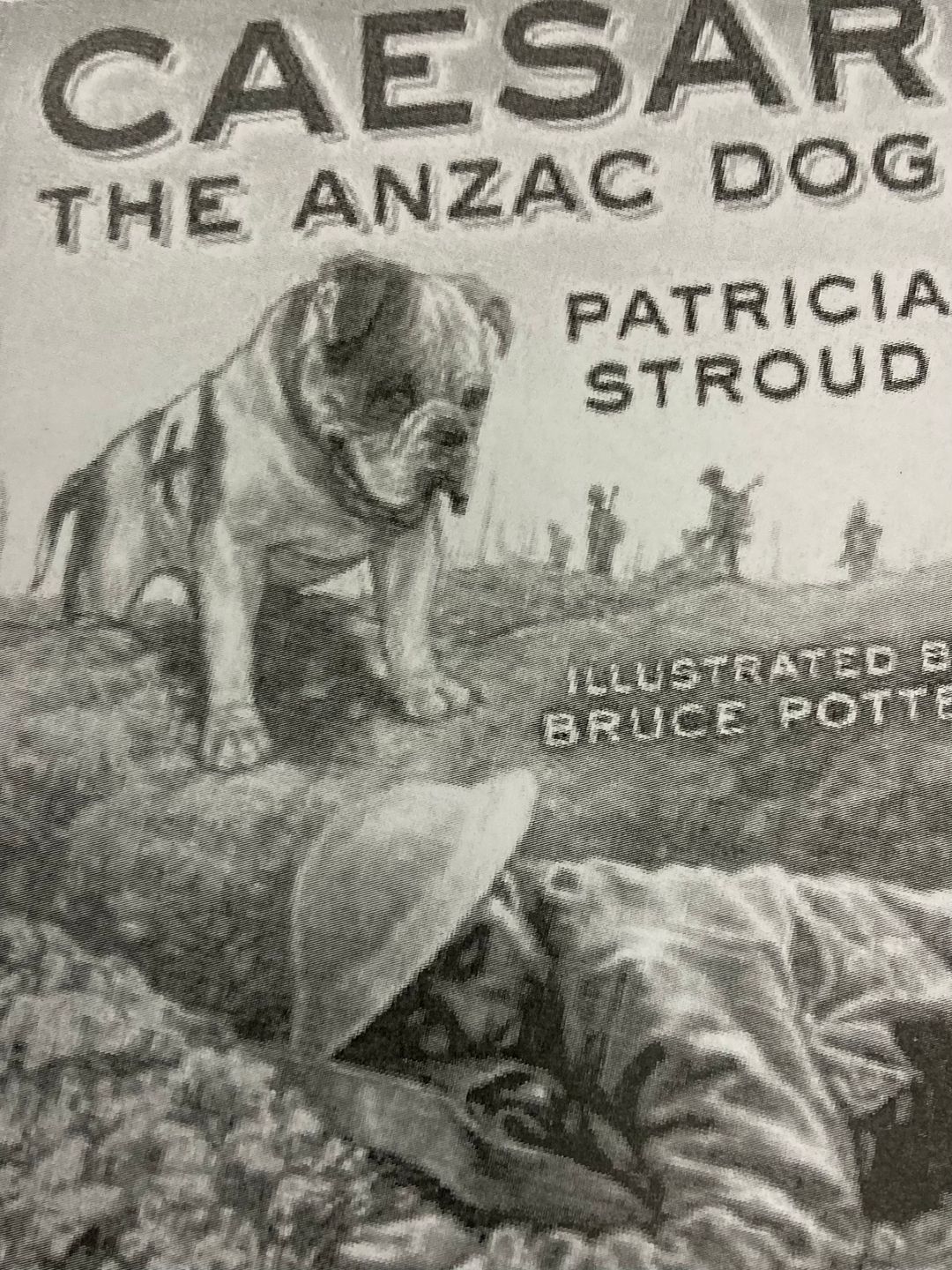 For Anzac weekend we are bringing you a very special story.
Not all war heroes were men or women. Dogs play a huge part in war. Not only the detection dogs of today, but in the past as guards and sentries, messengers, pulling gun carts and hauling ammunition. Mascots, too, were beloved, adding incalculable benefit to those who cared for them. Thomas Samuel Tooman was born on June 15, 1886, in Remuera, Auckland to Samuel and Catherine Tooman (nee Cassidy). Like a lot of men of his generation, when World War One broke out he enlisted, leaving on February 16, as a rifleman with the New Zealand Rifle Brigade. He had already met the buddy who would define his war service. Just before he left, he and bulldog Caesar took part in a parade up Auckland’s Queen Street. Watching in the rain was his niece Ida who would get his letters about Caesar. She tied her hair ribbon around Caesar’s neck as she said goodbye. Caesar was the bulldog mascot of 'A' company, 4th Battalion, New Zealand Rifle Brigade. Trained as a Red Cross dog, he would look for wounded soldiers on the battlefields. Tooman was an ambulance driver. With their amazing sense of smell, dogs were trained to only look for living soldiers. Caesar’s first training area was Egypt and he could differentiate between allied and enemy uniforms so they did not lead searchers to possibly armed enemies. The dogs also learnt to not bark, as they might give their locations away to snipers, and to wear gas masks fitted to their faces to prepare them for possible chemical attack. The dogs carried medical supplies, like bandages and water and sometimes writing supplies on a harness. If a soldier was lightly injured, he could use the bandages to patch himself up and the dog would guide him back to the trenches. Caesar was also trained to take a piece of a soldier's kit if he was unconscious, to bring back to show the rescue party, such as a cap or piece of torn clothing as evidence. Caesar’s first battlefield was the horror of The Somme. There were many Red Cross dogs kept at the New Zealand Headquarters. Many soldiers were utilised as stretcher bearers. Injured soldiers would be sent to the nearest Casualty Clearing Station, where doctors and nurses would be on hand to help patch them up as best they could. It was where Tooman and Caesar met the dog’s favourite nurse, Kath Butcher. The Somme would have been as different from Egypt as it was possible to get. Muddy, barbed wire scattered about and the craters left by shells, it was a hellscape. Caesar was personally responsible for locating many men who were wounded on the Somme battlefield, many of whom would not have survived without his help. One night Caesar did not return, and in daylight Tooman went looking for him. He was found, shot through the chest in No Man's Land, presumably by a sniper alongside a New Zealand soldier who had died with his hand resting on Caesar's head. Caesar was buried with the soldier he had found and with others, near the Casualty Clearing Station. His death was reported in New Zealand papers. Tooman was understandably very upset, but went on. After being severely gassed in battle, he recovered with the help of Kate Edith Butcher, the Volunteer Aid Detachment Nurse who he had met in France and later married. She had been serving as a British Red Cross nurse who fed and made a fuss of Caesar at a nursing station. They hung a portrait of Caesar in their dining room when they returned to New Zealand. Tom’s letters to his niece Ida told stories of Caesar and Ida told them to her daughter Patricia Stroud who published the book Caesar the Anzac Dog which can be found online although it is out of print. But wonderfully there is a recording of the story at the Torpedo Bay Naval Museum: https://navymuseum.co.nz/news/caesar-the-anzac-dog/ (Warning, it will make you cry). In 2019 the Defence Force named its new working dog facility after Caesar. Tooman died on November 7, 1956 and is buried in Waikaraka Cemetery in Auckland.  Arthur Blatch was wanted for murder.
In 1893, the house of Alfred Welch in Colchester, England, burnt down. Welch was found in the rubble with his throat cut and his skull fractured. Evidence pointed strongly at a man called Arthur Blatch - but he was never arrested or charged. Blatch had been a porter for Welch. Over £100 was missing. And so was Blatch. There were rumours he was in New Zealand but there was never any evidence. Then in 1900 police announced they had caught Arthur Blatch in Wellington near the Duke of Edinburgh hotel. He was taken before a court and charged with the murder of Welch. The court had to decide whether to send him back to England to face the charge. But there was a problem. Was he really Arthur Blatch? He claimed to be Charles Lillywhite - an American. And he said he could prove it. He had personal papers and letters in the name of Lillywhite. His fiancee was produced who said he was Lillywhite. Another man, who had known Blatch in England - but hadn’t seen him for 10 years - said he was Blatch. One witness, who started out compelling, was George Hewson who had known Blatch well, but then he mentioned he was now blind and he could certainly not see the man in the dock across the courtroom. There were several remands and Blatch/Lillywhite spent Christmas in jail without any resolution. Two visitors, one a police officer from Colchester, were brought to the court in 1901 - they were initially unable to identify the man as Blatch but then changed their minds and agreed he was. Despite some misgivings, the judge decided to send him to England for it to be sorted out. The man’s lawyer then did something a bit unusual. He filed for habeas corpus - a legal term meaning literally - produce the body - which challenges the right of the state to hold him. Before it even began, the man received more letters from America, calling him Lillywhite, from Tacoma, Washington in America. A Supreme Court hearing could not decide - there were two judges and they disagreed. It was then Blatch/Lillywhite agreed to be extradited and he left New Zealand under guard by a police officer. Blatch had a wife in England, who told police her husband had drowned. Blatch/Lillywhite arrived in England and a manhunt began for anyone who had known Blatch but in court hearings 40 people who had known him could not identify the man in the dock. In an even weirder turn of events, Isaac Lillywhite - the supposed man’s brother couldn’t pick him out of a line-up of 18 others. It took a while but finally he was declared to be Lillywhite. He was given £600 in compensation. Which leaves only one question. Was Arthur Blatch the man who killed Alfred Welch? Now normally we finish with a grave - but both Blatch and Lillywhite have now passed unnoticed into history although we know that Lillywhite returned to Tacoma where he died. So for the sake of completeness, Charles Robert Broberg - who was one of the police officers who arrested Lillywhite - went on to be a high ranking officer - he died on November 20, 1937 and is buried in Karori Cemetery. 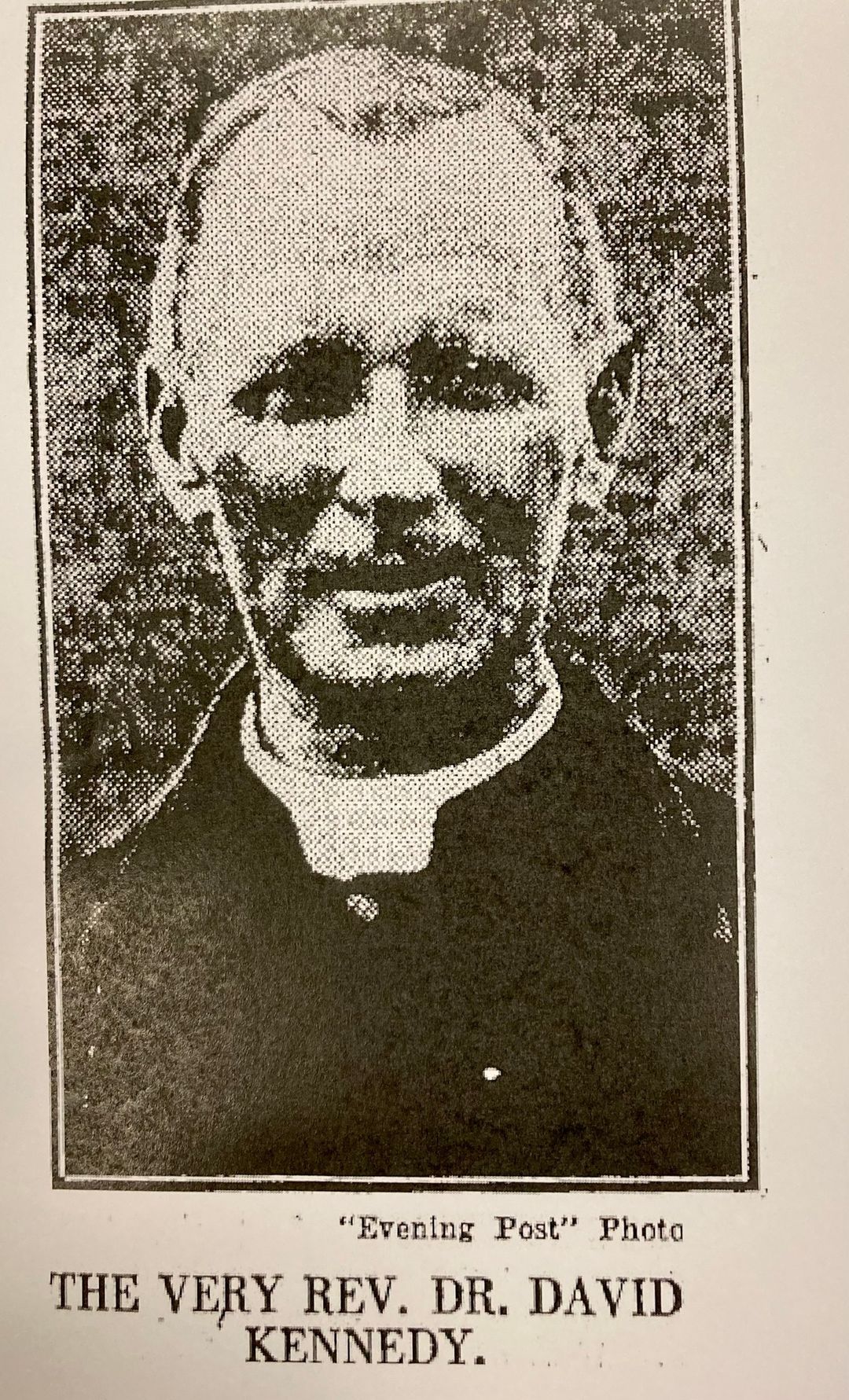 Meeanee is a pretty suburb part-way between Napier and Hastings.
It still has many historic sites, including the picturesque Anglican church St Thomas’ built by one of New Zealand's greatest church builders. But once upon the time it was home to the most advanced observatory in New Zealand. David Kennedy was born in Lyttelton on April 27, 1864 to Duncan Kennedy and Mary McCarthy - known as Bridget. They came to New Zealand in 1863 from Melbourne. The family lived in Christchurch where David became interested in theology and science. He went to study at the St Mary’s College at Dundalk in Ireland, then entered the novitiate and obtained a degree in mathematics and science. David taught and published for several years before being ordained into the priesthood in 1891. He came back to New Zealand in 1893 to the seminary opened by the Marists at Meeanee. David's main interest was astronomy and he began an observatory with a six-inch telescope funded by royalties from books he had written. This was sold in 1905 and he started an appeal to build a bigger one, which used a nine-inch telescope. In 1907, at Meeanee, the new observatory was opened. It had a revolving iron dome with a photo visual refracting telescope and a spectroscope, making it the best equipped in the country. The odd domed-shaped building was also a source of fascination. It was from here he studied Comet Daniel after it was discovered in 1909 - making a unique appearance from deep space. The first photos he took were of the comet. He was also the first person in the world to take photos of Halley's Comet on its return in 1910. Halley's comet, which returns every 75-76 years, was a source of great superstition and fear, with its appearance supposed to herald doom for the Earth. His photos were considered extraordinary and were published around the world. Kennedy also took photos of the Milky Way, Sun, Moon and the Southern Cross. In 1911, he moved the observatory to Greenmeadows but sadly it was destroyed in a storm in 1912. The telescope - called the Thomas Cooke telescope after its maker - was sold in 1923 to the Wellington City Council. It is now in the Carter Observatory in Wellington. For his efforts in photographing Halley's Comet, Dr David Kennedy was made a fellow of the Royal Astronomical Society based in London. Between 1909 and 1917 he was rector at St Patrick’s in Wellington then until 1920 in Greenmeadows. However there were no funds to rebuild the observatory. Under him, the seminary became an official meteorological station. Kennedy was an admired educator, cellist and scientist. He died, aged 72, in Palmerston North on March 10, 1936 and is buried at Karori Cemetery.  Robert McDougall thankfully didn’t live to see New Zealand’s most mysterious art theft.
But it was from the gallery in Christchurch that bears his name that an astonishing mystery took place. McDougall was born in Melbourne on December 27, 1860, and came to New Zealand as a three-year-old. After his education he became a junior clerk at the Colonial Bank of New Zealand in 1875, but his longest job was as manager of Aulsebrooks biscuit factory in Christchurch. HIs father had been brought in as a partner which lasted for two years. Later he bought an interest in the factory for Robert and in 1889 founder John Aulsebrook sold it to Robert. Robert was also director of the Kaiapoi Woollen Mill, a founder of the Christchurch golf club and had a great interest in many philanthropic ventures in the city. He married Malvina Mary Webb in 1897. Robert had a particular interest in art and he gave £26,000 (his obituary says £30,000) to build a gallery that is now named after him, the Robert McDougall Art Gallery in the Botanic Gardens. He died on February 21, 1942 - just months before his gallery made headlines for all the wrong reasons. The gallery was showing a near life-sized oil painting called Psyche by famous British painter Solomon Joseph Solomon. It had been brought to New Zealand in 1907 for an international exhibition. It had been bought for £440 and gifted to the gallery. Then overnight on June 22, 1942 the painting vanished. A skylight was broken in and the thief or thieves removed the canvas stretcher from the frame and then the painting removed from the stretcher. For months police investigated, but the painting has never been recovered or even seen. There had been a theory that a cleaner might have damaged the painting accidentally and removed it to prevent it being found out. But the truth is, no one really knows. Robert, who is remembered as one of Christchurch's most generous benefactors, is buried in Linwood Cemetery. Photo from The Press, 1942. Do you know what happened to the painting? Let us know:  Annie Aves must be one of the only people in New Zealand who was tried four times for the same crimes. And never ended up with a conviction.
To put it bluntly, she was an abortionist in a time when such women were reviled. Isabel Annie Michaelsen was born in Waipawa on March 18, 1887 to Danish-born Harald Michaelsen and his Scottish wife Kate Layton Fraser. Harald however killed himself when Annie was only three months old and Kate died three years later. Annie ended up being raised by storeman John Sinclair and his wife Annie Davis. After a short few years of schooling she left and became a domestic servant. At age 20, she married a man more than twice her age, 42-year-old grape-grower John Oliver Craike and they had three children in quick succession. Annie was separated from him by the mid-1920’s and she was supporting her small family as a cook. It’s unsure when she began working as an abortionist or where she learned it, but by the time she married Charles James Aves in 1932, she already had a reputation as the woman to go to. Annie set up house in Fitzroy Avenue in Hastings and women came from as far away as Wellington. Annie did not exactly hide her services. She believed the man responsible for the pregnancy should pay and she would issue IOUs to them and employ solicitors to chase those who reneged, disguising the fee as a loan repayment. And she was successful - in one 18-month period she had 183 clients and earned £2200. The police couldn’t ignore that - they raided her home in June 1936 and found 22 sets of foetal remains buried in her garden. But their evidence wasn’t strong. There were others living at the house and they never found the implement she used - a sea-tangle net. Complicating it was the fact that though some women would give evidence against her, they were considered accomplices to the crime. Barrister Cyril Geoffrey Edmund Harker defended her on the charge of unlawfully using an instrument to procure an abortion and the first jury was unable to agree. A retrial was ordered and the trial moved to Wellington. That led to two more trials - with no result in either. The final trial over five women in 1937 also returned no verdict but the judge nevertheless ordered her to report to the police twice weekly - although it’s unclear what good that would have done. Every one of her trials had an all male jury. After her husband died later that year Annie moved to Westshore in Napier and of course, continued her craft. But, it would all go horribly wrong. After a young woman came to her for an abortion and became seriously ill, the woman's partner Colin Hercock took a gun, knocked on Annie’s door and shot her. She died the next day, on October 3, 1938, in hospital. Hercock himself was tried, convicted of manslaughter and got a 12-year sentence, reduced on appeal to seven. Evidence of how widely Annie was regarded came at her funeral, with a lengthy procession which followed her hearse and the crowd who gathered at Hastings cemetery where she is buried. The photo is taken outside the house she was shot in and shows police investigating. From the Poverty Bay Herald. Wellington aviation pioneer Arthur Waldemar Schaef was pipped at the post on becoming the first person in New Zealand to fly and went to his grave probably wrongly believing he had built New Zealand’s first homemade plane.
Born in Eaglehawk, Victoria, Australia in about 1867 to German immigrant parents Gustav Schaef and Sophia Vogele, Schaef was also a talented professional photographer and he and his wife Lucy (nee Gleeson) owned several rental properties in Wellington. Schaef was an outspoken character and appeared to have been somewhat of a risk taker. As well as pioneering in the aviation field, he was one of only a handful of people to own a car in Wellington in the early 1900s. He was also twice sued for defamation, both times after accusing unwanted female tenants of being prostitutes, one of which led to his bankruptcy. In 1909, Schaef started working on his 7.6-metre-long aircraft named New Zealand Vogel. He believed he had every chance to take the honour of being the first person in New Zealand to achieve powered flight. Schaef’s main competition was a team led by Auckland brothers Vivian and Leo Walsh, who, with the help of three financial backers, in late 1910 imported most of a British Howard Wright biplane in pieces and were working on assembling it. Schaef, who was self-funded, could only work on the Vogel in the evenings and weekends. With the help of engineer Percy Fisher, the plane was ready for test flights by the end of 1910. Schaef’s first attempt was made at Hutt Park at the end of that year but the engine lacked the power needed to lift the plane. In January 1911 Schaef moved operations to Lyall Bay Beach – right next door to what would become the location of the present airport. He tried another test flight in mid-January but again failed to get off the ground. Before Schaef could make his third attempt, Vivian Walsh successfully flew the reassembled biplane, named the Manurewa, on February 5, 1911, at Papakura Racecourse. Despite his dreams of breaking the New Zealand record shattered, Schaef continued trying to get the Vogel airborne. On March 6 he achieved his best effort, getting five metres off the ground and gliding for 30 metres. After repeated failures, Schaef turned to trying to become the first pilot in New Zealand to successfully fly a seaplane. The Vogel II was kitted with floats and tested on Evans Bay but despite reaching good speeds, the aircraft failed to lift off and destroyed several propellers in the process. In March 1914 Schaef’s aviation dreams came to an abrupt end when his plane and shed in Lyall Bay were destroyed by fire. The following year Walshs pipped Schaef again when they also took the title for New Zealand’s first successful seaplane flight, on Waitemata Harbour on January 1, 1915. While the Walshs continued their aviation careers, Schaef faded from the limelight. In 1918 he briefly made news again. He was sentenced to two years’ reformative treatment after he was found guilty of deliberately hiding money in bankruptcy so he would not have to pay his creditors. Schaef died in Wellington in 1940 and was cremated at Karori Cemetery. In the 1950s research by aviation pioneer George Bolt showed the competition between Schaef and the Walshs may have been pointless when he found that Richard Pearse, a south Canterbury farmer and inventor, is in fact likely to have been the first person in New Zealand to have built and successfully flown a plane (possibly even before the Wright Brothers in the US).  No one watching William Henry Broome walk the streets of New Plymouth - exceedingly dapper in his three piece suits and hat - would think he was the inventor of one of New Zealand’s most iconic pieces of rugged clothing.
Broome was born in Leek, Staffordshire, England on September 30, 1873, the fifth child of Joseph Broome, a shoe manufacturer, and his wife, Elizabeth James. His father died when he was only a few months old. At the age of 21, William came to New Zealand. A tailor and clothier, he set up his shop, a clothier and outfitters called The Palatine on Devon Street, New Plymouth. On 12 June 1902, in New Plymouth, he married Maud Margaret Freeth; they went on to have four children before Maud died in November 1909. Then Broome met Ivy Ruth Hooker, a tailoress and married her in 1915. They had three children. William was always dressed to the nines, showing off his goods but his interests extended well beyond high fashion. He knew a good many of the men of New Zealand worked on the land, often in rugged conditions and he undertook to create a work shirt. William designed a (then) short-sleeved, long in the back woollen overshirt with a laced front, creating it for New Zealand conditions. He immersed it in a special - and still secret - waterproofing formula. He patented his invention in 1913 and also created the now famous Swanndri logo - a swan in a circle. The shirts were initially manufactured at the Bruce Woollen Mill in Milton, Southland, but the water proofing was done at William’s home in Doralto Road. A side effect of the waterproofing was that the shirts were sometimes imperfect in size, so William decided to sell them as one size fits all. He began selling them from his shop. He would set up a shop’s dummy wearing one then turn the hose on it to prove it was waterproof. They became, with the outdoor lifestyle of New Zealand, a huge hit. It became well known for its warmth and waterproof properties. In 1935 he went into business with C W Lynch to establish a men’s outfitting store, Broome and Lynch on the corner of Liardet and Devon St. William was also an active member of his community, playing tennis, cricket, bowls and golf. He sang in a male choir and a member of the New Plymouth Operatic Society. He died on June 8, 1943. His son Brian took over the Swanndri label and licensed it to tailor John McKendrick who added a hood and long sleeves and created the original olive green colour. His firm, Jack Mack Limited, began to produce the shirts and paid royalties to the Broome family. The trademark was later sold to Alliance Textiles who now manufacture the iconic shirt. Broome is buried at Te Henui Cemetery in New Plymouth. |
AuthorFran and Deb's updates Archives
September 2025
Categories |


 RSS Feed