 Quick poll. Which side do you fall on - you love daylight savings and can’t wait for it to be lighter in the evenings? Or do you loathe the mucking about that sends you into sleep deficit for weeks?
Well, this is who you have to thank/blame for it. Thomas Kay Sidey was born May 27, 1863 to John and Johan (or Johanna) Sidey in Dunedin. John had been born in Scotland and came to New Zealand where he gained some wealth as a storekeeper in the Otago Gold Rush. Tom became a lawyer and practised as solicitor before getting into politics. He became a member of the Caversham Borough Council and then its mayor before being elected to the House of Representatives, later going on to the Legislative Council (what was New Zealand’s upper house of Parliament) before being Attorney-General and then Minister for Justice. But it's not the details of his political career that he is remembered for now, but rather for putting forward the private members bill to put the clock back one hour in summer every year called the New Zealand Local Time Bill. There was any number of stories in the newspapers - including that the cost in saving in artificial light would be over £2 million, the support of the Southland Rowing Association, (in fact a lot of sporting bodies wanted it) that work hours should be shifted to accommodate the extra time in the evening and that farmers supported it, then that they didn’t. It came close to passing in 1915 when the House of Representative passed it but the Legislative Council rejected it before passing it in 1926 with the extra hour coming into effect in 1927. Tom was knighted for his efforts in 1930. Over time there have been a number of changes, stopping in 1946 and restarted in 1975, public debates and petitions and extending the hours. Tom married Helena Baxter in 1903, and they had one son (who went on to be Mayor of Dunedin). He died on May 20, 1933 aged 69, and was buried in Anderson’s Bay Cemetery in Dunedin but was disinterred and reburied over a year later in 1934. Photo by Todd Trapani.
0 Comments
 When lawyer Peter Finn stood up in the Invercargill Supreme Court in 1888 and said his client would be appearing to face a charge of arson, there can’t have been many who believed him.
After all, his client had escaped from prison several months before and despite the best efforts of the police, hadn’t been seen since. But the next day Rudolph Radka walked straight into the courthouse ready for his trial to the complete amazement of every one. Radka had been arrested in September 1888 for arson for his own home in Teviot St, Invercargill. A woman and her three children lived in the house. They survived. He was put into the Invercargill prison on September 17 after being committed for trial. Six nights later a guard saw him in his call but the next morning at 5.30am he was gone. There were a large number of odd rumours about him, including that he was dressing as a woman and working serving food in some cafe. Then on December 12 Radka walked into the Supreme Court. Radka claimed the cell door was left open. A wire clothes line was found over the front wall of the prison. Police had been watching ports in case he tried to flee the country after a boat had been found missing from a nearby jetty the same morning he escaped. At one point in a case of mistaken identity, two police officers thought they had seen Radka and followed a man only to have him complain to police that two men were following him. A reward of £50 was offered for his capture. In reality he was just mooching around the area and getting sick of being on the run. Radka was promptly charged with escaping and was given four months hard labour. In a nice case of irony, Radka was actually acquitted of the charge of arson he had been locked up for in the first place. What happened to Radka after his release is a mystery in itself. He got himself into trouble again a couple of times then vanished. Peter Finn was an Irishman who had gotten his qualifications in Australia then went into politics. He came to Invercargill in 1876 and with others, set up in practice. He continued to try politics but with little success and returned to Australia in 1890. He died in Meredith in Victoria, Australia on April 1, 1911 and is buried Boroondara General Cemetery.  Bobby Leach slipped on an orange peel and died in 1926 in Auckland.
In fairness to him, hilarity aside, he sustained a broken leg that had to be amputated, gangrene set in and the complications set in. It would be an ignoble end for anyone but for Leach, a world famous stuntman who had been the first man to go over Niagara Falls in a barrel, it was especially so. Bobby was said to be a Cornishman but in fact was born in Lancashire where his family were involved with the mill industry. Bobby’s talent was swimming. At 18 he went to America and began giving demonstrations in swimming and diving. He performed at Barnum and Bailey’s famous circus then in 1908, he went to Niagara Falls where he would begin a lifelong obsession. He dived from the Steel Arch bridge - sometimes called the Honeymoon Bridge - from 208 feet and crossed the dangerous Whirlpool Rapids in a barrel four times. Then on July 25, 1911 he performed a stunt he would forever be associated with, descending the river in a steel barrel for two and a half miles and dropping over the Horseshoe Fall from 163 feet. He was the first man to do so - although not the first person. Annie Edison Taylor had done it in 1901. Bobby was just as fascinated with aeronautics, performing parachute descents from balloons and dropped from one plane to another by means of a rope ladder. He planned many times to repeat his stunt at Niagara Falls but never managed it. At 44 he married Sadie Waldraff and together they had one daughter, Pearl. They were both with him during his publicity tour of New Zealand. So how did someone who had done some of the most dangerous things in the world die by slipping on an orange peel? His actual cause of death turns out to be bone cancer. It was already well advanced when he slipped and combined with amputation and gangrene, carried him off. Bobby is buried at Waikumete Cemetery in Auckland, far from his home land and even further from the place he conquered. Picture by Edward Koorey.  We watch in horror when there are school shootings overseas.
New Zealand's only school shooting happened in 1923 in the tiny Coromandel settlement of Waikino, set up as a support town to gold mining in the area. Everyone knew everyone in Waikino. And everyone knew John Christopher Higgins was a strange man. Indeed, he was often called Mad John. He was born in Canada in 1864 and married Clarice Child in 1908 in Alberta, Canada and came to New Zealand. They leased a plot of land, building a rough home. They had livestock and John worked as a wood salesman and miner. It would have been a hard existence. John increasingly became paranoid. He blamed neighbours for the death of his chickens. His fences were cut and his bees stolen. A few nights before the shooting, he found his horse dead in a paddock. He was sure someone had killed it. Clarice and John had two sons, John Junior (called Jack) and William. Both went to the local school. On October 19, 1923, John borrowed a horse from a local farmer to make a wood delivery. He then went to the school. The first person he met was principal Robert Reid who immediately recognised something was wrong. He spent some time talking to John, who was holding a gun in his hand, but was unable to prevent John from shooting him. John turned his attention to the rest of the school. In a classroom he began shooting. Teachers hid and children ran. Thirteen-year-old Kelvyn Maurice McLean was shot three times and nine-year-old Charles Alan Stewart once. He also shot Kathleen McGarry in the leg and Alexander John Bustard - both of whom managed to escape. By now the news was travelling and men were beginning to gather. In the principal's office, John tried to stuff Reid’s body into a closet. He did not know Reid was pretending to be dead. (Reid survived) By now the police were there and what happened could only be described as a shoot out with several police injured. Police managed to get inside and arrest John but what they discovered horrified them even more. John had three primed plugs of gelignite. Police found evidence of John’s descent into madness. He cut holes in the walls of his home to watch his neighbours, spying on them with a telescope. John was brought to trial and his madness was front and centre. Today he would have been found insane but back then a jury found him guilty of two murders and he was sentenced to death. He always maintained he knew he was doing it but could not stop. But a month into his imprisonment he was declared insane, his death sentence commuted and he was put into Avondale asylum where he died in 1938. The school was burnt down a week after the shootings and his wife and two sons were taken under the care of the community who raised money to help them return to Canada. They later returned. Why John had become so disordered was unclear, but he had spent some years mining in America and had received a head injury in an explosion which might have contributed. John was cremated and his ashes scattered at Waikumete Cemetery.  In 2006, a piece of ordinary New Zealand stone - greywacke - was put in place in the Church of England cemetery in Manly, Sydney among the distinctly Australian memorials.
It was placed on a previously unmarked grave of a remarkable woman who had conquered the mountains of New Zealand. Emmeline Freda Du Faur was born September 16, 1882 in New South Wales to Frederick Eccleston Du Faur and his second wife Blanche Mary Elizabeth Woolley. Despite starting training as a nurse she never finished, instead, due to having independent wealth, she travelled and climbed. In 1906 while spending the summer in New Zealand Freda saw a picture of Aoraki/Mount Cook and she became determined to climb it. Already an experienced climber she nevertheless had no skill with snow and rope work and she turned to guide Peter Graham with whom she trained. While in training she went on to climb Mount Sealy. Society frowned on an unmarried woman alone with a man so she had to take a chaperon and was forced to wear a skirt over knickerbockers and puttees. Just before the climb she trained at the Dupain Institute of Physical Education in Sydney where she met Muriel “Minnie” Cadogan who became her life-long lover. Minnie ran a well-respected feminist club in Sydney. On December 3, 1910, Freda became the first woman to climb Aoraki/Mount Cook and said she felt very little, very lonely and much inclined to cry. Shortly after she climbed Mount De la Beche, Mount Green and was the first to climb Mount Chudleigh. Freda climbed and named Mount Du Faur then went on to climb Mount Nazomi, Mount Dampier, Mount Pibrac and Mount Cadogan - both of which she named, the last after her love. In 1913, she along with Graham and David Thomson climbed all three peaks of Aoraki/Mount Cook - the grand traverse. Her last climb in New Zealand was Mount Sefton - and it was her last climb ever, Freda and Minnie moved to England and settled in Bournemouth. They did have intentions of further climbing but World War One intervened. In 1929 Minnie suffered a breakdown and Freda arranged for them both to go to a nursing home to rest. But almost immediately after their arrival Minnie was gone. It’s unclear if Cadogan’s family forcibly separated them but Minnie was put into a separate institution. Freda was able to visit her a couple of times before she was banned. Minnie then took her own life. Freda returned to Sydney but suffered depression and on September 13, 1935 she poisoned herself. She was privately interred. And for years her grave was unmarked until farmer Ashley Gaulter read a book about her and went to find the grave. After a newspaper report a stonemason came forward to help them put up the memorial. Now her place of rest is properly marked. Picture of Freda and her guides from Te Papa's collection. 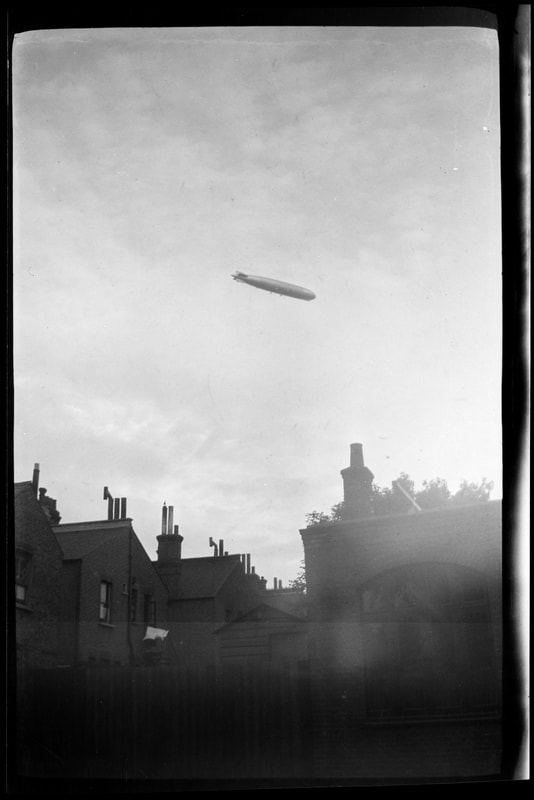 Nine thousand feet above war-torn London on March 31, 1916, Alfred de Bathe Brandon lined up his sights on a massive Zeppelin.
Germany’s Zeppelins were used to drop bombs and their sheer size was intimidating. On the other hand Brandon was flying a BE.2c, a single engine, two-seat, biplane outfitted with guns that looked incredibly flimsy. He had sighted the Zeppelin and went to engage it about 10pm. Three times he went on the attack, with explosive darts, incendiary bombs and then his machine guns. He managed to damage it enough that it fell into the English Channel. It was the first Zeppelin shot down over England. It was only later that it was found that anti-aircraft guns had actually done the critical damage. So on September 23, Brandon took on another Zeppelin - emptying a whole drum of ammunition into it before having to replace it. But when he started firing again the gun jammed. But the damage was done and the Zeppelin crashed. Alfred de Bathe Brandon was born July 21, 1883, in Wellington. He was the third to hold that name - his grandfather had been born in London and came to New Zealand where he set up a law firm and was a Crown prosecutor and politician. Hi father, Alfred jnr, was mayor of Wellington from 1894, who with his wife Louisa Kebbell had three sons and three daughters. One son continued the name Alfred de Bathe Brandon, who was educated in Wellington and Canterbury before studying law at Trinity College in Cambridge, England in 1906. He had joined the family law firm Brandon, Hislop and Johnston and served as a reservist in the 5th Wellington regiment. When war broke out in 1914, he quickly gave up his job and resigned his commission with the regiment to go to England. He learned to fly at the Hall Flying School in Hendon, paying his own way and after seven weeks, gained an aviator's certificate before joining the Royal Flying Corps. He became the first New Zealand pilot to receive the Distinguished Service Order and attained the rank of Major. He returned to New Zealand at the end of the war and didn’t fly again. But he did help draft a report to the government on the country’s air defences, reviewing existing and potential airfields. Brandon returned to law and in January 1942 he married Ada Mabel Perry at St Paul's Cathedral in Wellington. They had one son, Peter. The family law firm still exists today, named simply "Brandons" it is the third oldest law firm in New Zealand and Brandon Street in central Wellington bears the family name. Brandon died in Upper Hutt on June 19, 1974, aged 90. His grandfather is buried in the Bolton Street Cemetery while his father and he are in Karori. Photo from Te Papa collection.  Beautiful Stewart Island/Rakiura is believed to have had only one murder
Andre or Andrew Josey or Jose had lived on the island for about 50 years, making his quiet living as a fisherman. Jose was Javanese, from Indonesia, and had come to New Zealand on the England’s Glory (which was wrecked in 1881). He worked as a fisherman and ship’s cook and sometimes lived on a The Flying Scud, a 20-tonne cutter beached at Papatiki Bay. He could be seen most days near his modest home, casting his nets. It would have been a very serene spot. He kept chickens and ducks and a well-tended vegetable garden. Shortly before his death, Jose had sold his little home, and invested the money. In the early hours of December 14, 1927, Jose, who was 82, was heard crying out for help. He, and the man who was to kill him, had stayed in Catherine Walschleger’s boarding house for the night. “Help, help, he is killing me for my money,” came the cry. She ran for help from a neighbour and the police were called. Jose’s little room - just big enough for his bed and little else - was in complete disarray and at first the police could not see him. It looked like there had been a desperate fight. The bed had been overturned and Jose’s body was under the mattress. He had been beaten with a short thick piece of manuka. An attempt had been made to set the bedclothes on fire. It didn’t take the police long to go looking for Arthur Victor Valentine, 43, who had come to visit Jose the day before. He was found in his bedroom at the house still in pyjamas covered in blood. Valentine had apparently been trustee for Jose’s estate. An accountant, he had been employed by the Southland Harbour Board for many years. He had helped sell Jose’s little home and been given £200 to invest and another £150 as a loan. However Valentine might have been desperate for money himself. Earlier in December he was robbed in the office of harbour board of $240, the whole pay for the dredge employees. He had been hit over the head and found lying on the floor of the office. Jose had heard about it and had become concerned he had lost his money and was heading to Bluff when Valentine came to the island. After Josey’s death, none of his money could be found. What passed between them would remain a matter of speculation though. Not long after he was taken into custody, Valentine died of heart failure in the exercise yard of the Invercargill Borstal so never came to trial. Josey was buried on the island, not far from the home he had spent most of his life in. Photo from Te Papa's collection.  We love sugar. As addictive as any white powder, most of us have sugar in our diet somewhere. It’s been around in a refined form for over 2500 years and is one of the world’s biggest crops.
If it was poisoned, imagine how many it might reach. So when that is exactly what happened in New Zealand 1869, it’s no wonder it created sensational headlines. Forty bags of sugar came from Melbourne on the SS Rangitoto in December 1869 and people began displaying signs of poisoning. Henry Yates - who had a grocer’s shop in Molesworth St, Wellington - had not only sold some of it, his family was poisoned too. And it wasn’t just Wellington, reports began coming in from Dunedin and Oamaru, with whole families sick. Some had gone to the Sisters of Mercy convent and there were reports of illness there too. After prominent Wellington doctor, Morgan Grace, treated several people he discovered that the sugar was the cause and he tracked that to Yates’ store. The sugar was immediately handed to police. A sample was sent to the Government Laboratories to be tested and efforts were made to trace where all the sugar from the shipment had gone. The shipment was, at two or three tonnes, considered a small one. Fears were heightened when it was initially reported that a small child in Dunedin had died from the poisoning. It turned out the child had died of natural causes. The tests came back showing the poison was arsenic. But the packets found showed no signs of tampering. How did arsenic get into this everyday ingredient? And was it deliberate? By now, the sick people were starting to recover. The Victorian Sugar Company where it had come from said they did not use arsenic in any part of their manufacturing and began an investigation. They sent Richard Wardill to find out what happened. He discovered that some of the sugar had arrived discoloured with a yellow substance. It turned out the Rangitoto was also carrying 20 cases of Carbolic Sheep dip. He found they showed signs of leakage, the tin it was in not strong enough to keep it from eating through. It was found to contain arsenic. Wardill himself later ended up drowning himself in the Yarra River after it was discovered he had embezzled £7000 from his employer. Henry Yates, whose shop had been at the centre of the case, had been born in Staffordshire, England. He married Agnes Bell Haigh in 1856. He died in January 872 aged 38, in Masterton and is buried in the Archer St Cemetery in Masterton. Oddly, he is also listed as being in the Bolton St Cemetery. Photo by Mae Mu  By the time he died, Harold Williams spoke a staggering 58 languages.
The world has over 6000 but most of us struggle with more than one or two. Indeed, he was listed in the Guinness Book of Records as the world’s greatest linguist (although that title has since been overtaken.) Williams was born on April 6, 1876, the oldest of seven sons. His father, the Reverend W T Williams, along with his family, had emigrated from Cornwall, England to New Zealand. Williams himself said he wasn’t much into learning until at the age of seven, something snapped in his brain. He began to devour languages. Before leaving Christchurch and Timaru Boys’ high schools he had managed to teach himself Latin, Greek, Hebrew, French, German, Spanish, Italian, Maori, Samoan, Tongan, Fijian and other Polynesian dialects. The family moved to Auckland where he hung out with sailors, learning their tongues. He began learning Russian and Polish so he could read Russian authors, like Leo Tolstoy, without translation. In 1900, Williams began a pilgrimage to the home of Tolstoy. He went first to Berlin where he studied and taught English part time, gaining his doctorate in languages. He then began studying Slavic languages and became interested in Russian affairs. He became a correspondent for a news agency Williams continued reporting for several years writing articles from the Russian Empire. He met Ariadna Tyrkova through left wing reform circles and married her. A political journalist, she was the first woman to be elected to the Russian Duma. In 1914, at the outbreak of war, Williams was the only foreign correspondent to take part in Cossack raids, making him the chief source of information to the British Ambassador. He and another man set up a British propaganda office in Petrograd where his encyclopaedic knowledge was invaluable. He foresaw the coming revolution in Russia and in 1917 he sent regular dispatches until a peace treaty was signed. He and his wife were forced to flee and he was immediately recruited as part of the Committee on Russian Affairs. He was sent by the Daily Chronicle to Switzerland and then back to Russia but was forced to flee again. On his return from Russia, he taught himself Japanese, Old Irish, Tagalog, Hungarian, Czech, Coptic, Egyptian, Hittite, Albanian, Basque and Chinese. He mastered the Cunniform inscriptions and a book of 12,000 Chinese Mandarin characters but found himself jobless. Then in 1921 he was appointed foreign editor of The Times, holding that position until his death on November 18, 1928 in London. He is buried in Brompton Cemetery in London.  In April 1897, a fair bit of New Zealand suffered under a huge storm, running ships aground, rivers rising and the little settlement of Clive, just out of Hastings, was in dire straits. At one point on April 16, a cable was sent - “For God's sake send us some help” - then the telegraphic cable from Clive went dead. Storm warnings were issued on April 14 and over the next two days the rain poured in. The New Plymouth-Whanganui train was hit by a huge slip and derailed. It was a miracle no one died. The 1000 tonne iron ship Zuleika ran aground near Cape Palliser and began to break apart. Of the 21 crew, only 12 survived. Flooding washed out bridges around Bulls, damage to the Takapu rail bridge and at Waitangi the rail embankment was washed away. Huge areas of land around Hastings, Napier and Waipawa were under water - with one station reporting the loss of 15,000 sheep. Napier residents used boats to get around main streets. Clive was almost completely under water. The Napier pilot boat was sent to rescue those it could. And two more boats with private citizens onboard raced to help. Ten men took the boats from Waitangi which linked several main rivers. As the boats approached part of the banks gave way and the resulting surge of water swept the boats out to sea. All 10 men drowned. One of these was Arthur McCartney, the licensee of the Albion Hotel, who was a prominent local resident. Born on January 17, 1846 in Preston, Lancashire, England, he came to New Zealand in 1867. In 1883 he ran the Caledonia Hotel in Napier, but went bankrupt. Later he was discharged from that bankruptcy and took up the licence for the Albion Hotel. McCartney was the chairman of the Taradale Board of river conservators and a Captain of the Artillery and Rifle volunteers. He left a wife and four children. Also on one of the boats was Sergeant Florence O’Donovan from County Waterford, Ireland. He had been clerk of the court at Waipawa, married Julia Sarah Ann S Cecelia O’Connor in 1883. McCartney and O’Donovan’s bodies were the only ones recovered. O’Donovan was buried in the Old Napier Cemetery but records do not show where McCartney was buried. The other men were Constable Alfred Stephenson, clerk Frederick Cassin, labourer John Henry Prebble, carpenter Frederick James Ansell, wheelwright Henry Brierly, blacksmith George Chambers, Henry George Oborn - who had very recently arrived in HB to work as a draper in the branch store of Kirkcaldie and Stains that had opened the same year and a commercial traveller for a Sydney firm John Rose. Between them, they left 20 children. They were not the only fatalities. There were reports from throughout Hawke’s Bay of people being swept away in the waters. The landscape of Hawke’s Bay was forever changed by the flood with the course of the Tutaekuri river altered and a new river mouth created. Shortly after, despite efforts to prevent it, there was also an outbreak of diphtheria resulting in even more deaths. The 10 men were remembered by a memorial that even today sits on Marine Parade opposite Ocean Spa with their names and the legend “Greater love hath no man than this, that a man lay down his life for his friends.” Photo by Lindsay Morris.  |
AuthorFran and Deb's updates Archives
September 2025
Categories |
 RSS Feed