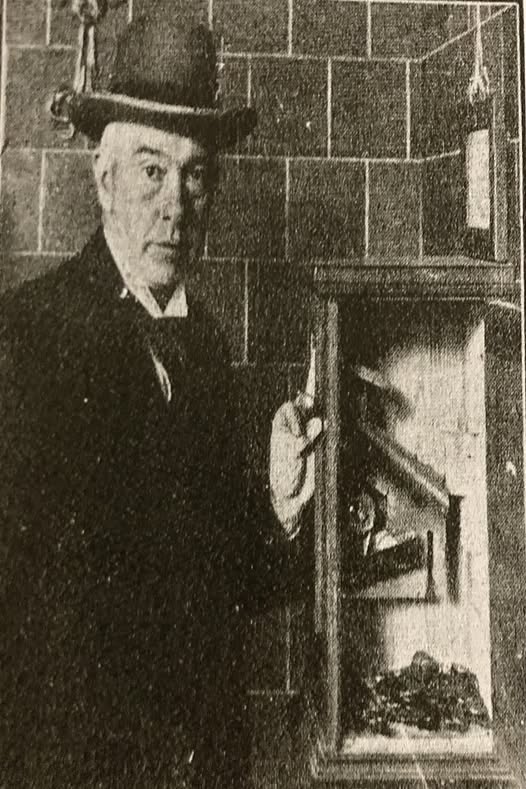
 Robert Dickie’s obsession was with stamps, but not in the collecting way.
He was, in fact, sick of tearing up large sheets of stamps for sale when he worked at the Post Office. There had to be a better way, and by that he meant by machine. But it wasn’t until he saw his first moving picture that an idea came to him and he began working on it. What he was essentially thinking about was a vending machine for stamps. Robert James Dickie was born in London on December 30, 1876 and when he was 12 his whole family came out to New Zealand for a new life. Not long after he joined the Chief Post Office on Customs St in Wellington to work - something that would be part of him his whole life. It was the policy of the Post Office that all staff learned all the rolls and it was while he was at the front desk that he got bored with tearing up sheets of stamps. He sought out a mate to help him draft the idea which they then took to an engineer. Together they built the first machine and got a patent for it, essentially becoming the first to patent for a vending machine. The machine was greeted with quite a bit of publicity. But it did not solve the problem of stamps being in large sheets - Dickie lobbied the government to print them in a single roll but was refused so he bought the sheets, cut them up and created a spool machine for them to run through. In 1905, the machine was ready and Dickie presented it to the Post Office who liked it well enough but were not fond of the idea that the machine would sit outside with money in it at all hours. Dickie was crestfallen, but worked to solve the problem by buying the stamps all in one go so that the Post Office was not assuming any financial risk. At some point, some unknown Wellingtonian became the first person in the world to buy a stamp from a vending machine. In 1906, Dickie began marketing the machine to the world and went into a business partnership, coming up with marketing ideas, like setting one up in the House of Commons in Britain to help get approval. The machine won the gold medal, grand prize and overall diploma at the 1909 Alaska-Yukon-Pacific Exposition in Seattle and it went on to be used all over the world. By the time he retired the machines were in use around New Zealand. Dickie died on August 25, 1958 aged 81 and is buried in Purewa Cemetery. Photo from the Auckland Sun.
0 Comments
Leave a Reply. |
AuthorFran and Deb's updates Archives
September 2025
Categories |
 RSS Feed