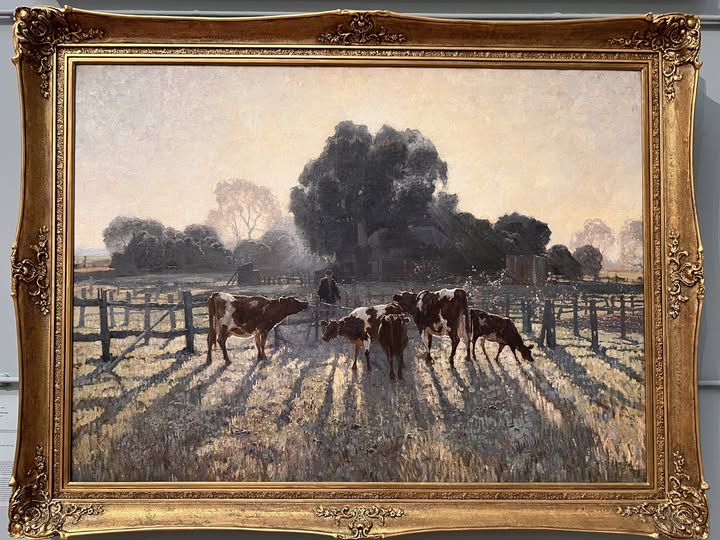
 One of Australia’s best landscape artists is actually a Kiwi.
Elioth Lauritz Leganyer Gruner was born in Gisborne on December 16, 1882 to Norwegian bailiff Elliott and his Irish wife Mary Ann. But it’s unlikely he remembered the rural life of Gisborne in the late part of the 1800’s. His family moved to Sydney before he was a year old. But the rural life turned into the mainstay of his art. He began drawing early and by the age of 12 his mother took him to train with Julian Ashton, an art teacher and artist. He had to work, so at 14 took a position in a shop as a draper’s assistant to bring in money for his family after his father and older brother died. He kept painting on weekends and in 1901 he began exhibiting to the Society of Artists in Sydney and from 1907 began to get recognition. When a shop opened in 1911 on Bligh St to sell works of art from Australian artists Gruner took charge of it. He was continuing to work with Ashton and when Ashton became ill Gruner took over teaching, only to discover he hated teaching. He won the Wynne Prize (for painting or sculpture) in 1916 for a painting showing a farm at Emu Plains. He won again in 1919 for Spring Frost (the painting we show). The Valley of the Tweed was considered one of his best works and was a very large piece but his last - he rarely again painted anything big. In 1918 he, like so many others, enlisted in the Australian Imperial Force on 4 June, went into Liverpool camp and was discharged on 31 December. A trip to Europe in 1923 extended for two years and allowed his painting style to mature and his attention to light - one of the things he was noted for - shifted. A one man show in 1917 allowed him to sell nearly everything he had painted. He then turned his attention back to the depiction of light and went on to create works that were considered his best. Gruner, a fair man with a square face was slow moving and slow spoken, was desperately unhappy and drank heavily especially in his later years. He never married, was shy and quiet and very sensitive to criticism about his work which led him to destroy pictures when he was unhappy with them, but also did not like to receive too much praise. He spent long periods in almost isolation to get his paintings done but in the city lived a stylish social life. Despite never marrying he had several children to several women. Throughout his life he suffered from inflammation of the kidneys and died at his home on october 17, 1939, and was cremated with a memorial at the Rookwood Memorial Gardens in New South Wales.
0 Comments
Leave a Reply. |
AuthorFran and Deb's updates Archives
September 2025
Categories |
 RSS Feed