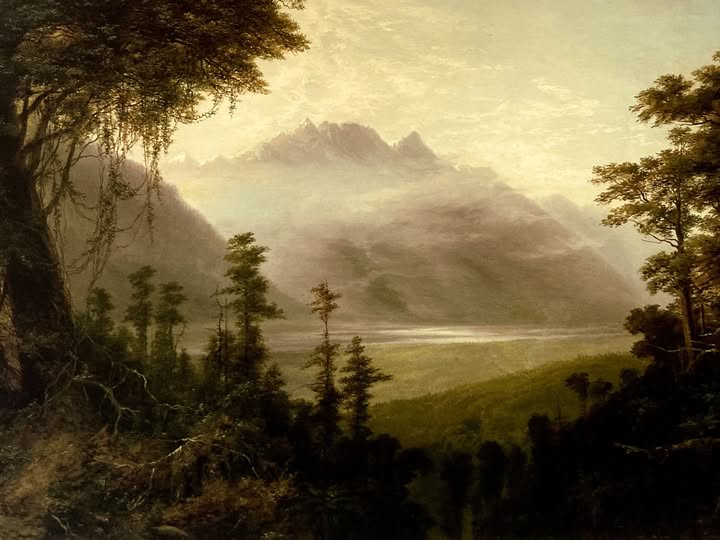
 When the Duke of Edinburgh - then Prince Alfred, Queen Victoria’s son, undertook a tour of Australia and New Zealand in 1868, he took a royal artist with him.
It wasn’t the done thing to use things like photography, which was not as common as it was even 20 years later. So Prince Alfred invited Nicholas Chevalier to come with him. Chevalier already knew Australia and New Zealand and was to go on to become a celebrated artist - along with his wife Caroline - of New Zealand landscapes. Chevalier was born in St Petersburg, Russia on May 9,1829, to Louis Chevalier and Tatiana Onofriewna. He studied as an artist in Switzerland and Munich while also studying architecture before going to London to study lithography and work on watercolours. After a couple of years in Italy he moved to Melbourne where he met Caroline Wilkie and got married. He worked as a cartoonist and illustrator. Then in 1863, he designed a dress for the governor’s wife that incorporated the Southern Cross along with a lyrebird inspired fan. She did not wear it in the end but the pair then collaborated on a present for the newly married Princess of Wales and came to the notice of the Royal Family. He first visited New Zealand in 1865 and arrived in Dunedin where he took a £200 commission from the Otago Provincial Council to travel the province and create paintings. The intention had been from the paintings to be exhibited at the Paris Exhibition in 1867 and help attract settlers. There is no record his paintings ever went to the exhibition but it did lead to the Canterbury Provincial Council to make him the same offer. He went to Lyttelton with his wife and they began a tour of the West Coast. Caroline wrote of the beauty of the region 'Immense trees clothed with lichens of many colors all hanging around their stems like grey beards & all looking very weird & as though they were hundreds of years old as they may have been.' After traveling around the Mt Cook area, Nicholas held an exhibition in Christchurch and then in Wellington before returning to Melbourne. He was then asked to create decorations for the visit of Prince Albert and then to travel with them by the Prince himself. He was close by when Prince Albert survived an assassination attempt in Sydney. Nicholas went with the duke on visits to Otago, Nelson and Canterbury and made drawings, then on to Wellington and Auckland, sailing by way of the East Cape. In Auckland Nicholas made detailed drawings of Māori artefacts in the museum. He accompanied the prince back to England via Tahiti, Hawaii, Japan, China, Sri Lanka and India. Back in England he held several exhibitions of his New Zealand work as well as being employed by Queen Victoria to record important state occasions, Nicolas died in London on March 15, 1902 and is buried in Kensal Green Cemetery, London. His work is in collections in Te Papa and the Dunedin Public Art Gallery.
0 Comments
Leave a Reply. |
AuthorFran and Deb's updates Archives
July 2025
Categories |
 RSS Feed