 It was just after the afternoon tea break on April 13, 1965, at the General Plastics factory in Kuripuni in Masterton.
The big factory’s workers had been at work the whole day, lunchtime had been taken and the 70 workers were now thinking about knock off time. At the 3pm teatime, most staff went on their break with just a few still working. Just as they were making their way back to their work stations, a massive explosion rocked the factory. It was so big and so loud that later, workers in different parts of Masterton both heard it and felt it rattle their buildings. At the factory, which was making buttons, the entire roof was blown off along with part of a wall. Fire then gutted nearly all of the factory. The fire brigade raced to the building but were unable to save it. It was insured for £37,000. Flames were said to have reached 60ft. Once the fire was out and the staff, who had fled the building, were counted, six were injured and four were missing. At an inquiry staff said they had noticed an odd smell before the explosion. Beryl Castle said she had asked a supervisor about the smell and he went to investigate but wasn’t seen again before the explosion happened. Beryl said she managed to get out through a hole in the wall where a window blew out. Richard Swanson said he also noticed a strong smell just before the explosion and came to just having escaped having the roof fall on him. Joan O’Hara told the inquiry that the factory was not well ventilated. In fact the explosion was caused by dust. Dust had collected for years in and under the floor of the factory and a short circuit in one of the button-making machines sparked the fire that caused the explosion. An expert who spoke to the inquiry, Percy Clark, said the dust was highly explosive. He had investigated various possible sources and had ruled out sources like light bulbs. He thought that the spark would have created the fire that spread like a shock wave igniting more and more piles of dust. It was not thought the company understood how dangerous the dust was. The commission of inquiry later recommended that legislation was put in place to regulate ventilation and accumulation of dust. The four people who died were Kenneth Bull, 32, Olive Victoria Parker, 61, Tilly Himona, 44 and Maisie Louisa Cavanagh, 51. All but Maisie is buried at Masterton’s Archer St cemetery. Maisie is buried at the Papawai Urupā in Greytown.
0 Comments
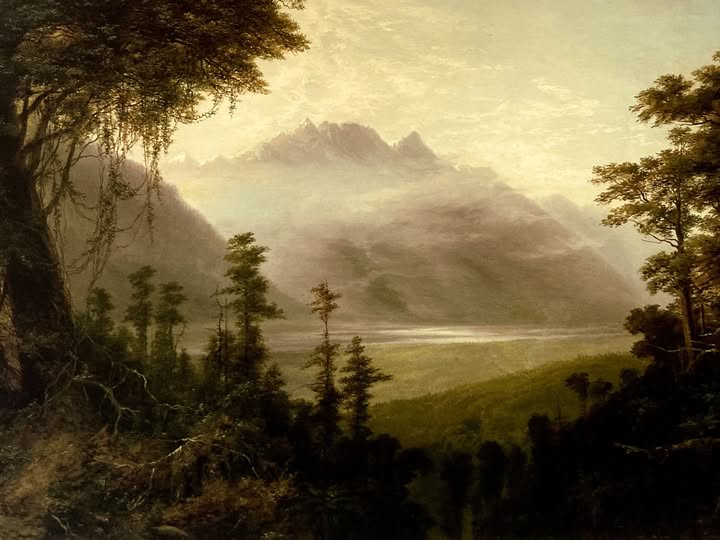 When the Duke of Edinburgh - then Prince Alfred, Queen Victoria’s son, undertook a tour of Australia and New Zealand in 1868, he took a royal artist with him.
It wasn’t the done thing to use things like photography, which was not as common as it was even 20 years later. So Prince Alfred invited Nicholas Chevalier to come with him. Chevalier already knew Australia and New Zealand and was to go on to become a celebrated artist - along with his wife Caroline - of New Zealand landscapes. Chevalier was born in St Petersburg, Russia on May 9,1829, to Louis Chevalier and Tatiana Onofriewna. He studied as an artist in Switzerland and Munich while also studying architecture before going to London to study lithography and work on watercolours. After a couple of years in Italy he moved to Melbourne where he met Caroline Wilkie and got married. He worked as a cartoonist and illustrator. Then in 1863, he designed a dress for the governor’s wife that incorporated the Southern Cross along with a lyrebird inspired fan. She did not wear it in the end but the pair then collaborated on a present for the newly married Princess of Wales and came to the notice of the Royal Family. He first visited New Zealand in 1865 and arrived in Dunedin where he took a £200 commission from the Otago Provincial Council to travel the province and create paintings. The intention had been from the paintings to be exhibited at the Paris Exhibition in 1867 and help attract settlers. There is no record his paintings ever went to the exhibition but it did lead to the Canterbury Provincial Council to make him the same offer. He went to Lyttelton with his wife and they began a tour of the West Coast. Caroline wrote of the beauty of the region 'Immense trees clothed with lichens of many colors all hanging around their stems like grey beards & all looking very weird & as though they were hundreds of years old as they may have been.' After traveling around the Mt Cook area, Nicholas held an exhibition in Christchurch and then in Wellington before returning to Melbourne. He was then asked to create decorations for the visit of Prince Albert and then to travel with them by the Prince himself. He was close by when Prince Albert survived an assassination attempt in Sydney. Nicholas went with the duke on visits to Otago, Nelson and Canterbury and made drawings, then on to Wellington and Auckland, sailing by way of the East Cape. In Auckland Nicholas made detailed drawings of Māori artefacts in the museum. He accompanied the prince back to England via Tahiti, Hawaii, Japan, China, Sri Lanka and India. Back in England he held several exhibitions of his New Zealand work as well as being employed by Queen Victoria to record important state occasions, Nicolas died in London on March 15, 1902 and is buried in Kensal Green Cemetery, London. His work is in collections in Te Papa and the Dunedin Public Art Gallery. 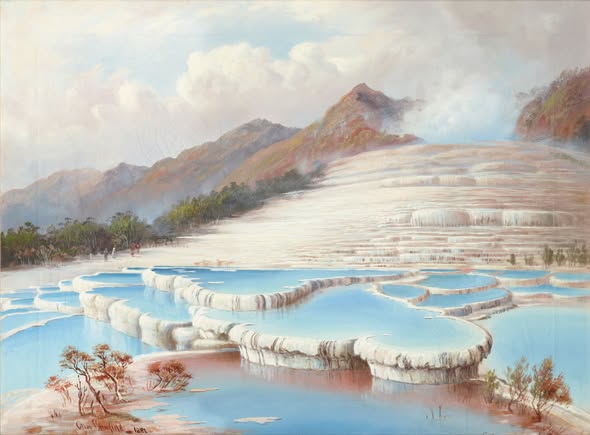 Ernst Dieffenbach thought Wellington was a bad idea. As far as he was concerned it was not fit to be a colony city.
Born Johann Karl Ernst Dieffenbach in Giessen in the Grand Duchy of Hesse in Germany on January 27, 1811, he had trained in the field of medicine and was a student during a time of great discoveries in the physical sciences, along with political reform which led to him becoming a political fugitive in Switzerland. After he was jailed there for two months for duelling he was expelled (although not before gaining his degree) and headed for England. It was there he met prominent scientists like Charles Darwin and took a position with the New Zealand Company as a naturalist. In 1939 he sailed for New Zealand on the Tory. Once here he began exploring, travelling through the Marlborough Sounds, the Hutt Valley, Taranaki, the west coast of the North Island and even spent four weeks on the Chatham Islands. He is considered one of the first European men to see the Pink and White Terraces. He also climbed Mt Taranaki. Dieffenbach became increasingly critical of the New Zealand Company’s land purchase scheme. His first look at what would become Wellington convinced him that they were selling unsuitable land. He also argued with them about his reports in which he meticulously recorded things like distances, temperatures for the new settlers. He is considered the first trained scientist to live and work here and he sent a huge number of specimens back to the Royal Botanic Gardens, the Kew and the British Museum. He is believed to be the person who coined the term greywacke for the sandstone of New Zealand mountains. In 1841, he wanted to make a complete scientific survey of the country once his contract with the New Zealand Company ran out and he convinced the governor William Hobson of it. But it was rejected when Hobson asked for funding. Dieffenbach returned to England where he published a book, Travels in New Zealand which gave accounts of life here and observations about the plight of the Māori before the rising tide of European settlement. He could see that the Māori way of life was threatened by the arrival of colonists. He worked as a translator and scientific jack-of-all-trades and tried to return to New Zealand but was unsuccessful. He was able to return to his birthplace, Giessen and eventually was nominated to the national assembly there but declined, instead becoming associate professor of geology at his old university, going on to be director. Dieffenbach married Katharina Emilie Reuning in April 1851. They had two daughters, Klara and Anna. Ironically his book helped promote more people to come to New Zealand which was absolutely not his goal. He died of typhus in 1855, probably on 1 October, and is buried in the Old Cemetery in Giessen.  Richard Owen held a piece of bone in his hand. It was about 15cm long and he initially had no idea what it was.
He thought it might be from an ox since it was clearly part of a larger bone - probably a leg. He was sent bones by a variety of people finding them around New Zealand and at one point he had boxes of unidentified bones. In 1839, he had theorised a huge flightless bird but there was little evidence. Then missionaries William Colenso and William Williams sent two big boxes that intrigued Owen. On January 19, 1843, he picked up a huge intact femur and came to the conclusion it was part of a femur of a huge flightless bird. The discovery was astounding. The world of course, knew of ostriches and other big flightless birds, but nothing like the one Owen was suggesting. It caused a furor - here, in the boxes in front of him was bone after bone from that bird. The bones had come from Poverty Bay and were from a bird Māori called a moa. The bones were displayed, vindicating Owen’s theory and he gave the bird a name - Megalornis novaezealandiae - later changed to dinornis. The idea of a bird that stood 14ft or so tall captured the imagination. And one was reconstructed that people flocked to see. It was Owen who created the term dinosauria from which we get dinosaur. Owen was born on July 20, 1804, in England to a distinctly poor family and lost his father by the time he was five. He went to Lancaster Grammar school but did not distinguish himself and ended up joining the Royal Navy as a midshipman. When that was not for him he went to the University of Edinburgh to study medicine but was unhappy there and went on to Barclay School - the same school Charles Darwin went to. He became an assistant cataloguing the Hunterian Collection - specimens from famous surgeon John Hunter for the Crown. He had to identify and categorise it from scratch as the papers that had come with it were burned. It got him interested in comparative anatomy. From there his reputation took off and he is now considered one of the most outstanding naturalists in the world. Owen died on December 15, 1892 and is buried in the churchyard at St Andrew’s near Richmond in Surrey. 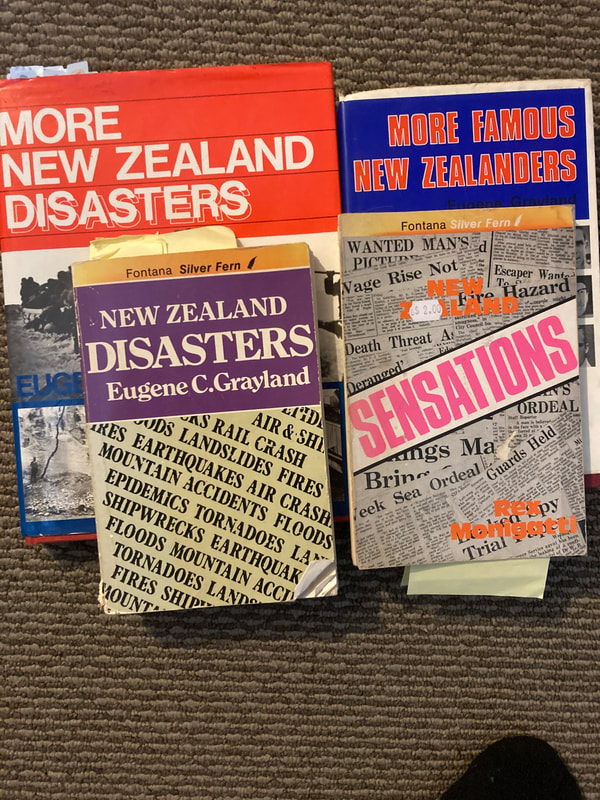 It’s time we acknowledge the help of a particular person when we are writing some of our stories.
Between us, Fran and I have a large collection of books related to New Zealand history - in fact the stranger the book the better. But few have been as helpful as books written by Eugene Grayland. If we are short of inspiration, the books written by him never fail to give us an idea. Eugene Charles Grayland was born in 1916 to Charles and Anne Grayland. He began writing at primary school and just never stopped. He partly grew up in Hawke’s Bay. His career was in journalism and he worked for so many newspapers, magazines and journals in various capacities that it would take up most of this post to write them all down. But along with that, he wrote books. He started his own private printing company Colenso Press and began putting out his own books. They are not in print now but they do tell compelling stories. New Zealand Disasters, More New Zealand Disasters, Tarawera, Famous New Zealanders, More Famous New Zealanders and New Zealand Sensations are just a few. Many were published along with his wife Valerie who wrote detective novels under the name V Merle Grayland. But what makes Eugene’s work so special is the detail of his stories. Not just the extraordinary tales he tells, but how much fact is in them. Some are relatively small disasters by today’s scale but he never fails to use a name if he has it, telling the stories from the human point of view. And it’s because of this he is still having an impact. Deb read about the Eskdale floods from 1938 in one of Eugene’s books. In the story was a little line about a man trapped in a house after a slip rammed into it, causing a beam to pin him to his bed. There wasn't anything about his name or what happened to him, so we went looking. Sure enough - in one newspaper article of the time was William Lee’s name and the fact he was a retired soldier. That led to a series of events that are ongoing to this day. We found Mr Lee’s grave and it turned out he had no headstone, which led to his family being found and a headstone made for him. We were honoured to be part of that. But from that came the realisation that there were other veterans who did not have headstones and the nationwide search was on. Since then more have been properly honoured and had their graves marked. Eugene himself died in 1976 and is buried in Waikumete Cemetery. The little plaque that marks his place doesn’t reflect the impact his work continues to have.  The liner Mamari was getting a cleaning. The huge ship had arrived from Australia to load wool before going to London.
But before that she was due to have her hull cleaned and painted and was brought into the Calliope Dock at Devonport in Auckland. The dock was 33m wide and 170m long, and could take good sized ships. Ships sailed in, the big doors were closed and the seawater drained out. On November 27, 1906, William Henry Smith was scrubbing (by hand) the hull of the Mamari. Below him, the water was being pumped out and was down to only a couple of metres. At the bottom of the dock were chocks made of timber on which the Mamari would rest. She was just about ready to settle into these. All along the ship, workers were getting stuck in, about 50 men in all, some working from boat decks at water level. On her deck was Captain Moffatt watching. The sudden loud noise startled them all. And the water began to rise furiously. Smith found himself caught in the midst of a whirlpool with huge logs in it. One caught him in the right leg, smashing it and he sank. All along the ship, men were being swept into the dangerous water, filled with logs and far too close to the huge ship. Some were being pummeled up against the sides. From around the dock other men came running, reaching out to pull men out of the water. Some of the chocks that the Mamari was supposed to settle into had shifted, causing the ship to lurch forward and churn up the water. Smith was rescued - dragged from the now foamy water with a broken leg but as he was he was hit in the head by another piece of timber. He managed to drag himself out of the water onto dry land. Orders were quickly given to refill the dock to allow the listing ship to float. And a roll call of the men began. Thirty men had been badly injured, two could not be found even when divers went into the unsettled water to look for them. The ferry steamer Osprey was requisitioned as a hospital ship and medical staff came to help. The Mamari was put out to sea and anchored in the harbour to allow the dock to be searched. It took hours to then drain the water again and find the missing men. An inquiry said the Mamari was too big for the dock and the Auckland harbour board was criticised. Three men had died, William Craig May, Rupert Clark and John (sometimes James) Mayall. May and Mayall are buried at Waikumete Cemetery. Clark is buried at O’Neill’s Point Cemetery.  There is an old saying that court trials are as much theatre as justice and it’s certainly true in the case of Thomas Hall, where crowds lined up for seats and tickets had to be sold to see his trial.
Thomas Hall was born in Hull, Yorkshire, England, but, like with much of his life, there are few records that give us precise facts. His father Thomas Williamson Hall and wife Sarah Young came to Timaru in New Zealand about 1865 and Thomas was about 16 or 17. He worked on a sheep station, managing it for his uncle John Hall who would later be premier of New Zealand. Thomas didn’t like it however, his family was well enough off and he did not like the harshness of sheep country life. He reinvented himself as a businessman but was, in fact, a conman. He was described as good looking, talked well and was always ready for any amusing enterprise. Thomas became a partner in a land agents and lending money business and began courting Kate Emily Espie. He married her on May 26, 1885. She was the stepdaughter of the rich Captain Henry Cain. Thomas drew up Kate’s will within a month of marrying her. And a month later he took out two life insurance policies, one was for £3,000 payable on her death; the other, for the same amount, was payable if she died in seven years. Henry died a year later and Thomas had appeared a dutiful son-in-law to him. Cain had frequently mentioned that the whisky Thomas gave him was the reason he was sick. After Henry’s death Thomas took on a live-in companion for Kate, Margaret Houston. Kate gave birth to their son Nigel and fell ill, and it worried the family doctor Patrick McIntrye who could not work out what was wrong. Thomas was just as caring with Kate as he had been with Henry, preparing food and tea for her. When a visiting friend accidentally drunk some tea meant for Kate, she fell ill herself, And the rumours began. It was then Dr McIntyre suspected antimony poisoning, and once a sample of Kate’s stomach contents were analysed, his suspicions were confirmed. Both Thomas and Margaret were arrested on a charge of attempted murder. But not without some drama. Thomas was caught with the poison in his pocket. He tried to throw it into the fire but was wrestled to the ground by police. His business also went bankrupt and was discovered the bank accounts were badly overdrawn and he was also charged with fraud. He had been shuffling money around to make it appear he was more successful. But he badly needed money - and the insurance policy was attractive. The crowds at the depositions hearing in Timaru were huge. The evidence was overwhelming against Thomas, but Margaret’s was circumstantial. At trial she was acquitted while Thomas was found guilty (in just eight minutes) and sentenced to life imprisonment. But by then there was concern over Henry’s death and the body was exhumed to find unmistakable signs of poisoning. Thomas was charged with that too and found guilty but it was overturned on appeal. Hall served his term and was released from Mount Eden prison in 1907. A relative gave him an annuity to get out of New Zealand and stay away. He was believed to have gone to Australia and lived there under an assumed name. The day and place of his death are unknown as Thomas Hall but he is believed to have been using the name Peter Newstead and died in the seaside town of Yeppoon.  During war time extraordinary measures are sometimes taken that were supposed to be for the public safety.
Things like censorship of mail and prosecuting people for making seditious statements all led to a type of hysteria about doing the wrong thing and that it would harm New Zealand’s war efforts. In part, it was also to control a public reaction to conscription which was not popular. It led to an odd law, called the anti-shouting law. Those conscripted soldiers had a discipline problem. Quite a number did not want to be there and drinking became an issue. And it was made worse by people who wanted to buy them a drink because they were serving their country. Which led to no shouting drinks or the anti shouting law. The War Regulations were enacted in 1914 allowing the government to make other laws as emergency regulations to keep law and order. The Anti-Shouting law was part of it. The temperance movement had been in New Zealand since the 1870s with clubs springing up around the country. Most of them did not last long. When Wellington lawyer Richard Clement Kirk founded one in Petone in 1905 it was expected to go the way of all the rest. And it did within a couple of years. Pundits quipped that the men that founded temperance leagues were the sort that would not shout a round anyway. The law came into effect in 1916 and publicans had to enforce it much to the despair of their patrons. People could not even hand over the money to someone rather than pay themselves. Their customers quickly dropped away - pub owners said their trade dropped by a third in days. And the quickest way to get around it was to buy alcohol and drink at home, meaning people were still getting drunk, just somewhere different. Then the persecutions began. Plainclothes constables were sent into pubs to check the law was being followed. There were loud protests, most notably from the trade unions and the Licensed Victuallers’ Association. Over time the enthusiasm from police to keep going faded. There were, after all, so many more important things to do. Officially the law was repealed in 1920 - it had lasted only four years. But while it had not served its purpose - the lawmakers tried a new measure modeled after an Australian law - of 6pm closing. The six o clock swill that saw huge numbers of rounds bought just before the deadline and men stumbled home wildly drunk continued until 1965. And Richard Clement Kirk who tried and failed to keep a temperance league going in Petone, had been born in Mongonui in 1861, went on to be mayor of Petone for a couple of terms. He died in 1927 and is buried in the old Taita Cemetery. Photo by John Arano. |
AuthorFran and Deb's updates Archives
July 2025
Categories |
 RSS Feed